Friday, December 3, 2021

A cemetery can be scary place. This view can’t help but take us to the ultimate belief for Christians, and everyone else who thinks about it—what happens after we die? What is our eternal destiny after this life? If we ceased to exist after death, as some believe, there would be no need for religion of any kind. The Word of God tells us otherwise. 

Since death is a reality, the basic question is “Where do we go after death?" The thought of death scares most people, even some Christians. They see it as cutting life short. Also, because they’re not 100% certain what it will be like. Protestants who believe in the Bible as the Word of God, believe it’s heaven because of God’s saving grace received through the atoning blood of Jesus Christ. Catholics believe it may be a place called Purgatory or Limbo for unbaptized infants. Atheists believe it’s nothing or nowhere. Since so many Christians (over 1 billion) believe in Purgatory and Limbo, what are they and where are they? From the Protestant point of view, there is only heaven and hell. 

As God’s children, we know He has a plan for us. In the scheme of things, we are His sheep, He is our Shepherd. Which means, there is no need to fret for those who profess Christ as their Savior. 

Jesus is the reason why Christians should not fear death. Or even be apprehensive about it. 

In the parable of the Rich man and Lazarus, Jesus tells us that not everyone goes to the same place after death. He gives an example in Luke 16:19-31 when He tells the story of a rich man who was dressed in purple and fine linen and lived in luxury every day. And at his gate was laid a beggar named Lazarus, covered with sores and longing to eat what fell from the rich man's table. 

In that parable, Jesus describes each one’s destiny after death. There has always been a place for those who professed the one true God, and those who rejected Him. Jesus tells us of the separation between Hades and Paradise, i.e., what we would call a version of Hell and Heaven—not the final destination, which came after His crucifixion and resurrection. 

Hades, like its Old Testament counterpart Sheol, refers to a number of different things. Sometimes it refers to the grave, the place where the dead reside. It also refers to the place where the wicked suffer after death, which is how it was used by Jesus in Luke 16.

Each time we recite the Apostles’ Creed, it is telling us that Jesus descended into hell and on the third day, He rose from the dead. What exactly does it mean that He descended into hell (or Hades)? But what about paradise as Jesus told the thief on the other cross? 

A Further explanation is on the slide. There are a number of theological explanations as where Jesus went after He died on the cross. Nevertheless, He told the thief that they would be in paradise that very day (i.e., “today”), not hades, as noted on the next slide. 

In the Gospel of Luke, when hanging on the cross, Jesus responds to the thief being crucified alongside of Him, telling him, that on that very day, he, the thief, would be with Jesus in paradise. Even then, there was a place that Jesus referred to as paradise, sometimes called Abraham's Bosom, associated with the realm of the righteous dead awaiting the resurrection of the body. Those souls would be taken to heaven by Jesus as a result of His atonement for their sins. 

When Jesus died, He entered the realm of the dead, what’s describes in the Apostle’s Creed as hell. What hell is it referring to? The equivalent is Abraham’s bosom that Jesus refers to in Luke 16:19-31, the parable of the rich man and the beggar, Lazarus. Also in Acts 2:31 Peter tells us, that Christ was not abandoned to the grave, nor did his body see decay. Just as a resurrected body awaits those who profess Jesus as Lord and Savior. Our resurrection bodies will be patterned after that genuine resurrected body of Jesus Christ (Philippians 3:20, 21; 1 Corinthians 15:47-49; 1 John 3:2; Luke 24:36-43). 

The Roman Catholic Church professes a place called Purgatory and a place called Limbo. Where exactly does Purgatory and Limbo come from? What are they, where are they? 

In Roman Catholicism, there is a process or place of purification or temporary punishment as noted on the slide, in which souls with a remnant of sin remaining on their soul, are prepared for heaven by paying their sin debt due to unconfessed sins, or sins not fully repented of. 

The Catholic Church points to early church tradition. Yet, Scripture teaches that Christ paid our sin debt, meaning that there is nothing left for us to pay. Paul’s letter to the Galatians focused almost exclusively on this issue, in that the Judaizers insisted we needed to do our part to compensate for our sins by religious works. Whereas Paul emphasized over and over, there is nothing left to pay, since Christ paid it all in full. Bottom line is we can’t earn salvation. It is by grace alone and not by works that we are saved. What could we possibly add to Jesus’ crucifixion and death to compensate for our sin debt? Absolutely Nothing!  

This is just one of many images of what is perceived as Purgatory. How Catholics see it: Note the Virgin Mary in the center surrounded by angels available to lift people out of Purgatory and bring them to heaven, once their sin debt is paid in full. This is why praying the rosary is important for many Catholics, it is the means of earning indulgences to be applied to those in Purgatory to shorten their time there. It forces one to ask, "how does time apply to our spiritual life after death?" 

The Catholic Church denies this was or is a common practice and renounces the practice of selling indulgences. Nevertheless, it was one of the triggers for Martin Luther’s posting of his 95 theses (grievances) for debate that led to the Protestant Reformation. Money collected for those indulgences, encouraged and used by Pope Leo X, went toward construction of St. Peter’s basilica.  

Martin Luther posted his 95 theses (grievances) to the door of the Wittenberg Church, a common practice for items of concern and debate. Paying for indulgences was one Church practice objected to by Martin Luther, and subsequently other church leaders followed with grievances and objections to Church teachings, including Purgatory, which led to the 16th century Protestant Reformation. The whole basis of the Reformation was Scripture alone for doctrine. If tradition contradicts Scripture, it is to be cast aside. 


The End of "Purgatory" posting

Saturday, November 20, 2021

One World Religion (part 2 of 2)

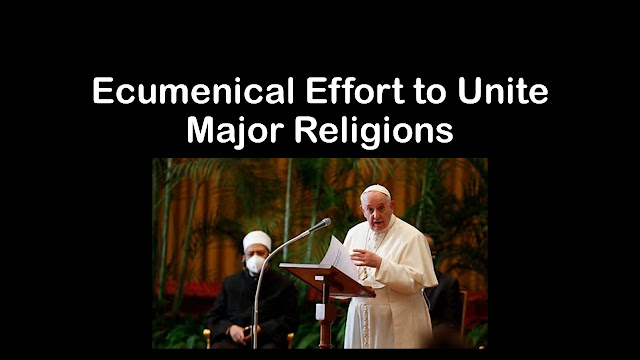
Representatives of the world's major religions shown standing together as a sign of unity.  
 
Shown in the photo are leaders from the world's various major religions. Christianity is represented by Pope Francis, a member of the Eastern Orthodox Church, and several Protestant leaders. The question on the table is, do we all worship the same god and do all paths lead to the one true God? A stated belief that is the reason for this gathering.

Is Christianity and Islam compatible as proclaimed on the slide? Do both religions worship the same God? If yes, what then is the path to that God? Where is that path defined? In the Bible or in the Quran? Or both? The next few slides explain.

Roman Catholic Pope Francis' stated goals, as printed in various publications, are noted on the following slides. 

This and the following slides capture some of the Pope's stated views regarding a "universal awareness". I do not intend this as a political statement, but rather one of reflection on the world around us and its need for Jesus Christ, which is the true role of the Church and those who profess Christ as Lord and Savior. 

The slide reflects a translation of the pope’s statement of his stated objectives. Key words: "Earth Charter" and "Global Society", which some have interpreted as a one world government, under a UN charter, as indicated on the next slide.  

It's clear that Pope Francis is advocating a Global Governance under the United Nations, which of course would include the USA, and not as a sovereign nation as it is now. Pope Francis spoke of the need for secular powers to establish global control over areas including finance in regard to environmental disaster and "climate control", which many are proclaiming, as a "religious fervor". You can find the full story on the following link: https://bereanbeacon.org/pope-francis-exploits-world-religion-and-government. 
Are we moving closer to the end of the End Times? This implies we need a closer look at Jesus' Revelation to John, i.e. the Book of Revelation and what it reveals about the End Times. 

There is but one God and one Father as professed by Christ. Jesus’ own words should suffice for every Christian, even hinting a religious unity as a path to God and eternal salvation contradicts His' words.  Yet the Pope himself seems to ignore John 14:6. You can check this out further via the following link, just copy and paste into your web browser.  https://www.gotquestions.org/Jesus-only-way.html

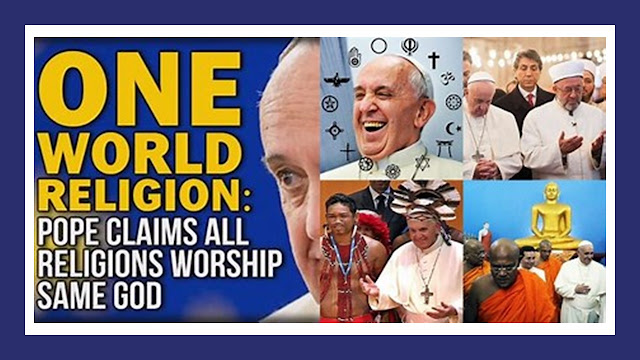
This slide speaks volumes. Did Pope Francis miss that verse in John 14:6? Pope Francis isn’t just reaching out to the Protestant world, he also proclaimed that Islam and Christianity worship the same God. I don’t know his intent, but how can any Christian pope say Islam and Christianity worship the same God? The key words here is a “one world religion” as we see occur in the Book of Revelation. Yes there is a one world religion headquarters coming as noted on the next slide.

Key words: the Catholic-Muslim interfate council. Pope Francis has also reached out to Protestant Evangelicals, as previously stated, to unite in a similar manner. Kenneth Copeland and others have not only praised it but approved the effort. Copeland has actually advocated an end to the Protestant Reformation. The one thing that they're missing in all of this is the Gospel of saving grace. It would be religion without the gospel of grace. 

Yes, this is for real. It’s called the Abrahamic Family House, since Jews, Arabs and Christians point to Abraham as the father of their respective faith. 

 What did Jesus tell the Apostles? Get along with other religions? Or share the Gospel with the world? 

He died on the cross for our atonement and salvation. He is the only path to God and eternal life. 

Let’s look at Jesus’ own words on this movement for world religion unity. 1. a disciple is to be baptized in the name of the Father, Son and Holy Spirit. 2. they are to obey what Jesus commanded. What has Paul been telling the Galatians churches, and the Romans and Corinthians and Ephesians, that eternal life with God, is Christ alone, without religious traditions and ceremonial works, which totally rejects any movement that combines all of the world’s religious ceremonies and practices into a single movement. 

We are told in 1 Timothy to be aware of deceiving spirits. Satan is a liar and the father of lies. He is a very convincing liar, just like he fooled Adam and Eve in the Garden, and the apostle Judas to betray Christ. What about 21st century America's relationship with God? 

America has been a great nation because of God’s blessings. We were founded by the early settlers who wanted religious freedom. Our founding values stood on God’s Word, including our founding documents. But, I need to ask, is this a disappearing Book in America? "So help me God" is no longer used in taking an oath in court or in Congress. 

The Bible gives the answer: God cannot smile on a land of iniquities. But it's never too late to cry out to Him in prayer....

As we approach Thanksgiving, let's reflect on all the reasons for giving thanks to Almighty God. The Pilgrims came to America for religious freedom. They could have stayed in Europe if they blended their worship and beliefs in with the national state religions. Christianity is still the primary religion in America, at least for those that answered the census questions, as per the next slide. 

This slide shows where America stands regarding its religious associations--I deliberately didn't say "beliefs". Where is the Christian Church? Are we taking the Great Commission in Matthew 28:19-20 to heart? Pastor Adrian Rogers give us further insight into Christianity in America and the role of the Church and Christians on the next slide… (it's worth your time).

Pastor Adrian Rogers 43-minute message on "The Generation to Come and the America of Tomorrow". A message is tailored to and especially needed for today and what is being taught in today’s schools. It didn’t take a long time, but we are exactly where Pastor Rogers acclaimed we would be.  
(copy and paste the link into your web browser): https://youtu.be/6WQRkhokq-A


The End (part 2 of 2)
(if you missed part 1, it is posted directly below)

Friday, November 12, 2021

Some may be wondering if this is true? Are current events leading us in that direction? Is the recent decline of the United States an indication of what is to come with the USA losing its position and influence on the world scene? Let’s explore this topic, not from a political standpoint, but from a biblical one. What does the Bible tells us? 

Some believe that the Book of Revelation was written for the first century Church in regard to the Roman Empire. While others believe that John saw future events, yet to come. Many biblical scholars believe the Book of Revelation speaks of a one world religion under a one world government led by the Antichrist, being described in Revelation 17. If so, it would raise the question, are there signs that we’re moving in that direction? If so, what are they? 

Of course this is an over simplification of an interpretation of Revelation 17. Nevertheless, we need to be aware of the signs. So, what are those signs? 

If we are moving in that direction, toward a one world religion, it would be one step at a time. Yes, there is an effort underway to draw all religions together in unity, which of course is contrary to the Biblical doctrine as proclaimed by Christianity and the Gospel message. The very reason Israel fell a number of times, was that they turned to other gods. And there was divine retribution for their heresy, for there is only one God.

Ex 34:14  Do not worship any other god, for the LORD, whose name is Jealous, is a jealous God. 
It was true in the Old Testament, and is just as true today, there is no room for other gods within the Church of Jesus Christ. For the Church to unite alongside of other religions, i.e., other gods, is to dishonor the Lord God, and Jesus Christ as Lord and Savior.

One step closer to Jesus being just one of many ways to God, versus the only way to God. Yes, there is an effort underway, initiated by Pope Francis, to bring all religions together in harmony, stating that we all worship the same God. A good idea or a bad idea? Were you aware that such an effort was initiated by the current Roman Catholic pope who has proclaimed it as a step toward world peace? Would it really lead to world peace? 

 The pope's goal is for all Christian bodies to join together with Rome, in fellowship with all other major religions. So, what would that look like? The next slide provides an indication. 

Image represents unity of the major religions: Christians, Buddhist, Muslims (prayer beads), and Jews coming together as a symbol of worshiping the same God, equally. Sounds like a worthy and desirable effort to the modern progressive mind. But, does it really glorify God? Does it glorify the God of the Bible? What does the Bible tell us? For the answer lets go to Jesus’ own words in John 14… (next slide)

Jesus did not say, “I am a way.”  He said, “I am the way.” Without Jesus there is no path to God the Father, no matter how much unity is professed and harmony achieved. We are justified by faith alone in Christ alone; in that we are no longer under God’s law, but under His grace in and through Christ, and Him alone. 

Let’s step back to the first century, with Paul and the apostles evangelizing the Roman world, and when the Apostle John wrote Revelation. There were many gods in the ancient Roman world. Even then, not all of them were of the same status. If Paul offered Jesus as another god, all would have gone well for those Christians, versus suffering persecution for professing Jesus Christ as the one true God, and the only way to eternal life. So, what has changed? For those that profess a belief in the Bible, nothing has changed. There is not even a hint in the Bible that there are other paths to God and salvation. 

Like one big happy family, everyone would worship their own god in their own way. Slide shows a Roman pagan worship service, common across the Roman Empire of that time. Not one of those gods is still standing. All that remains of them and their temples are ruins. Other religions have emerged over time, but Jesus Christ stands alone as the one and only way to God, and through Him, eternal life. 

Temples to worship the gods of Rome and Greece. What they were then, and what they are now... (next slide)

During the time of Christ, Pagan temples stood in dedication to their gods, who were greatly admired, professed and worshiped across the Roman Empire, standing as a profession of unity and harmony. Only the ruins remain of the many pagan temples spread across the entire Empire of that day. Slide shows one such temple, in Italy, the very center of the Roman Empire, which too is no more. 

Both Peter (crucified) and Paul (beheaded) were executed in Rome for professing “Christ alone”. If they had professed Jesus as one of the many gods of Rome, or just alongside the other gods, all would have gone well for them and for the other Christians. But they were willing to sacrifice their lives rather than profess Jesus as just one other way to God. 

It would have looked like this—with Jesus alongside the other gods if Christ was professed as the Jewish God who performed miracles, and shared with the Roman world as such. He may have been added to the lineup (slide: 2nd from right) because of His miracles. And many Romans would have gladly worshiped Him as such, along with Zeus, and Apollo, and Diana, and others, especially those who needed a miracle. 

But Paul and the other Christians refused to profess Jesus as such, even though they would have avoided persecution, as such. 

Christians would have avoided and even escaped this, just for acknowledging the other gods. Peter and Paul would not have been executed—with Christians being fed to the lions and killed by gladiators in the Roman coliseum.  This was the price they were willing to pay for professing that Jesus alone was the only way to God and eternal life. 

It was this—Christ alone, and exclusion of all other gods—from the apostles’ point of view, even with a desire and goal not to offend other religions and to bring religious harmony. 

So, why is Pope Francis professing this--Jesus side by side with the other religions, proclaiming that all worship the same God? If all worship the same god, than all religions lead to the same god and eternal life. But that isn't what the Bible teaches as we see in the Gospels and apostolic epistles (letters to the church). 

The pope can't do it alone, but he's getting a lot of help. On the 500th anniversary of the Protestant Reformation, Kenneth Copeland (arrow) called for an end to the Protestant Reformation (2017) Oct 23, 2017. He and other Protestant pastors and religious leaders met in Rome with Pope Francis to discuss unity.  

The I’ll let the slide speak for itself. Copeland defines himself as an evangelical minister. Oh my!

Posted below is a link to his six minute video message, to end the Protestant Reformation. Copy and paste the link into your web browser. That church demon he refers to is the Protestant Reformation and its message of being saved by grace alone, through faith alone, in Christ alone: https://youtu.be/iWJM-tP90Zo  

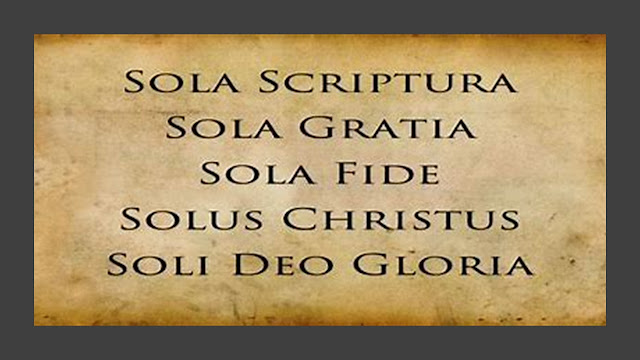
The starting place and rally cry for the Protestant Reformation, a return to the Holy Scriptures, with Scripture alone, grace alone, faith alone, Christ alone, Glory to God alone, not Buddha, or Allah, or any other path to God, because, according to Jesus (John 14:6-7) there is no other path to God. The Reformation was a revival of living by the Word of God and not by church tradition standing in the forefront. The same message the Apostle Paul proclaimed to the Galatians, that the Judaizers were successful in bringing to the forefront of their churches. Martin Luther, John Calvin and the other Reformers, proclaimed Christ alone and salvation by grace alone, not by our own efforts to reach God. Jesus did it for us on the cross, so we didn’t have to. So what has changed for Pope Francis and Kenneth Copeland and the others Christian leaders in this movement? 

Is that what the Bible teaches? We will resume this topic next week. Questions? Feel free to email me any questions you may have. 

The End of Part 1 of 2