Sunday, July 24, 2022


The founding of the United States of America was by God's providence. With so many pro-abortion demonstrations and threats against Supreme Court Justices and others, one has to wonder, does One Nation Under God still ring true today, as it did a decade ago?

Supreme Court rulings do have and have had major impacts on the American culture. The U.S. Supreme Court was established by Article 3 of the U.S. Constitution. It plays an important role in our constitutional system of government. First, as the highest court in the land, it is the court of last resort for those looking for justice. Second, due to its power of judicial review, it plays an essential role in ensuring that each branch of government recognizes its limits.

A treaty negotiated by John Jay with Great Britain was to reestablish trade between the USA and Great Britain and avert another war. His role in colonial America was significant. 

John Jay was the first Chief Justice of the Supreme Court (1789-1795) being appointed by President George Washington. In 1795, Jay resigned from the Court to become the Second Governor of New York during a time of tumultuous dealings with Britain over territorial disputes. He had been in England at the time of his election, leading negotiations which would lead to the Jay Treaty.

Portrait of John Jay after his appointment to the Supreme Court. 

The Judiciary Act of 1789 was passed by Congress and signed by President George Washington, establishing the Supreme Court of the United States as a tribunal made up of six justices who were to serve on the court until death or retirement. 

Abortion-on-demand has revealed a deep divide in the American culture. Some see it as a political issue; while the truth is, it’s a moral and spiritual issue cloaked in a political overcoat. The willful killing of a child, born or yet to be born, goes beyond politics. 

Associate Justice Alito wrote the majority opinion for abolishing abortion as a Constitutional right, as stated on the slide. 

Associate Justice Breyer, wrote the descending position as noted. Breyer officially retired and was replaced by Ketanji Brown Jackson, who is believed to be a progressive liberal. Time will tell just how progressive--a.k.a. left of center. 

What does the Bible say about killing? The 10 Commandments are all inclusive and does not set aside the unborn child as a non-person, as we see in Psalm 139 and Luke 1 (following slides)

2 Timothy tells us that all Scripture is the inspired Word of God. It does not give us the option of picking and choosing what parts of Scripture are binding and what parts are optional. Sadly, some Christians think otherwise; exceptions are being made by certain historic denomination. 

Psalm 139 describes the beginning of human life within the womb. The baby is knitted together—the key words “knit together” assures us that the child is wonderfully made and doesn’t suddenly become a living human being at birth.

The “baby in Elizabeth’s womb” leaped for joy at Mary’s spoken words. 

The statistics shown on the slide are based on a survey published by Ligonier Ministries. It's very telling as to why some Christians, who don't agree on essential biblical issues, can support pro-choice in regard to abortion. 

Let’s begin here. A recent press release by the United Church of Christ objected to the Supreme Court decision to overturn Roe v. Wade, by declaring abortion as a state matter to be determined by the people of each respective state. Notice the press release’s terminology: “birthing people” rather than mothers. The wording speaks volumes for their “cultural ideology”, which certainly cannot be defined as “biblical theology”. The only way to “terminate a pregnancy” is to kill the unborn child, even up to the moment of birth. 

The United Church of Christ doesn’t stand alone on the abortion issue. Other denominations have accepted abortion, which of course, is a statement to the culture that it’s okay. Denominations that support abortion as a personal decision are noted on this and the next slide. 

The extent of the list certainly surprised me, inclusive of both Christian and Jewish congregations. 

Pastor John MacArthur’s offers a biblical opinion regarding churches that do not follow the Bible for faith and practice, which is equally appropriate for the abortion issue; in that those churches have instead embraced the culture. Recent statistics show that the membership of those denominations is in decline. 

The protest signs reflect both sides of the debate, most participants of whom are millennials; the generation that will determine the future of America, especially when they can point to so many churches that support pro-abortion views; which is also the stated position of the Democrat leadership in Congress. 

A pro-abortion group called “Jane’s revenge” means exactly what’s stated on the slide. As noted on their website, their call to action is: “Now is the time—Stand up—Take action”. The next slide shows exactly what that means.

Here’s just one of several such situations that show exactly what their slogan means: Destruction of a Pro-Life Center that provides alternatives to abortion for pregnant women and girls. Another comment on their website: “You have seen that we are real, and that we are not merely pushing empty words.” What’s interesting is that the U.S. Justice Department has not taken action.
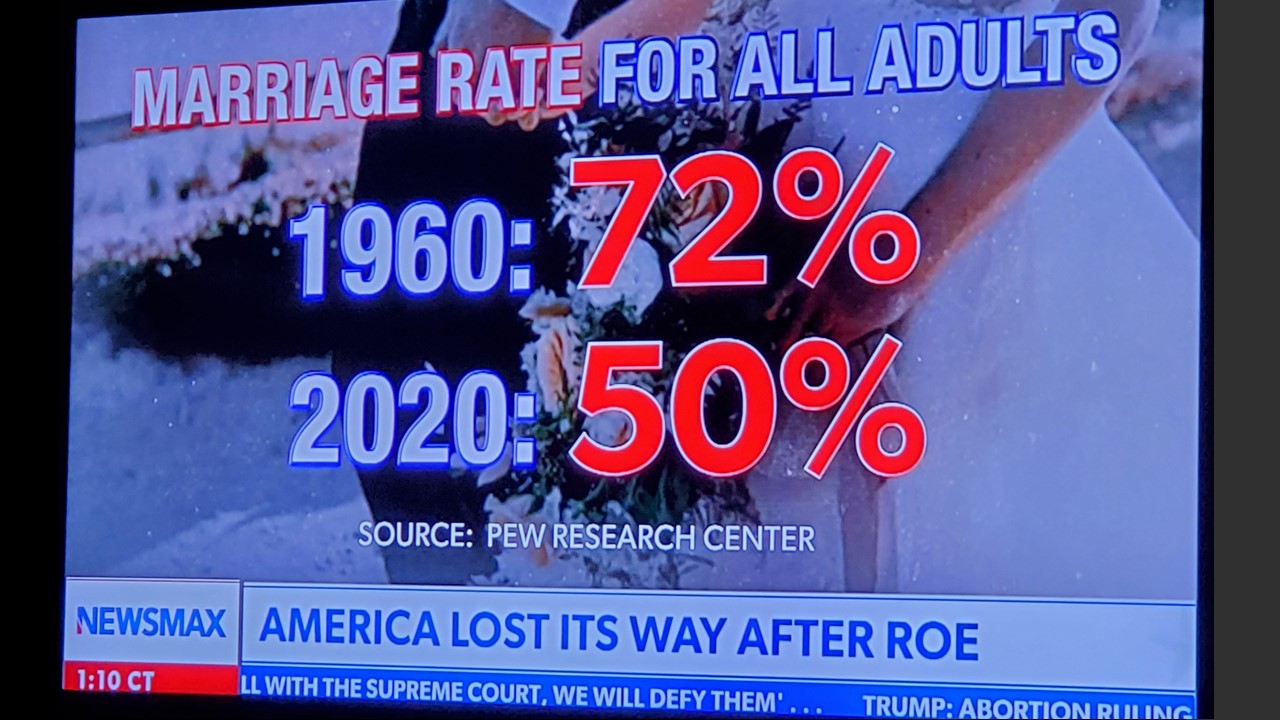
The consequences of Roe v. Wade, is sexual intimacy without consequences, as a form of recreation and not an integral part of marriage. As such, the marriage rate for adults fell from 72% to 50% over the last 60 years. As the caption states, America lost its way after Roe, with the legalization of abortion across the Nation. 

The impact was even greater for Blacks as noted, going from a 61% marriage rate to a 33% marriage rate, leading far too many Black families without a biblical role model. And in too many cases, leaving unwed mothers on welfare. Consequently, it has been reported that crime in many of those Black neighborhoods has risen accordingly. Sad for them and sad for America. 

What much of America used to look like. The culture saw sex as an integral part of marriage, and not a recreational activity. I remember those days well. In a passionate moment, a neighborhood friend got his girlfriend pregnant. The “neighborhood guys” insisted he marry her or else, and he did. Abortion wasn’t considered an option—and this was in the Bronx. We also spent a lot of time at a local ice cream parlor in the Bronx back then. But oh my, times have sure changed and so has the Nation. 

This is an agenda for a Washington State school system. As noted, these are sexual education topics for elementary school children at the lowest levels. Perhaps a future posting. I couldn’t just let it pass without at least a mention. 

Pastor Adrian Rogers’ 42-minute message: “The Generation to Come and the America of Tomorrow.” Click on the following link or copy and paste it into your web browser. It’s worth your time. 
https://youtu.be/ucf444GCFzM

Pray for America!
This is the last blog posting until the Fall

Saturday, July 16, 2022

The founding of the United States of America was by the providence of God. Is America still “One Nation Under God”? With so many pro-abortion demonstrations and threats against Supreme Court Justices, one has to wonder. Does that pledge still ring true now as it did just a few decades ago? Growing up we were proud to be American. Following WW2, we understood the true significance of what that meant across the world and the defeat of a brutal tyranny both in Europe and Asia. 

From the early Church, prayer was an essential part of church life, especially during times of persecution. Prayer is as essential for today’s America, as it was then. 

It was their perseverance in prayer and evangelism that changed the world around them. The pagan Roman Empire itself was changed with Christianity being declared the official religion of the Roman Empire by Emperor Theodosius I, in 380 AD. The power of prayer and God's grace is essential for change. 

Prayer is not new for America. The prominent influence of prayer in public life came early in American history as noted on the slide. 

Christian prayer came to America’s shores early in its history and was woven into the very fabric of colonial America’s culture and society. The creation of and signing of the Mayflower Compact was one such event in our early history, shown on the slide.

Edward Winslow (18 October 1595 – 8 May 1655) was a Separatist who traveled on the Mayflower in 1620. He was one of several senior leaders on the ship and also later at Plymouth Colony. Both Edward Winslow and his brother, Gilbert Winslow signed the Mayflower Compact.

The 1962 Supreme Court virtually changed America, as we'll see in the next slide. Little did they realize just how much. The Warren Court was the period in the history of the Supreme Court of the United States during which Earl Warren served as Chief Justice. Warren replaced the deceased Fred M. Vinson as Chief Justice in 1953, and Warren remained in office until he retired in 1969. Warren was succeeded as Chief Justice by Warren Burger. The Warren Court is often considered the most liberal court in US history.

A 1962 Supreme Court ruling changed America’s prayer life forever beginning at the youngest ages. A Court decision by which young Americans lost a historic and cultural roadmap. Much of the lack of respect for law and order can be traced directly to that Court decision. 

Prior to 1962, for many Americans, this was the start of a typical school day. Why does prayer matter? It is direct one-on-one communications with God. It is a relationship in and through Jesus Christ as Lord and Savior. No nation can survive without that connection, neither the Christian Roman Empire or Israel in the Old Testament, both of which failed in turning away from God. 

That same reverence of and in prayer existed in and with every generation in America. It honors God for His blessings and grace over our land. Something we cannot and should not forget. 

We are at a crossroad in today’s America, as our Nation moves farther away from it core values. Nevertheless, we need to be steadfast praying with a sense of humility and dependance on God’s Providence, the very lifeblood of His grace and protection. 

Adrian Rogers 34-minute message, “When the Spirit Speaks”, is worth your time for both understanding the role of the Holy Spirit in our life and our relationship with God. It is the Holy Spirit that changes our heart and relationship to God and gives our prayers meaning. Click on or copy and paste the following link into your web browser. 
https://www.youtube.com/watch?v=gE8P3Z_gfqs

The End
of this week's posting

Friday, July 8, 2022

“Under God” was not always in the Pledge of Allegiance.  When was it added and by whom? 

During World War II, Dwight D. Eisenhower served as Supreme Commander of the Allied Expeditionary Force in Europe, achieving the rank of five-star General of the Army. He understood and openly acknowledged God’s providential care in winning World War II against Nazi Germany that had swept across Europe and beyond. During his first term in office, in recognition of that truth, he urged Congress to legislate “Under God” be added to the Pledge of Allegiance, which it was. 

The roots of America were nourished with prayer. The Pilgrims came to these shores to get away from religious persecution, they came to establish to right to worship God freely. Americans had always openly worshiped God, even in the public square, until 1962 when things changed, which we will look at further on. 

On June 14, 1777, the Second Continental Congress took a break from writing the Articles of Confederation and passed a resolution stating that “the flag of the United States be 13 stripes, alternate red and white,” and that “the union be 13 stars, white in a blue field, representing a new constellation.” In 1916, President Woodrow Wilson marked the anniversary of that decree by officially establishing June 14 as Flag Day. 

George Washington was acknowledged as a man of prayer. As noted on the slide, he did pray for God’s protection on these United States. As we are seeing, those principles no longer guide our nation. The Revolutionary War didn’t formally end until 1783 at a great cost of life and determination. Does that same spirit exist today? 

His words regarding God and the Bible ring as true today as they did then. 

On October 3, 1863, expressing gratitude for a pivotal Union Army victory at Gettysburg, President Abraham Lincoln announces that the nation will celebrate an official Thanksgiving holiday on November 26, 1863. It was in recognition of God’s providential grace on our Nation. This announcement harkened back to when George Washington was in his first term as the first president in 1789 and the young American nation had only a few years earlier emerged from the American Revolution. At that time, George Washington called for an official celebratory “day of public thanksgiving and prayer.” While Congress overwhelmingly agreed to Washington’s recommendation, the holiday did not yet become an annual event due to other pressing issues in forming the infant nation.

Unconstitutional? Not if you look back over our former leaders like Washington and Lincoln. But over time, things changed. In 1962 the Supreme Court ruled against prayer in public schools as unconstitutional. What impact did that have on our youth and our culture? Looking back over our history, how could the Court conclude that public prayer is unconstitutional when the Founders themselves observed public prayer. 

So, is public prayer a political or moral issue? What are the consequences of a nation turning its back on God? When Israel did so in the Old Testament, they clearly suffered the consequences. But there is a crack in the door that now supports public prayer, but just when and where will still be a contested issue in the courts

Two significant Supreme Court decisions, one prohibiting prayer in 1962, and one declaring abortion as a constitutional right, in 1973, both of which changed the very foundation of America. Nevertheless, a ray of light has shined forth with the current Supreme Court on both issues. How did those past decisions affect the United States culture? 

Let’s pause for a moment with Ralph Reed’s brief description of that 1962 decision. For 60 years the battle for young minds continues. Ralph Reed is the founder and chairman of the Faith & Freedom Coalition. He points back to the United States Supreme Court decision, as being of historic importance, by ruling that daily recital of prayers in public schools, even though non-compulsory, was unconstitutional. The court held that the recital of such prayers in schools financed through public taxation violated the religious freedom guarantees in the Constitution. That decision was handed down in a New York case. It has affected all public schools throughout America, ever since. So where do children get their moral compass? Certainly not in school. Are we seeing its influence on young Americans? Absolutely!!! 

But a recent Supreme Court decision may be the beginning of change regarding prayer, by overturning a school administration’s decision to fire a H.S. football couch for praying publicly on the field after a game, with his team present. It took seven years for it to reach the Supreme Court. We can be certain it won't be a slam-dunk for prayer going forward. 

What does CNN have to say about the Court’s decision? Their headlines tell us. They see it as an erosion of separation of church and state. Are you surprised? I’m not. Why is the mainstream media so against any recognition of God? 

Are there consequences when prayer is banned? We saw evidence of such consequences with Israel in the Old Testament, time and again, when they turned from Jehovah God, and embraced by the pagan culture. Consequently, ten of the twelve tribes were defeated and scattered, never to return to their homeland. But a merciful God wasn’t finished with them, with the rebirth of Israel in 1948, when Holocaust survivors and a scattered remnant of Hebrews/Jews from around the world returned to the land promised to Abraham, Isaac and Jacob. 

What about the USA? Do Americans pray? How relevant are these statistics to the events taking place in our Country? Statistics are generally a small slice of people v. the entire population, but they typically do provide insight. 

Recent decisions from today’s Supreme Court is starting to make a difference on certain significant issues. From left to right in first row (sitting): Samuel A. Alito, Clarence Thomas, Chief Justice John G. Roberts, Stephen G. Breyer (just retired. Replaced by progressive liberal, Ketanji Brown Jackson), Sonia Sotomayor. Standing in back row, left to right: Brett M. Kavanaugh, Elena Kagan, Neil M. Gorsuch, Amy Coney Barrett. Jackson was described by Sen. Ted Cruz, who attended law school with her, as one of, if not the most liberal Associated Justice to serve on the Court. All of which make the next SCOTUS appointment monumental in significance. It illustrates the importance of Christians participating in the election process. If not, that void will be filled by those, not only striving to change, but determined to destroy America’s founding values. 

This is where those decisions are presented, by both sides, considered and subsequently decided. 

Making America great again definitely includes appointing Supreme Court justices who believe their role is to interpret and preserve the U.S. Constitution, not legislate from the bench. President Donald J. Trump did exactly that with three judicial appointments as well as other judges within the judicial system. The following slides show his SCOTUS appointments. Each one was hated by the Progressive-Left that publicly campaigned against and even attacked them via the media and political opposition in Congress. 

Jerusalem has historically been Israel’s capital. Almost every U.S. president after Truman, expressed their support of moving the U.S. embassy from Tel Aviv to Jerusalem, but it never happened until Trump decreed that historic move as a reality. 

Back to Trump’s appointments for the SCOTUS: Neil M. Gorsuch, shown here, was an American lawyer and jurist who now serves as an associate justice of the Supreme Court of the United States. He was nominated by President Donald Trump on January 31, 2017, and has served since April 10, 2017. Gorsuch was born and spent his early life in Denver, Colorado,

Brett Michael Kavanaugh is an American judge serving as an associate justice of the Supreme Court of the United States. He was nominated by President Donald Trump on July 9, 2018, and has served since October 6, 2018. He was previously a United States circuit judge of the United States Court of Appeals for the District of Columbia. 

Amy Vivian Coney Barrett (born January 28, 1972) is an associate justice of the Supreme Court of the United States. She is the fifth woman to serve on the court. She was nominated by President Donald Trump and has served since October 27, 2020. She was a U.S. circuit judge on the U.S. Court of Appeals for the Seventh Circuit from 2017 to 2020.

We will further explore the two Supreme Court decisions in 1962 and 1973 on prayer and abortion respectively, that dramatically changed America, including the majority and descending positions for the Court's 5 to 4 rationale for overturning the Roe v. Wade abortion ruling. 

The End