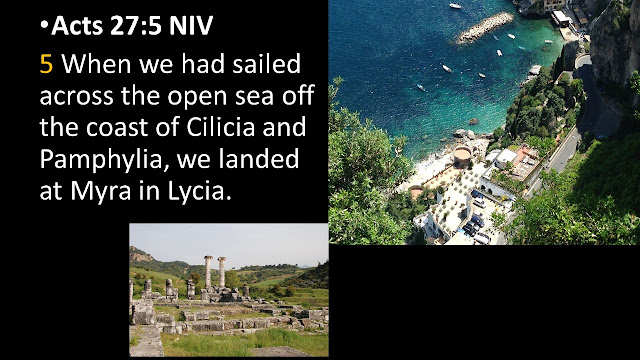
Chapter 27 closed with the ship Paul was traveling on being shipwrecked and those aboard used the wreckage to get to shore.

Map shows Paul’s entire trip from Caesarea to Rome and the stops in between, and where they are in chapter 28 on the Island of Malta as noted on map. Despite the storm, they managed to sail from Crete to Malta before being shipwrecked. Did God, in His sovereignty, bring Paul to Malta to share the Gospel with Malta’s inhabitants? I believe so. Even a storm served His sovereign decree and purposes. Is America facing such a storm at this time? Will God use it to serve His sovereign purposes? Absolutely.

We reached the end of Acts and the finality of Paul’s sea voyage to Rome. Please see important message on prayer at the close of this chapter. For it truly glorifies God and enhances our prayer life.

Everyone survived the shipwreck just as the angel had told Paul in Acts 27:23. Using the ship’s wreckage, they made it to shore, where they were comforted by Malta’s inhabitants.

Paul is bitten by a deadly viper. Those of the Greek/Roman culture of the time believed that the gods brought justice through events. Since Paul was bitten by the viper—a deadly poisonous snake—they presumed he was a murderer and that justice was being served by the wrath of their gods, through the viper.

Map on slide shows the Bay (red arrow) believed to be the location of Paul’s landing on Malta. Yellow arrow on smaller map pinpoints the location of Malta off the coast of Sicily. Lower right shows a viper snake, similar to the one that bit Paul. Our goal is to accompany Paul and living the Word, and not just read about him.

We see a miracle validating to the inhabitants that Paul wasn’t a murderer. The venom from a viper is fast acting—by his survival, they presumed he was a god in the form of a man, a common belief for that time. For those who had professed Christ onboard ship during the storm, possibly the Roman centurion Julius, it helped reinforce Paul’s ministry and message.

Some attribute the snake handling practices shown to Acts 28:3-6, as a means of demonstrating their faith. It is also attributed to chapter 15 of the Gospel of Mark, noted on the next slide. Regardless of the Bible verses that prompted it, it shows the danger of making it up as we go along, versus adherence to the Bible, both in words and intent.

This slide provides further insight into the practice of these churches. The problem is that their focus is on the snake as a demonstration of faith, rather than on Jesus Christ, Himself. In Galatians, that we’re currently studying Sunday morning, the people turned away from the Gospel of grace in Christ Jesus, and focused instead on their religious works as insisted on by the Judaizers. Missing the Gospel message that we are saved by grace alone and not by what we do, including handling snakes as a demonstration of faith. They missed the message of the Gospel that Paul shared in his journey throughout Acts. Verses in the Bible have to be interpreted within the context of the book they appear, and the message it is taken from, and what it was intended to convey.
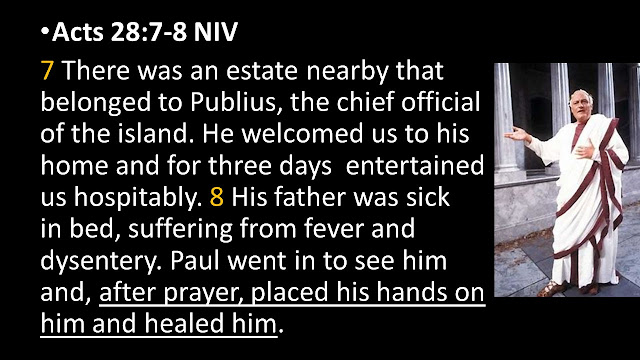
Back to Malta. Starting in v.7 we see the power of miracles. The Holy Spirit was active in Paul’s ministry. Have you ever wondered why not today? Paul prayed over Publius’ father. What role did prayer play? Would he have been cured without prayer? Paul was in a state of prayer because of his relationship with and commission by Jesus. His prayer demonstrated that healing came from God and not by some magical power within Paul. For more on effectual prayer see Pastor Adrian Rogers’ powerful message at the end of this chapter.

We can be certain that Paul preached the Gospel throughout his healing ministry on Malta, although Luke doesn’t record the results. Why draw that conclusion? He healed the sick. He told those aboard the ship, including the soldiers, crew and other prisoners, that none would be lost. If Paul preached Christ in other difficult situations, why would he not preach him here? All these questions will be answered in heaven when we see the true glory of God shining through all the mysteries that are veiled now.

After a three month stay in Malta, they resumed their voyage to Italy on another ship, stopping at the port city of Syracuse in Sicily, as shown on map, for a short stay, before proceeding to the Italian mainland.

As Luke noted in v.11 the Alexandrian ship’s bow was adorned with the figurehead of the twin gods Castor and Pollux, shown on the slide, and described on the next slide. People not only believed in but depended on various pagan gods, for almost every occasion.
 A figurehead on a ship's bow, was to obtain protection from those gods. The Roman/Greek world of Paul, believed in many gods. Jesus would have been accepted as just another God, if Paul preached Him as such. But as one of many gods, the Gospel of saving grace would cease to exist. There is a movement underway today that was initiated by Pope Francis, to unite all religions with Rome. If you would like to know more about it, let me know.
Map shows all of the ship's stops, from Malta onto Italy, and stops along the coast of Italy, landing at the port city of Puteoli. After a week there, they proceeded on a land route called the Appian way, to the City of Rome. What that road looked like is shown on the next slide.

Appian Way from the port city of Puteoli to the City of Rome. Remnants of that road exist today as shown in the photo.

The “brothers” were Christians from Rome who had heard of Paul’s arrival. As a Roman citizen, Paul received certain courtesies, especially in light of the questionable nature of the charges against him. Most likely, he was still being accompanied by the centurion, Julius, who may have accepted Christ as his personal Savior. The other prisoners are not mentioned, but as non citizens, most likely they were sent on to a Roman prison.

The Forum of Appius (map) was about 39.5 miles from Rome. “Three Taverns” (map) was a way station on the Appian Way Road, about 30 miles from Rome.

By this time, knowledge of Christianity as a Jewish sect, had spread even to the Jews in Rome. We see Paul calling together the Jewish leaders to explain why he was arrested. Paul was still under guard by one or more Roman soldiers. What an earful they were getting regarding a Jewish sect in Judea.

The “they” noted in v.18 were Governor Festus and King Agrippa. Paul is inferring, as a Roman citizen, he could have brought charges against the Jews who brought him to trial. But of course, it would not have done any good. Let sleeping dogs lie. But, he was determined to plead his case to these Jews, regarding the charges against him. We can be certain word traveled across the Jewish communities in Rome and elsewhere in Italy.

The difficulty, as we saw in Acts 15, and in Galatians, and elsewhere in Paul’s letters, many of the Jews sharing Christ, insisted that Gentiles must become Jewish and follow Mosaic Law in order to receive Christ as Savior. The covenant promise God made with Abraham was fulfilled by Christ and no longer binding, as it had been under Mosaic Law.

Apparently, the complaints against Paul that brought him here, had not yet reached Rome. “This sect” they are asking about, indicates they are not Christians but want to know about “the sect” (Jewish followers of Jesus of Nazareth). Those Christian-Jews believed the Levitical laws of the O.T. were still binding on all Christians including Gentiles. The brothers in this case being the other Jews.

Those Jews reassembled with Paul, with an even larger number showing up. Paul used the occasion to share the gospel in regard to the Old Testament prophesies. Some believed but others did not. (v.24). For an answer, we can only refer to Jesus’ parable of the seeds sowed on the ground in Matthew 13, which points to the doctrine of predestination and election. A future topic.

Paul explains what the Holy Spirit spoke through the prophets, but with similar objections as Paul had experienced in Jerusalem. His final statement before they left is in regard to the Holy Spirit as prophesied by Isaiah the prophet (v.25-27). Isaiah prophesied about hearing and not hearing, just as Jesus tells us in Matthew 13 (next slide).

In Matthew 13, Jesus explains why some listen and believe, and others do not. This is equally true of the Jews confronting Paul and the Gentiles that accepted the Gospel message from Paul.
For the Jews, insistence on the Mosaic Law became a hindrance.

In Matthew 13:3-6, Jesus tells the parable of a farmer who sowed seed, and the conditions that prevented it from thriving (continued on the next slide).

The conditions Jesus describes is comparable to the Word being preached in the world. Did you ever wonder about the moment you accepted Jesus as Lord and Savior? Did you hear it (the seed) on the radio or TV? Did you hear it from a parent, or friend, or church sermon? Did you ever share that “seed” with someone else? What was their reaction? Jesus explains the meaning of the parable in Matthew 13:18-23 as noted on the following slides.

Jesus tells how Satan comes and snatches away the Gospel message from those who do not understand it; their minds were not receptive. We can imagine circumstances where that would be true. Perhaps some of the sailors that were saved with Paul during the storm. As long as the storm raged, they accepted Paul’s word and believed. But as soon as they were ashore, and safe, the words left them, as being no longer relevant.

Many people believe sermons that are materially comforting, such as “promises that assure prosperity”—just as we see with certain mega churches on TV—and reject the Word as soon as troubles abound; the seed never took root as Jesus tells us in v.21. The Word that doesn’t take root will not last for all the reasons Jesus notes. One may feel encouraged during an uplifting church service, and soon after return to worries and concerns for their own well being and financial status forgetting what they heard in church.

When a person ponders the Word deep in his or her heart, and it seeps deep inside their mind and soul, that person will persevere. Those who persevere in the Word of God are part of the Body of Christ, as Paul was. The rewards aren’t always apparent, but they are everlasting and eternal. Not only will the Word persevere, it will produce fruit.

Paul reminds those Jews, that God’s Word was also being sent to the Gentiles, who will listen and accept it, unlike the Jews who reject it. One may wonder why v.29 appears in the NKJV, but not in the NIV. Was it added as a historical fact or inspired and inadvertently dropped? An explanation is provided at the conclusion of the chapter.

Scholars generally agree that Paul was acquitted after two years, and then left Rome. He was eventually arrested again and taken back to Rome where he was beheaded in 67 AD.

A little background on how his case could have been handled under Roman law, as noted on the slide, with option 4 as the logical outcome.

Chapter 28, the last chapter of Acts, is jammed packed like an action novel, with shipwreck and imprisonment, without telling us about Paul’s internment and eventual release. The following slides tell us why verse 29 was omitted from the NIV, yet appeared in the NKJV.

Continued on next slide.

Continued on next slide.

You’ll have to answer these questions for yourself. We have other study topics Sunday morning at 9:00 in Heritage Lounge. Do you have a desire to pray effectively? I’m sure you do. Listen to Pastor Adrian Rogers’ sermon noted on the next slide.

Pastor Adrian Rogers’ 43-minute message on “The Secret of Effectual Prayer”. Praying is one of our callings as Christians, for it is something we all can do. God doesn’t need our prayers, but invites us to pray. Definitely an important message, especially as we close on the Acts of the Apostles and Paul missionary journeys to share Christ with a pagan world. Copy and paste the following link into you web browser"
https://youtu.be/XpS7I2JoECw
End of
The Acts of the Apostles
Chapter 28