Friday, October 8, 2021

The Bible is the inerrant Word of God, Who gave it to us, not just to read in our spare time, but to pray over and ponder. As we approach the final chapters of Acts, there is a constant message about sharing Jesus with the world. Our world is a lot smaller than Paul’s and yet a lot larger than Paul’s, and just as wanting for Jesus Christ. Paul shared Jesus by word of mouth; we have so many other means of doing so. Think about it and pray about it. I do exactly that every time I post to this blog. Our faith in Christ is from God through the Holy Spirit. As Pastor Adrian Rogers said in one of his sermons, we are the 29th chapter of Acts. God never asks us to do what He doesn’t enable us to do. 

Ratio Christi is Latin for “The reason of Christ”. The darkness entering America began on college campuses decades ago. Students in our churches are often ill-prepared for the challenges to their faith that they face on today’s college campuses. We as Christian parents and grandparents can help make a difference by supporting Ratio Christi. Just as Paul brought Christ to a darkened pagan world, we can help bring Christ to today’s darkened college campuses. 
https://ratiochristi.org/about/  (copy and paste into your web browser)

Have you every really thought about Acts and where it is taking us?  It’s history of the infant church, written via the Holy Spirit’s inspiration, and a roadmap for us today. It’s also about sharing Jesus with a world in need of a Savior. See Adrian Rogers message at the end of this chapter AND visit Ratio Christi’s website regarding how we can help, right here and right now, as parents and grandparents of college age youths. If we don’t care, who will?

When and how did the infant Christian Church, professed by Peter, Paul and the other Apostles, become the Roman Catholic Church? What led to the 16th century Protestant Reformation? Join us Sunday morning as we explore this question. 

John 14:26, in the NKJV the Holy Spirit is called “Helper”. As we read God’s Word, we can call on the Holy Spirit, the Counselor and Helper, to guide our understanding and its relevance to today’s world. 

Chapter 23 ended with Paul being brought before Governor Felix in Caesarea and placed under arrest in Herod’s palace. As we go through Acts, keep in mind, it was written by Luke as inspired by the Holy Spirit. Chapter 24 marks a turning point for Paul. 

May the Holy Spirit, the Helper and Comforter, open our minds and hearts to His Word and the wisdom in applying it in our life in thought, word and deed. 

V.1 picks up five days after the soldiers brought Paul before Felix with a letter of complaint against Paul. Ananias, the high priest arrived with their lawyer, Tertullus (Ter-tul-lus)—who was versed in Roman law, and who was to present their case against Paul. He begins with compliments to the Roman governor (v.2-3). The reality is that the Jews had no love for the Roman nor any desire to be under Roman rule. 

Rome was very sensitive to riots in their provinces, and it was the responsibility of the Roman governor to maintain peace and order. The case being made against Paul, though untrue, was that he had created disorder, not just in Jerusalem but elsewhere in the Roman Empire, a violation of Roman law. 

V.7 which appears in the NKJV, but not in the NIV, reflects the mood of their charges, with a degree of exaggeration to further enhance the charges. Lysian (Ly-si-as) was the Roman commander who rescued Paul from the crowd in Chapter 22:23, where the Roman soldiers carried Paul away. The violence was on the Jewish side and certainly not the Roman side. 

The way to make a lie sound like the truth is to emphasize it over and over, especially with loud accusations—something we would label as “fake news” on the mainstream media when something political is misrepresented and repeated almost verbatim on the other like-minded networks. 

Paul states his case noting that the charges are untrue. 

Paul states that he is a follower of “the Way,” thus proclaiming his belief in a physical resurrection. And that he has done nothing wrong in the eyes of God or man, nor did he violate Roman law. 

In v.17 Paul recounts his absence from Jerusalem—the time of his three missionary journeys. And that there was nothing in his actions when he was arrested, that warranted those charges. 

Paul continues to emphasize that there was absolutely no reason for the charges against him other than his stated view of the resurrection of the dead; which we know refuted the Sadducees' belief that there wasn't a resurrection nor an afterlife. 

Felix wanted commander Lysias’ testimony and postponed the hearing until his arrival. 

Scripture doesn’t explain whey Felix asked to see Paul at this time. Perhaps his Jewish wife’s curiosity concerning Paul and the rumors she may have heard concerning him and what he professed regarding "the Way". 

The truth comes out. Like many holding high office throughout history, Felix expected a bribe from Paul to dismiss the charges against him. These verses show Felix’ true colors as we conclude chapter 24.

The injustice against Paul is pretty revealing of the character of the Sanhedrin and Roman governor Felix to weight his decision regarding Paul, based on a bribe. The same is true in much of global politics today. 

The Holy Spirit is our Comforter, as He was Paul’s Comforter. Ask the Holy Spirit for direction for our life as He would have us live it. Today’s world is every bit in need of the Gospel message as was the first century Roman world of Paul. Which takes us to Pastor Adrian Rogers’ message via the next slide. 

Pastor Adrian Rogers 38-minute message on “learning to share Jesus”. Let me pause for a moment to reflect back on Ratio Christi, whose goal is to share Jesus Christ on college campuses, which is only possible with the support of those who share their goal. 
https://youtu.be/YjXj7P0kv3c  (copy and paste into your web browser).

End of
The Acts of the Apostles
Chapter 24

Friday, October 1, 2021

We are called to be a light in a darkened world. 

Many people never heard the good news of Jesus Christ. Oh, they heard His name—generally as an expletive—but were never told that we are sinners in need of a Savior. We heard about Jesus because someone reached out to us; perhaps a parent, a friend or even a neighbor, who first shared the gospel with us, that led us to faith in Jesus Christ. Perhaps in these uncertain times, Jesus is calling us to do the same. 

God could very well be talking to the USA, proclaimed throughout our history as "One Nation under God". His Word is eternal. How do we, as a Nation, turn back to God? Perhaps one person at a time. 

Our Sunday class was not held in 2020 due to the covid-19 shutdown, which is why I created this blog. The question before us is how can we be a light in a darkened world. We have resumed in 2021 with our Sunday morning studies. Please join us.

Chapters 23–26 covers a two-year period of time from the summer of AD 58 to the fall of AD 60. There is a lot of background information in this chapter, so it was divided into two parts. Yes, I know you read Acts several time, but did you also delve into the background information to further understand its message? Now is your opportunity, as we continue with Chapter 23. 

The Sanhedrin were the Jewish religious leaders, the very ones responsible for Jesus' crucifixion. 

They retained the same sense of pride and jealously that killed Jesus. If they accepted Jesus as Messiah, their authority would cease. No one in power, readily relinquishes their power, and generally will do anything to retain it. Sadly, we are seeing it in our own federal government. Definitely a call for prayer. 

But, their power was to cease a lot sooner than they anticipated when Jerusalem was destroyed by the Romans in AD 70, only a decade later than the events reported in the Book of Acts. 

Jewish outrage against Paul did not subside, yet the Pharisees found no guilt in Paul, especially being a Pharisee, himself. The Sadducees claimed there was no after life, and no angels. If Jesus had risen, as Paul claimed, their denial of an afterlife would be totally debunked. 

While still under arrest, Jesus appeared to Paul. We see the sovereignty of God in this verse. Paul would now be going to Rome in accordance with the Sovereign will of God. God used both Jewish hatred and Rome’s adherence to law to achieve it. 

A contingency of Jews conspired to kill Paul. If you can’t win the debate, then you kill the opposition—in this case, Paul. They are religious leaders of the Jewish people and nation, yet, lying and murder was acceptable to them for the circumstances. 

Deceit was their principal weapon. It is still a weapon in the very halls of Congress and even promoted by some of the mainstream media—referred to as fake news. All of which reflects Adam's fallen nature, and why repentance of sin and faith in Jesus is so important.

This is the first mention of Paul’s family members—in this case his sister’s son—who were in Jerusalem at the time. Paul asked the soldier on duty to take his nephew to the commander. We will take a further look at Paul’s family at the end of this chapter. 

It probably didn’t surprise the commander, who most likely was well aware of the Jewish leaders’ methods even in their dealings with the Romans. 

The young man, Paul’s nephew—his sister’s son—reports to the Roman Commander, the plot against Paul. 

The Jews, 40 of them, took an oath not to eat or drink until after they killed Paul. We can only wonder how long their fast lasted, after Paul’s escape. 

God protects Paul, using a large contingency of Roman soldiers, who take him to Caesarea, the Roman capital of Judea—where the first Gentile convert, a Roman centurion, accepted Christ by Peter's witness (Acts 10). It was the most important city of Roman Palestine. The military detail wasn’t to fight the 40 Jews waiting in ambush, but to serve as a deterrent against their attempt to kill Paul. 

God protects Paul using the Romans to take him to Caesarea to stand before Governor Felix, with a letter explaining the situation. 

Here the commander’s letter continues. God’s sovereign hand can be seen in this situation. Being born a Roman citizen was God’s plan to both guide Paul on his missionary journeys and to protect him as such. 

They had traveled at night to avoid ambush and the trouble it would cause if they killed those Jews. When it came to religious disputes, they were often a volatile people and most likely there would have been mob outrage and ensuing chaos, which Rome wanted to avoid. 

(Anti-pa-tris) (Ci-li-cia). Paul being a Roman citizen, the governor agreed to hear the case against him. The next slide shows the journey. End of Chapter 23. 

Romans took Paul from Jerusalem, stopped in Anti-pa-tris and then on to Caesarea—a total of about 64 miles. 


Since so much of Acts focuses on the Apostle Paul, have you ever wondered about his personal life, or if he had a wife? I have. I don’t just want to know about him, but I want to know him. Some day we will meet Paul in heaven, and the other apostles, as well. I think it would be nice to greet Paul on a more personal level. The background of Paul’s family was taken from gotquestions.org.   

Paul’s birthplace, Tarsus was an important city in the Roman Province of Cilicia (modern Turkey). His father was Roman citizen and thus Paul was born a Roman citizen. The extent of the Roman Empire was much like the USA growing to 50 states from 13 colonies—like every other civilization, not everyone living there was awarded citizenship. 

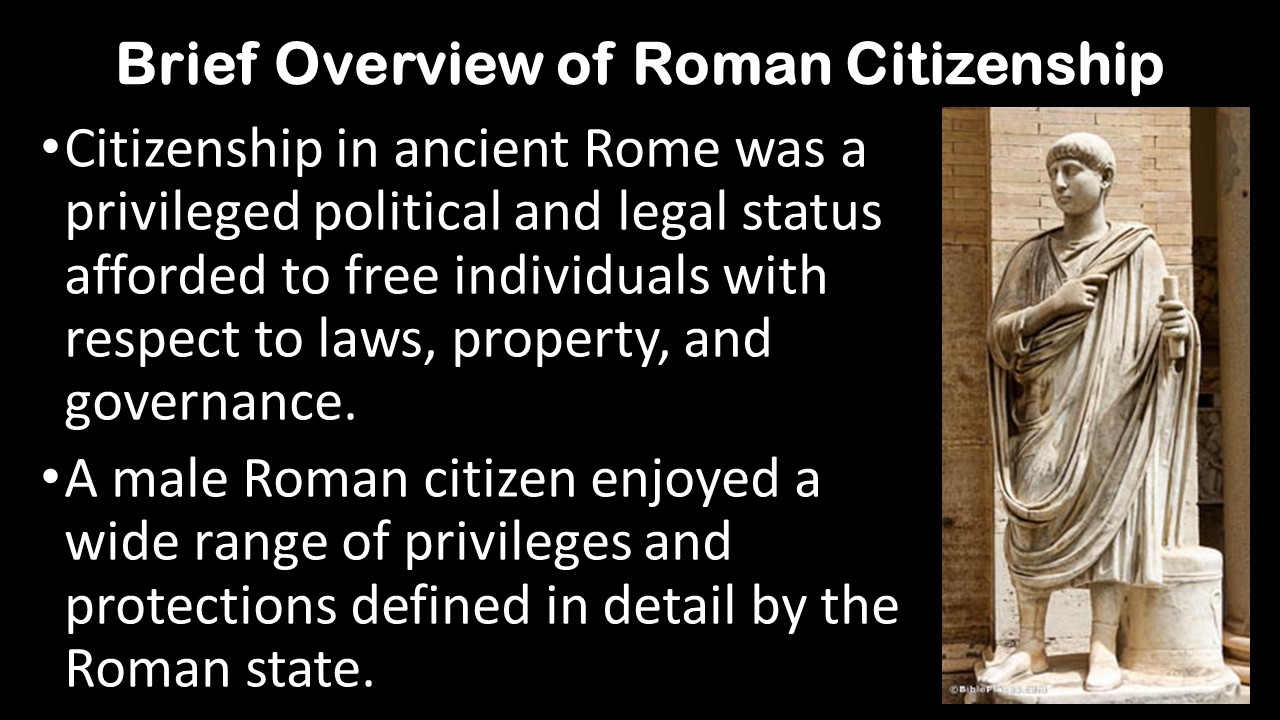
Brief overview of the privileges of Roman citizenship. (Continued on next slide).

Women in Rome. 

Chap. 23 provided insight into the Jewish religious leadership, the Sanhedrin, being divided into two groups: Sadducees and Pharisees. Often typical of such leaderships, they were filled pride and a thirst for power and retaining that power. Also the importance of Roman citizenship. Paul as a Roman citizen from Tarsus, spoke Greek the common language of much of the Roman Empire, thus he could converse and write in Greek, equipping him to share the Gospel across the Roman world; a reflection of God’s sovereignty. 

End of 
Acts of the Apostles
Chapter 23

Friday, September 24, 2021

Chapters 23 – 26 covers a two-year period from the summer of AD 58 to the fall of AD 60. A lot of background information is included to further enhance our understanding. It makes for a long read, so I divided the chapter into two parts. Why is the background info important? It helps us to better understand God’s written Word, which doesn’t contain the background information, but definitely helps us to better understand the situation being written about. Since the chapter is being split, I suggest you read the entire chapter on your own. Understanding who the Sanhedrin is, is an important part of the New Testament Gospels and the Book of Acts. Since they were the religious leaders responsible for Jesus’ crucifixion.  

I see a lack of background information as watching someone read a script on an empty stage, versus going to the play with full costumes and period-stage-sets. But first and foremost, prayer should definitely be part of the Word, be it a quiet reading of the Bible, a formal Bible study, or the postings on this blog. It is the Holy Spirit that opens our hearts and minds to what He is telling us—better yet, what He is teaching us. 

We ended chapter 22 with Paul being brought before the Sanhedrin. His preaching at the temple created a disturbance. This led to Paul’s arrest by the Roman centurion, who brought him to the Roman commander because Paul was a Roman citizen. The commander brought him before the Sanhedrin to determine the cause for the disturbance, which is where we find Paul now. 

Standing before the Jewish leaders, Paul, being a Pharisee and knowing Jewish law, called them out for the hypocrites they were. 

By Jewish law and culture, the high priest was to be respected. Paul’s comment was disrespectful, for which he apologized, not recognizing him as the high priest. Not only does Paul apologize but quotes the very Jewish law he had unintentionally violated. 

Other Jewish leaders were also gathered there as we see in v.6. The gathering consisted of two groups that comprised the Sanhedrin, the Pharisees and the Sadducees. Paul played on his knowledge of their different beliefs, which we will see in the next few slides. Their different beliefs were significant resulting in a long-standing split between them. 

The two distinct religious groups held very different views of the afterlife, which we will be discussing in our Sunday Foundation’s study in Heritage Lounge at 9:00. It would be well worth your time.

This verse gives a brief explanation of the differences between the two groups. Since the Sadducees did not believe in the resurrection of the dead, it’s surmised that they did not believe in an afterlife. Does that mean they would strive for all the gusto they could get in this world? Highly probable. The proud generally strive for power and prestige. We see the same in the political arena of today, with a lust for power outweighing policy. 

We will pause here to provide insight into the two groups that comprised the Sanhedrin, the Jewish ruling religious class. Both of whom played a significant role in the life of Christ including His crucifixion. 

The Jewish leadership was comprised of these two groups as previously noted. We’ll explore the differences in the next couple of slides. Image shows where the Sanhedrin met within Jerusalem's temple in a place known as the "chamber of hewn stones"—enlarged on next slides (although they sometimes met in the house of the High Priest). 

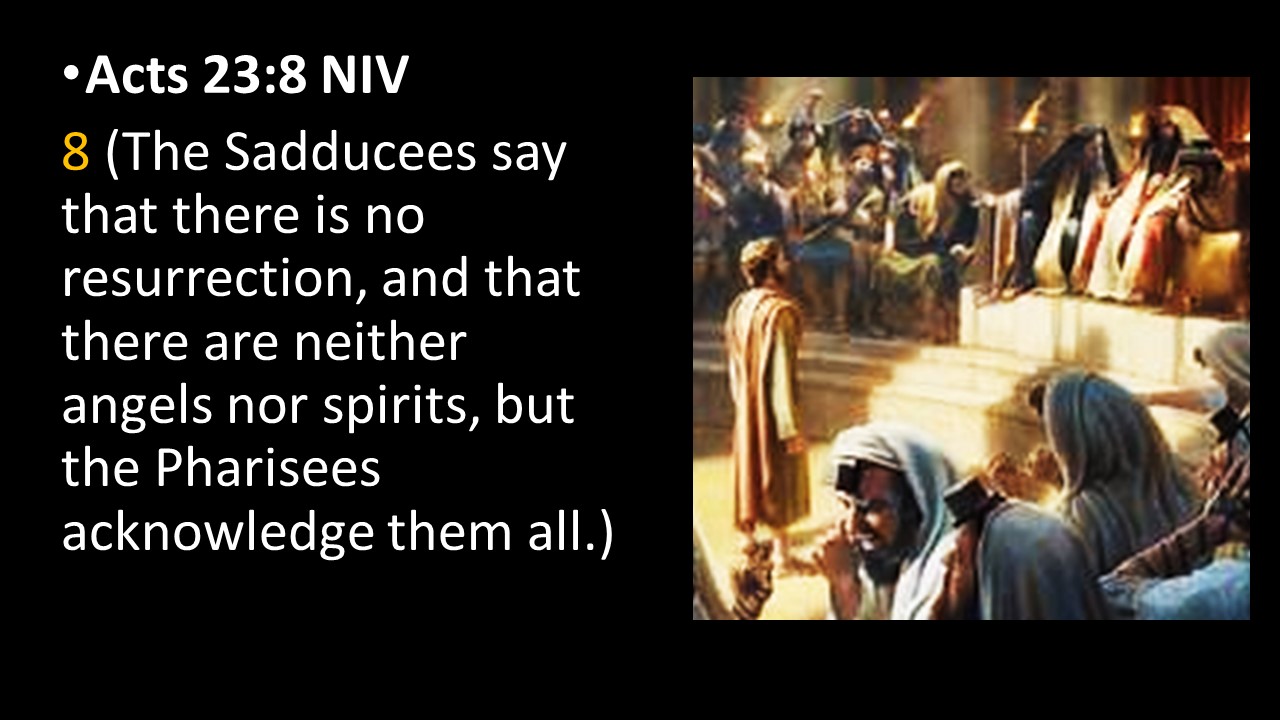
Images show where the opening verses of chapter 23 took place. 

Another view of the Sanhedrin’s meeting chamber.

The Sadducees were what we would refer to as the “aristocrats”, the upper-class Jews of the day. A member of whom served as the High Priest (image). 

The Sadducees, who didn’t believe in an afterlife, wanted to retain their authority, which also meant staying on the right side of the Romans. Does a similar attitude seem to be increasingly prevalent in today’s political world, with some, perhaps many, seeking power and fortune first and foremost. We can learn a lot about the world around us from God’s Word. Keep our Nation in your prayers. 

The Sadducees power was based on Rome’s approval, and consequently, they did everything to avoid Rome’s displeasure. Rome was interested in maintaining order, and the Sadducees did everything to avoid situations that would stir a group’s anger, that could incite a riot. This is why Jesus Christ had to be eliminated, too many people were starting to follow Him instead of them. And now Paul, may be doing likewise professing this same Jesus once again as the promised Messiah, especially with Paul being a Pharisee. 

A reminder, Saul (aka Paul) was a devout Pharisee in faith and practice, so much so that he participated in the stoning of Stephen, the first Christian martyr, as a Jewish heretic (Acts 7:57-59). 

We see something similar in the Christian Church. The Roman Catholic Church put long-standing church traditions on par with Scripture for faith and practice. The Protestant Reformation was predicated on Scripture alone. We will be looking at this further in our Sunday morning Foundation studies at 9:00 in Heritage Lounge. 

Acts 23:7-8 (The Sadducees say that there is no resurrection, and that there are neither angels nor spirits, but the Pharisees acknowledge them all.). Early church icon of Michael the Archangel (Jude 9; Rev. 12:7).

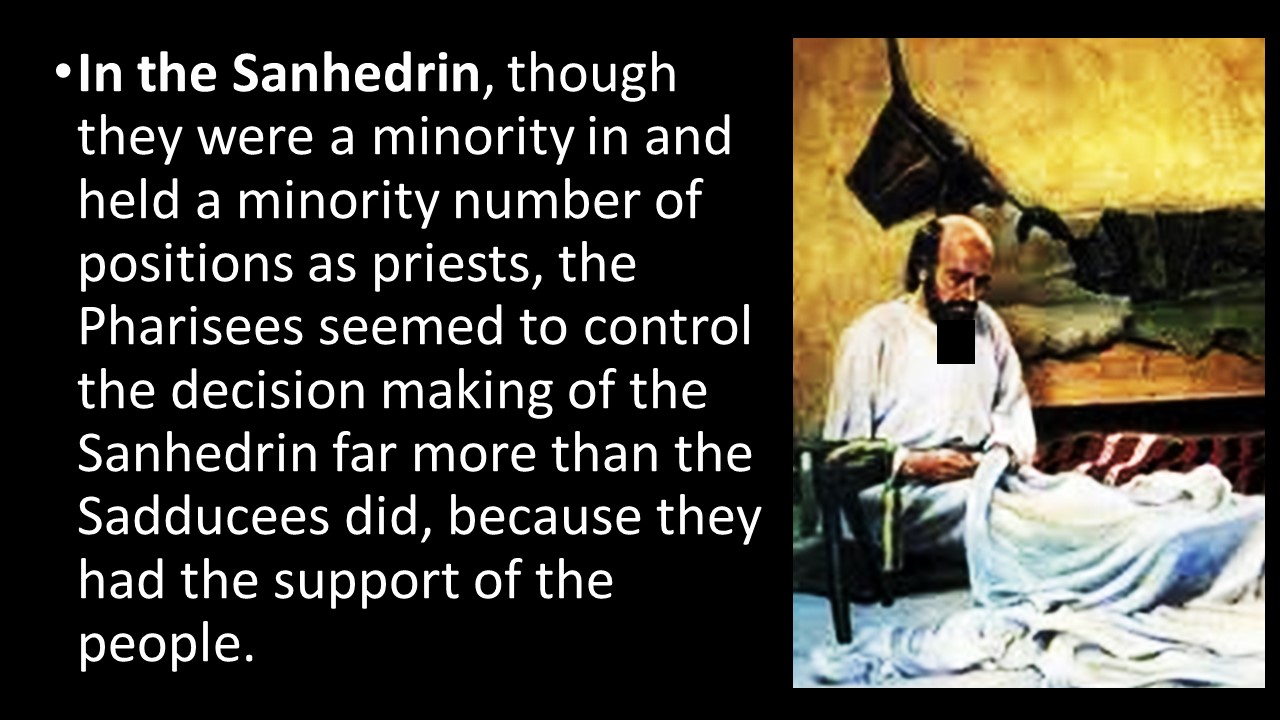
Pharisees were not from aristocratic families, but generally from those who conducted trades, such as Saul of Tarsus family, who were tent makers. 

As we saw in Acts 18:3, Paul performed the trade of tentmaker.

Jewish law at the time was based on Mosaic law and tradition. The Mosaic Law consisted of 365 negative commands and 248 positive for a total of 613 commands.

In bringing Christ to the Gentile world, Paul rejected the premise that Jewish law was essential for salvation as demanded by the Judaizers. The Protestant Reformation came about based on Scripture alone for faith and practice, part of our Sunday study. 

As the religious leaders, Pharisees couldn’t afford to allow Paul to profess Christ, and have the people turn away from their authority.

What the Pharisees believed, continued from previous slide. 

Again, the Sanhedrin couldn’t afford to allow Paul to profess Christ. If the people accepted Jesus, they would reject the authority of the Sadducees and Pharisees and condemn them for killing the promised Messiah—thus they would no longer be the religious leaders of Israel, and perhaps even cause a Roman backlash. 

Our country is drifting to a dark place, and only God can help us, or even save us as the Nation we were created to be as One Nation Under God. Pray that the Holy Spirit will open the minds of those in Congress and the White House to realize the damage that is being done by poor decisions and misguided policies. Pray for our pastor and his family, for our church and its Session. In Jesus' name, Amen!

End of
The Acts of the Apostles
Chapter 23 (part 1 of 2)