Friday, August 13, 2021

In the closing verses of Chap. 17 Paul concludes his stay in Corinth. Opening verses of Chap. 18 we see that Paul left Corinth to go to Athens. This chapter also provides incite into the Greek and Roman world of Paul's day. It presents an opportunity to walk alongside of Paul rather than just reading about his journey. 

Don’t just read the words. Think of yourself accompanying Paul through the streets of Corinth. When arriving in Corinth, Paul met Aquila, a native of the Roman province of Pontus, who had previously lived in the City of Rome. The Roman Emperor Claudius drove the Jews out of Rome, with some, like Aquila moving to Corinth. Claudius was Emperor from 41 to 54 AD. He was born in Gaul, the first Roman emperor to be born outside of Italy. 

V.1 doesn’t tell us how Paul traveled from Athens to Corinth; if by land or by sea? Either route is probable, by sea would be a lot easier and quicker as we see on the map. 

In v.3, we see Paul was a tentmaker by trade, most likely in his hometown of Tarsus. The early church didn’t always have the means to provide for his needs. Often, people outside of the cities lived in tents as shown. 

City life was very different. What the city of Corinth looked like at that time. Since most Jews were merchants, we can be fairly certain that the synagogues were not in the poorest sections of town. It’s believed that Paul may have stayed in Corinth longer than any other city. All major Greek and Roman cities included a pagan temple, as shown. 

We can only imagine how many of these buildings (replicated via ruins) Paul may have preached in. It was a thoroughly pagan and immoral culture—the degree was evident and the expression to Corinthianize meant to be licentious, or sexually immoral. Think of the challenges Paul faced. The same challenges exist today. 

What it looks like today… pagan gods of that period did not survive nor did their temples except as ruins of history past. Past pagan glories “gone!” But new gods of 20th century materialism have replaced them. 

It was an intellectual center of learning, with inquisitive minds even in regard to the monument of the UNKNOWN GOD, which made it ripe for the Gospel message. 

Corinth was a turning point for Paul. Being a Pharisee, he felt compelled to reach the Jews, but he ran out of patience with the hostile Jews who rejected the Gospel and Jesus as Messiah. 

Aphrodite was goddess of love, beauty, pleasure and procreation. The goddess is still alive and well in the world, including the USA. This is what Paul had to contend with in reaching the pagan Gentiles, all of whom had many gods. The message on the slide says it all. 

Titius Justus was a Gentile adherent of the Jewish faith at the synagogue and a Roman citizen. Crispus, as synagogue ruler, was responsible for making the arrangements for synagogue worship services, and guest speakers. Picture shows ruins of that synagogue. Those who professed Christ, were saved by faith, and then baptized into the Church. 
(Note: Titius Justus is not the Titus Paul wrote his epistle to)

Paul faced strong opposition from both devout Jews and pagan Gentiles. Paul was a Hellenistic Jew, comfortable in the Greek culture and Greek language, sufficiently to write all his epistles (letters) in Greek. In v.9-10 Jesus assures Paul he is safe, not to fret or worry. Is that also a message for us in sharing the Gospel of saving grace with others? 
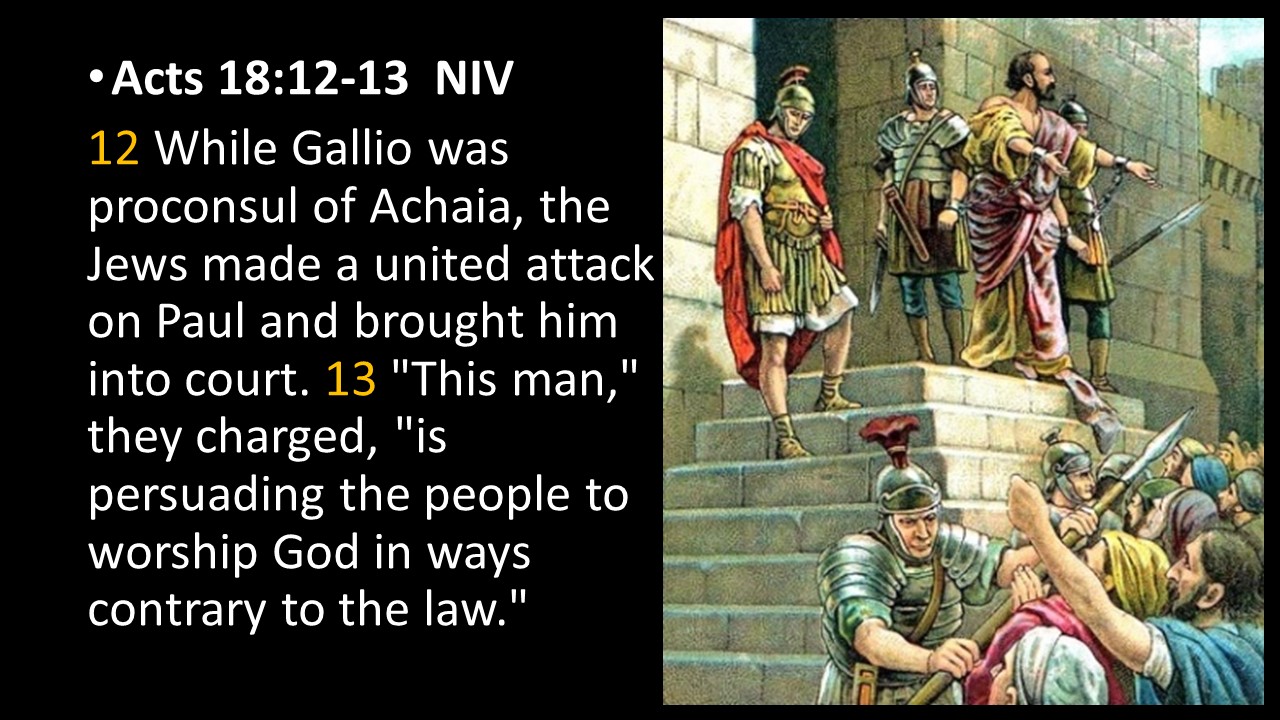
V.13, the Jews pointed to Roman law when condemning Paul—“worship contrary to Roman law”—religion had to be approved by Rome. Judaism was approved and Christ was denounced by the Jews. As in other cities, these Corinthian Jews couldn’t just ignore Paul, but tried to destroy him as a heretic. 

Nevertheless, Jewish rage had consequences. 

More insight on Sosthenes. Why do we care? Luke, inspired by the Holy Spirit, saw fit to record him here in Acts. Scripture doesn’t explain why Sosthenes was beaten. Other than he was a high-profile Jew who tried to have a Roman citizen condemned—how dare him, from the Roman perspective. 

After a long stay in Corinth, Paul leaves for Ephesus, which he did not visit on his first missionary journey. This is the first mention of Ephesus in Acts. Once again, Paul is determined to bring Christ to the Jews. Cut his hair—vow as Nazarite.

After staying several months in Antioch Syria, Paul sets out on his 3rd missionary trip, returning to Galatia and Phrygia to revisit the converts in those areas (noted on map by stars). 

Map shows Paul’s travels through Asia, Macedonia and what is now Greece. The extent of Paul’s 3rd missionary journey covers 4 chapters of Acts.

Paul preached Jesus as Lord and Savior in each of the cities noted.

Priscilla & Aquila instructed Apollos with correct doctrine learned from Paul, that they imparted to Apollos. But they did so privately, and not while in the synagogue. 

Apollos traveled to Achaia is Greece to profess and defend the Gospel, which brings us to the conclusion of Acts 18. Did you walk with Paul or just read about him? 

The Jews rebelled against Paul’s “heretical message” from their perspective—but they failed to recognize Jesus as the promised Messiah.  What is the modern Jews’ view of Messiah? O.T. has ended, how do they make restitution and atonement for their sins, especially without sacrifices in the Jerusalem temple? Mostly, not having an answer, they ignore it. Which is equally true of all those who reject Jesus as Savior. They’re too busy with other stuff. But it's the role of the church, as it was with Paul, to keep professing Christ. 
Does America need prayer? You bet it does! Does Job 12 describe the current path of America? Without prayer, God will turn away from us as Job tells us. Pray for America. 

This prayer was copied from Covenant’s weekly prayer chain, a prayer worth repeating. With God, all things are possible. Don't give up praying for America. 

Think in terms of the first century church as revealed in Acts, the heart of which is the Gospel of saving grace through faith in Jesus Christ. We live in a world that has turned away from God. Even some portions of the Church have turned to a social gospel. Jesus sent the apostles to share the gospel with a pagan world, we seem to have returned to that very situation. Share the gospel, perhaps even this lesson, with those who need to know Jesus Christ as Lord and Savior. God bless each of you. 

End of
The Acts of the Apostles
Chapter 18


Friday, August 6, 2021

The Apostle Paul’s travelogue & evangelism journey continues. Let’s envision that we are accompanying Paul and not just reading about him. And ask the Holy Spirit to inspire us to see His message in the Words as we accompany Paul on his travels. 

Remnants of the ancient pagan world still exist throughout the region, especially pagan temples. Those gods no longer exist, nor is their memory part of the culture. But, this is the world and religions Paul uncounted in his travels, when those temples stood in their full radiance. 

What many of those pagan temples looked like in the time of Acts, also today’s remnants. From glory to obscurity and tourist attraction. 

Chap. 16 closed with Paul and Silas leaving Philippi. In Chap. 17 they continue their journey. The city of Apollonia was named after the Greek god Apollo. Paul’s custom when visiting cities with a Jewish presence was to profess the Gospel in the local synagogue, that Jesus was the Christ the promised Messiah as proclaimed in the O.T. prophesies.

Amphipolis, their next stopover, was a port city 30 miles SW of Phillippi. Romans captured and incorporated the region of Macedonia in 168 BC. Image shows the ruggedness of the coastline and terrain Paul and his companions had to travel through. Mt. Pangaion, as noted, is an elevation of 1,956 ft.

Paul’s efforts professing the Gospel in local synagogue that Jesus was the Christ, the awaited Messiah convinced a number of those Jews who Jesus was. Gospel of grace also struck a cord with the God-fearing Gentiles; perhaps those who had accepted Judaism, including some prominent (upper class) women—”not a few” meaning not just a couple, but a notable number. 

The Jews in Thessalonica were jealous with rage that Paul was winning converts. Why were those Jews so outraged? If Jesus was worshipped, they would lose their authority and influence over the Jews and Gentile-converts. People in power, will do anything to stay in power, even those serving in government, perhaps even more so; just look at the world around us. 

Paul remembered their hardships in his letters to the Thessalonian church. Jason was a devout Christian who faced persecution for his faith, but persevered. Post bond, a financial fee to ensure they wouldn’t leave the city. There is no other mention of Jason in the N.T., except briefly in Romans 16:21.

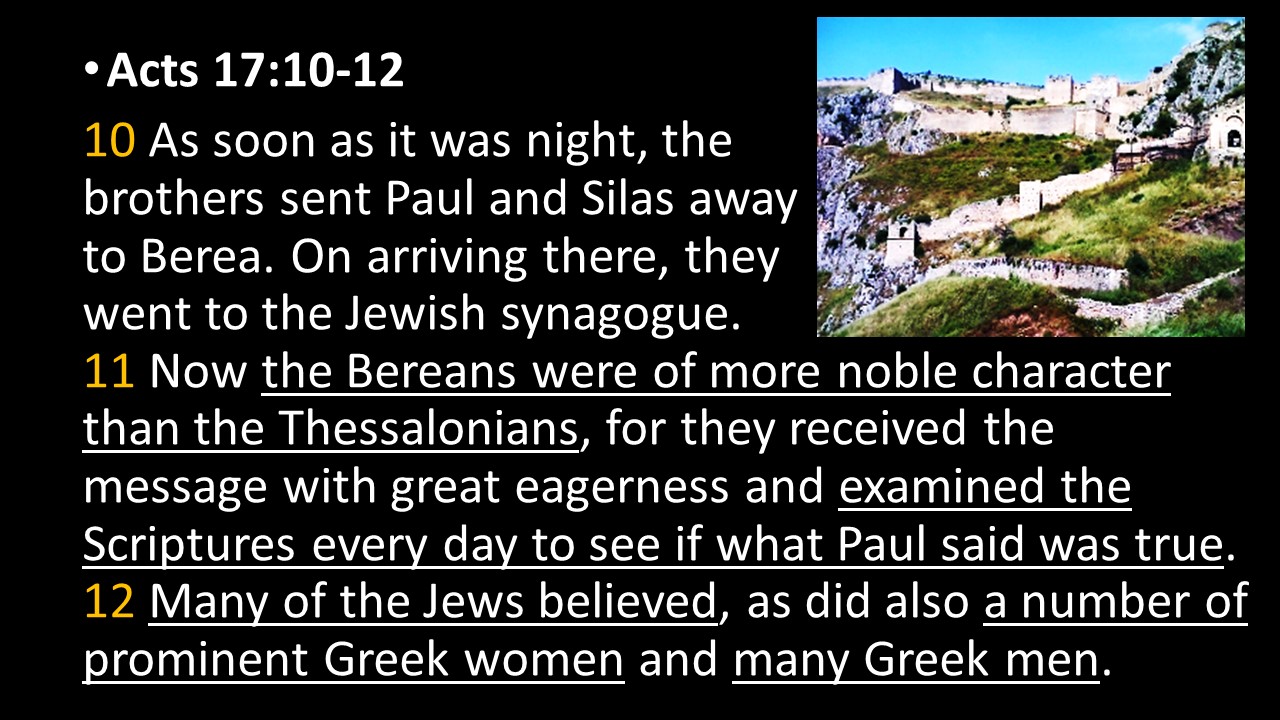
They (most likely including Jason) hid Paul and Silas, and that evening sent them to Berea (v.10) about 50 miles away. The Bereans were more receptive to Paul’s claims about Christ as Messiah and searched the Scriptures to see if his claims were in accordance with Old Testament prophecy. V.12 tells us that many of them believed and accepted Jesus Christ as Lord and Savior. 

The Thessalonica Jews were angry enough to pursuit Paul and Silas to Berea. Those in Berea who believed Paul, escorted him to Athens by ship for safety. Silas and Timothy stayed in Berea, and would follow Paul later, since he was the real target of Jewish rage.

V.16 indicates that Paul was alone in Athens, a city full of pagan gods. Yet, he went to the synagogue alone to profess Christ to the Jews. He even roamed the marketplace professing Christ to whoever would listen.

What Paul would have seen while in Athens. It was the leading city of Greece and Greek culture. It was conquered by the Romans in 146 BC but retained its Greek culture and sophistication, some of which were even emulated by Rome itself. 

Any time Jesus is professed as Savior to hardhearted & unrepentant sinners, they rebel rather than ignore it. It raises the question once again, “Why do some rebel and others believe?” It is as true today as it was then. Without the Holy Spirit, men’s hearts are as hard as stone. How does the Holy Spirit change sinner’s hearts? Perhaps another study—so stay tuned. 

Areopagus Hill (aka Mars Hill) was a meeting place for intellectual and philosophical interest, located on a prominent rock outcropping on the northwest side of the Acropolis in Athens.  

Paul brought the Gospel message within their frame of reference “TO AN UNKNOWN GOD”, that they could relate to. He did not speak to them as Jews that had a knowledge of O.T. prophesies or Hebrew history. Certainly a lesson for us in sharing the Good News of the Gospel, “believe in the Lord Jesus Christ, and you will be saved.”

Did these intellectual philosophers think about creation itself or only of their array of gods? What did they hope to gain from their gods? These verses offer a great deal of food for thought. V.26 is a direct affront to evolution. The one man noted is Adam from whom the entire human race descended. It also highlights God’s sovereignty over all things, including life and death, and even where and when we were born. Food for thought? I think so. What is God's purpose for your life?

Map identifies Noah’s sons noted by the 3 red stars. The spread of mankind after Noah including the people Paul addressed in Acts 17:26. Map shows tribes associated with each of Noah’s sons identified by the color. I won’t go there because it gets pretty complex and timely. Mostly I wanted to show that Asia Minor of Paul’s time encompassed descendants of all three sons. Just as all mankind descended from Adam, all mankind also descended from Noah and his sons. In other words, God created one human race, regardless of ethnicity or color. 

God is not a puppet master nor is He just an observer of mankind. He gave us free will, but God still determines consequences for our actions both good and evil, though He is not the author of evil—man is via sin. In other words, as stated in v.28, in God we live and move and have our being. How does God determine consequences? It would take a study in and of itself to delve into it. As members of the human race, we are also subject to the consequence of sin and the Fall, beginning with Adam. We live in a fallen world with all its consequences. 

Paul is saying that God brought all men into existence, and they only exist by His will. What does Paul mean that God overlooked such ignorance in the past—but not anymore?  In v.30 he is telling them that man’s idolatry was overlooked in times of ignorance, because they had no basis for knowing Him, but that has changed with Paul’s message regarding Jesus Christ. It seems to imply that they will be found less culpable in the final judgment. But the Resurrection of Jesus Christ is proof of who He is; proof for the Jews and the Gentiles—the time of ignorance as an excuse is now behind them. 

Remnants of the Areopagus Hill, aka Mars Hill. 

As noted by Paul, the history of man, as noted in the Old Testament, can be traced from Adam to Noah and his three sons, and their descendants. 

That Jesus is risen is intended for both Jew and Gentile. Perhaps the word of Jesus' resurrection didn’t reach the Greeks in Athens.  But, not everyone rejected Paul’s message.  Dionysius was a judge at the court of Areopagus. 

We would share Christ with an atheist differently than with a human secularist or marginal Christian.  

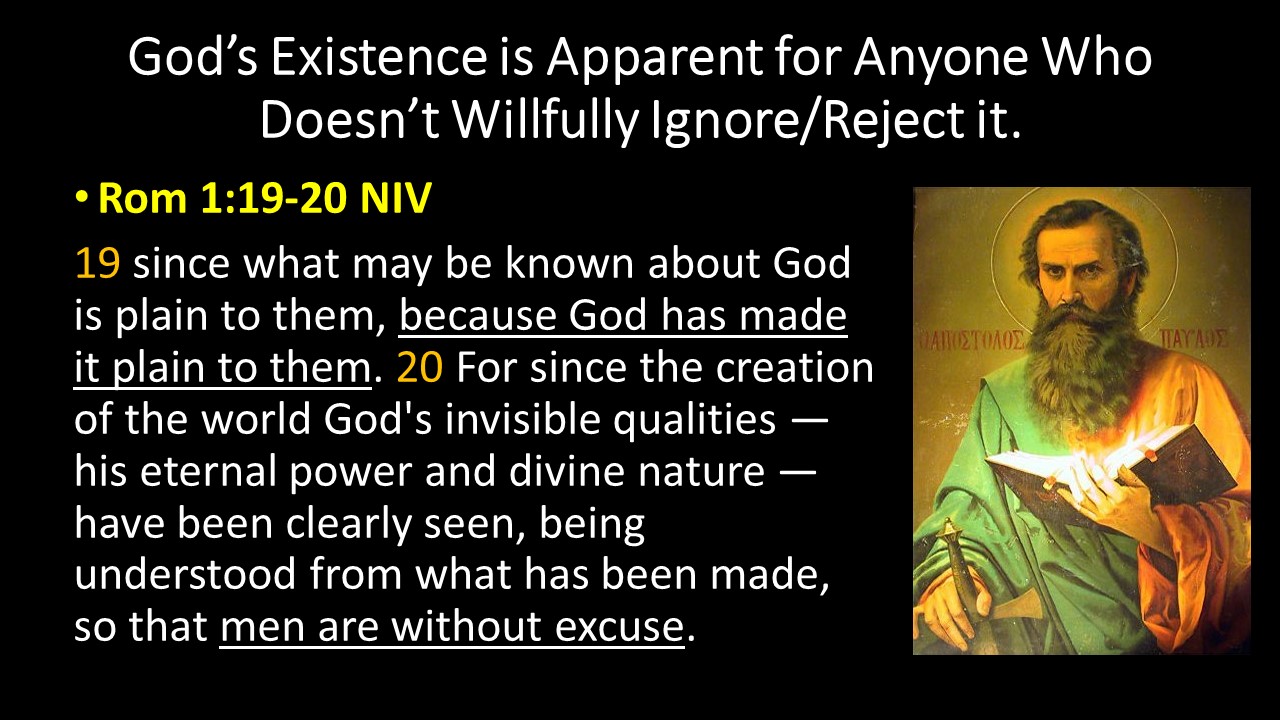
Paul explains further in his letter to the Romans. Maybe Paul’s experience in Athens highlighted this reality that God has revealed Himself, but man has chosen to ignore it and are now “without excuse”.

Map shows the extent of Paul’s travels across its European leg, down through Macedonia and Achaia—what is now Greece. A journey that included travel by both land and sea as they made their way to Athens and Corinth before returning to Roman Asia. 

Jewish rage under the guise of religious righteousness. Also, you can’t question or criticize another’s religion without stirring their rage or anger, especially with the truth that the only road to God is through His Son, Jesus Christ, nor are all religions equal before God, regardless of their intent. 

This blog was created on 3/22/20 in response to the COVID-19 lockdown, in lieu of totally shutting down our Sunday Foundations classes in Heritage Lounge. The topics vary as noted on the slide. They can be accessed via the blog archive in upper right hand corner. Just click on the dates as noted. 

Set aside a moment of prayer for our Pastor, his family, and our church, that we may grow in His Spirit and touch those around us with His Word and God’s grace. 

There comes a time, when it’s time to come home to worship together in fellowship. There are two active Adult Foundation classes at 9:00 A.M., one in Heritage Lounge (adjacent to school), and one in the “Multi-Purpose Room” (adjacent to the sanctuary). Sunday Worship is at 10:15 A.M. Hope to see you there. 

End of
The Acts of the Apostles
Chapter 17