Friday, July 16, 2021

Paul & Barnabas traveled 80 miles southeast from Antioch in Pisidia to Iconium, an ancient town of Phrygian where we meet them again in the Chap. 14. Note: For those interest in going back to Chap. 1, click on the dates 03/21-03/28 in the “blog archive” in the upper right corner. 

Take a moment to compare an actor sitting on an empty stage reading a script v. actors in full costume, on a stage with a period setting, to help puts the words into perspective, bringing greater insight to the words. The maps and other background information used in this study are intended to do the same for God’s words in the Book of Acts, and hopefully, provide better oversight that gives us deeper insight and understanding. Having said that….it takes us to the next slide. 

We open Chap. 14 in the City of Iconium, located in the Roman province of Galatia in Asia Minor. Paul’s letter to the Galatians was written to them and those in the surrounding areas. That entire region is now modern-day Turkey, which is 99.8% Muslim; and 0.2% Christians and Jews. 

Once again Paul and Barnabas met opposition from the Jews. And yet again, the Holy Spirit reinforced Paul’s message with miracles. Still many devout Jews refused his message with jealous rage—i.e., the popularity of his message v. their long-standing religious laws and traditions. Picture shows ruins of the Jewish synagogue in that region. 

A pictorial overview of Paul and Barnabas’ travels to and from Iconium. 

Stoning was the Jewish penalty for blasphemy, so once again Paul and Barnabas fled from that city. Gentiles worshiped pagan gods and Paul’s message also opposed their beliefs leaving many of them equally angry—something they had in common with the Jews. The “good news” in v.7 is the gospel message of saving grace, that Jesus died to atone for our sins. 

V.8 Lystra was a city fortified by Augustus as a Roman colony—it was settled with Roman army veterans. It was built on a hill rising 100-150 feet above the surrounding plain where Iconium was located. In v.8-9 Paul cured a man lame from birth. Because of the miracle, the people thought Paul and Barnabas were gods in human form, a common belief at that time that the gods took on human form. 

The three cities in v.1-11 are noted by the red star. Iconium, situated in a large fertile plan, was in province of Galatia. Lystra and Derbe were in the province of Lycaonia. As you can see on the map, the three cities are relatively close to each other. The distance between Iconium and Lystra is said to be about 20 miles. 

Map shows the Roman provinces in that region, in what is now called Asia Minor—including the Roman province of Asia. Notice the city of Ephesus (all of which are in modern-day Turkey). This is the region that most of Paul’s letters to the churches were written to—with the exception of his letter to the Romans and personal letters to individuals such as Timothy and Titus. Yet, today that region is almost totally Muslim. Perhaps it’s a message for today’s church? 

Slide shows some of the rugged terrain of Cappadocia. The photos help us appreciate Paul and Barnabas’ missionary journey through that rugged region. 

Because of Paul’s miracle, the temple priest brought sacrifices (v.13) to worship Paul and Barnabas. An ancient legend stated that Zeus and Hermes came in human form seeking hospitality—those who rejected them, their homes were destroyed (earthquake?). 

Can you imagine what animal rights people would say about these practices? Even in regard the O.T. Israelite temple sacrifices? “Why God?” they would ask. The price for sin is a blood sacrifice, from an animal without blemish—pointing to Jesus’ blood sacrifice on cross without blemish! 

The Greek gods they were being associated with, Barnabas with Zeus and Paul with Hermes (the messenger, Roman name of Mercury), because he was the principal speaker. 

V.14 gives us Barnabas & Paul’s reaction. In v.15 they profess the living God. Yet, as we will see in v.18, the people insisted on worshiping them as living gods. Greek urn picture is from that period showing temple sacrifice (enlarged on next slide). 

In v.17 Paul explains God’s general (natural) blessings on them. Nevertheless, in v.18, the people insisted on worshiping them. It’s not only hard for people to give up their established religious practices but it’s often strongly resisted even with violence as we often saw with the Jews, and with some Gentiles, as we’ll see in v.19.  

What the temple looked like then, and its ruins now. No one worships Zeus or Hermes today, not even in the pagan world. 

Jewish hatred was once again voiced against Paul and Barnabas, by Jews that traveled from Antioch and Iconium, stirring up sufficient hatred against them, sufficient for Paul to be stoned and left for dead. A day later he and Barnabas left for the City of Derbe. We can be certain that Paul was in pain from the stoning. 

After preaching the “good news” Paul and Barnabas retraced their steps to encourage those that had accepted Christ, who most likely were also being persecuted. They appointed elders as church leaders. This painting shows the Holy Spirit accompanying them, and as they ordained elders. 

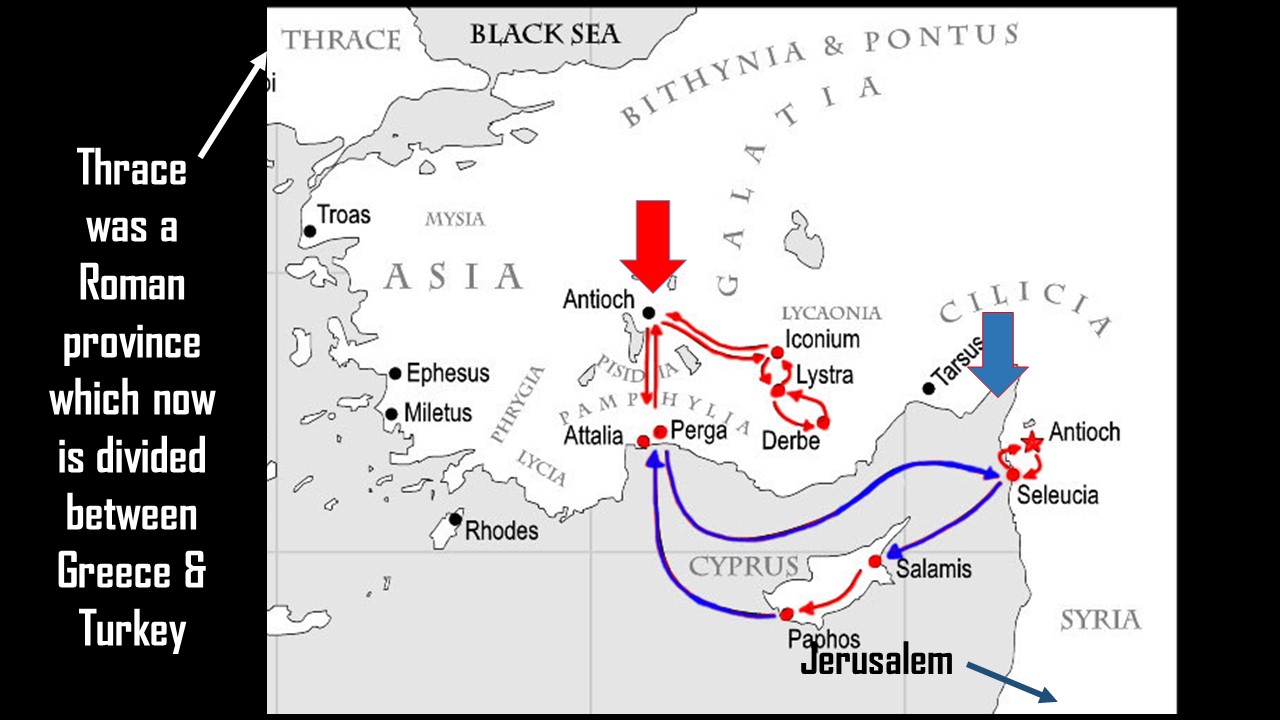
Map shows their return trip to what had become dangerous cities for them. It also points out Paul’s home city of Tarsus (Red arrow). Map shows the rugged terrain in that region. 

Paul and Barnabas’ journey was an arduous trip with physical challenges and danger, yet the Holy Spirit sustained them. They bypassed the Isle of Cypress and went directly to the port city of Seleucia in Syria on their return voyage, and then by foot to Antioch Syria. 

Remnant of the roads in that region, traveled by Paul and Barnabas—portions that still exist today. 

Ending Chap. 14 we see Paul and Barnabas’ returns to their home base of Antioch Syria after a strenuous and dangerous journey covered by both sea and land.

Almost the entire region shown on the map traveled by Paul and Barnabas spreading the Gospel and planting churches, is almost entirely Muslim today, except for Israel. I’ll call it food for thought…and prayer. Islam was introduced, by the sword and conquest, after the Roman Empire fell; nevertheless, the Gospel message was then spread across Europe. 

In spite of the physical hardships and constant threats against their lives, Paul and Barnabas spread the Gospel bringing many Gentiles and even Jews to accept Christ as Savior. They established churches and appointed elders to lead them as noted on map. 

America needs God. Lord God, we deserve judgment, but plead for mercy in Jesus' name we pray, Amen. 

End of
The Acts of the Apostles
Chapter 14


Friday, July 9, 2021

Acts is the history of the infant church and its influence on the Roman Empire. In Chap. 13 we start to see the spread of Christianity into various regions of the Roman world, first to the Jew, with Paul preaching in the synagogues, and then to the Greek (the Gentiles). 

A quick overview of Acts. Chart shows the Book of Act’s timeline and where we are in our study (red arrow). The year Saul was converted was 36 A.D. His first missionary journey was between 44 A.D. to 46 A.D. So he was a Christian for about 8 years before his journey to Cyprus here in Chapter 13.


Blindness demonstrated that Elymas’ sorcery couldn’t compare to Paul’s Gospel message and the power of the Holy Spirit. Since this was an important and influential city, this is what some historians believed the synagogue may have looked like based on its ruins. (enlarged on next slide).

What this Jewish house of prayer is thought to have looked like both on the outside and inside. Many Jews were merchants and emigrated to influential parts of the Roman Empire to practice their trade and enjoy the associated prosperity. The synagogue was an important part of their community life. 

I believe images help us to see the overall scene and put the printed Bible words into perspective. Map shows Barnabas and Saul’s first missionary journey that began and ended in Antioch in Roman Syria (blue arrow). Beginning in v.16 (next slide) we find Barnabas & Saul in Antioch Pisidia (red arrow) well inland in what was Roman Asia—modern day Turkey. Their travels included both sea and land trips. 

On the opening of his missionary trip, Paul began formally preaching to the Jews and the Gentile converts to Judaism. He begans by recounting the history of Israel as a background on the O.T. promises of a Messiah, in preparation for who Jesus Christ is. 

The Hebrews spent over 400 years in exile in Egypt and 40 years wandering in the desert. Preserving their identity and heritage as decreed by God. The image is a rendition of their wandering in the desert. Paul’s recount of Israel’s history most likely stirred up a response, since these Jews were not in Canaan, the Promised land given to Abraham by God. Jews that lived outside of Israel, could very well forget what their heritage was predicated on. This is just as true for Christians today. Statistics tell us that far too many young people have drifted away from the church and their Christian heritage joining the secular culture instead. The Jews were careful to avoid that by preserving and recounting their history and heritage as Paul was doing. 

Their heritage was decreed by God, and passed on from Abraham, Isaac and Jacob to all succeeding generations. It is part of the Jewish heritage to remind their posterity—each succeeding generation—of this truth decreed by God. 

Map shows this historic journey—Exodus of the Hebrews from Egypt to Canaan, the Promised Land, a journey that included 40 years of wandering in the desert for their disobedience and worshiping the golden calf (Exodus 32). 

As Paul spoke, he reminded them that the Hebrew Exodus and settlement in the Promised Land took place about 450 years. He reminds them of their history and common heritage and how the people of Israel cried out for a king, so God gave them Saul. King Saul wasn’t perfect but neither was King David who followed. David had Uriah the Hittite killed in battle to cover his adultery with Uriah’s wife, Bathsheba. One example why the Bible is the inspired word of God—even their greatest leaders’ sins are exposed—it isn't a human account to show the best of the Hebrews and their leaders. David is important because Jesus is of the royal line of David, of the tribe of Judah. 

As Paul spoke, they most likely envisioned Israel’s history. Map of Israel during the time of King Saul, noted by the arrow. Remember, the Hebrews demanded a king in 1 Samuel to be like other nations, rather than remaining a theocracy. So, God granted their desires with Saul.  

Often, sin has long-term consequences—i.e. the people of Moab and Ammon are the children of Lot’s incestuous relationship with his two daughters—they got him drunk, both times. (Gen. 19:31-38)

As Paul noted, Jesus didn’t just appear out of nowhere; He was the promised Messiah. People viewed John the Baptist as a prophet, and he was; as such, he pointed to Jesus as the one that was to come—the Promised Messiah and heir of King David.  

Paul shared John the Baptist’s statement of who Jesus was, a direct descendant of King David who was a direct descendant of Abraham, Isaac and Jacob. As we’ll see in the next slide, David expanded Saul’s kingdom as shown on the map, just as Solomon expanded David’s kingdom shown on next slide. 

In presenting Jesus of Nazareth, Saul felt it necessary to recount their Hebrew heritage and Old Testament promises. Their lineage came down from Abraham, Isaac, and Jacob. Esau (older by minutes) and Jacob were twin brother…. Jacob tricked Esau with a bowl of stew in exchange for his birthright as the first born (Gen. 25:32). Jacob and Esau were the sons of Isaac and Rebekah, and the grandsons of Abraham and Sarah. Only the linage of Jacob mattered in regard to Hebrew heritage. 

Paul explains to the Jews in the Antioch Pisidia synagogue, that in condemning Jesus, the Jewish leaders fulfilled biblical prophesy. They found no legitimate grounds to have Jesus killed, but nevertheless, they insisted on it. Emperor Caesar Augustus wanted peace in that region. Pontius Pilate did not want the Jewish leader complaining to Rome that he allowed an insurrection by someone that was professed to be King of the Jews. 

Adam Clarke’s commentary helps clarify v.27. They rejected Jesus because they did not know God, Himself. Their motives were self-fulfilling which is why they had to condemn Jesus and have the Roman’s crucify Him. He was a threat to their prestige and power, which is something we see even in the political world down through history, where retaining power is more important than the general wellbeing of the people. 

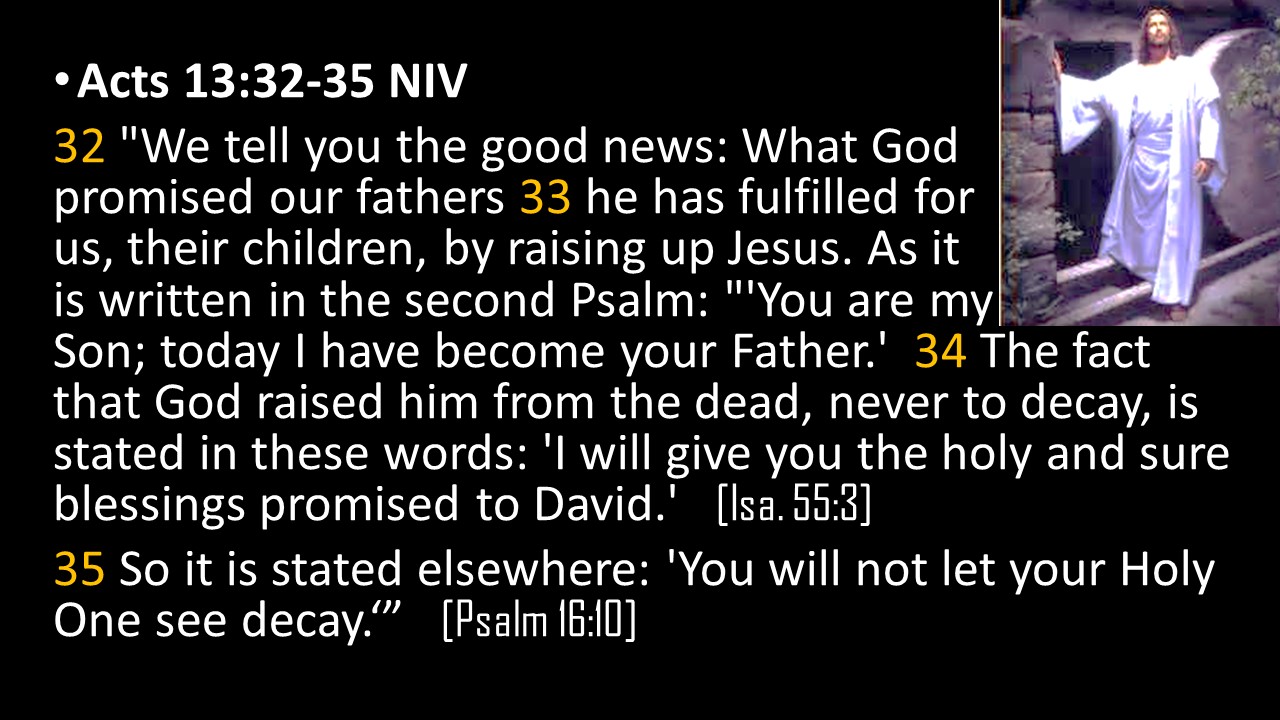
V.29—refers to fulfillment of the O.T. prophecies. V.31, 1 Cor. 15:6 tells us that there were more than 500 witnesses to Jesus’ resurrection, most of whom were still living at the time. The Resurrection was proof of Jesus as the Messiah (Psalm 16:9-11—which we will look at).

God’s promise to Israel was fulfilled in Christ. Paul tells how Jesus was the fulfillment of the O.T. promises. Being raised from the dead, Jesus’ body did not see decay (Psalm 16:10, next slide).

David's prophecy concerns the coming Messiah. In v.10 he expresses joy at knowing that his body too will rest secure and not be abandoned to the grave forever. As such, we too will be resurrected as Jesus’ body was resurrected. Also noted in v.11, is the assurance of eternal joy in God’s presence. That reassurance alone makes chapter 13 worth our time.

Paul reminds them in v.36 that David’s physical resurrection, though assured, was yet to come. V.38 that forgiveness of sin is through Jesus alone, v.39 that no one is justified and saved by following the Law, which must have been very difficult for those devout Jews to absorb. There is nothing man can do to atone for his sins before a Holy God. Without Jesus there is no degree of atonement that would suffice. We have His assurance that He did it all. 

Acts can be applied as much to the Church today, as when it was written. Europe was once referred to as Christendom. But much of Christian Europe has turned away from God. Many cathedrals have become tourist centers rather than dedicated to worship. Is it only a matter of time before the U.S.A. follows Europe? Our prayers should be that the USA turns back to God as it was before—though not perfect, Christian values were the very basis of our independence and freedom. 

V.42 Paul and Barnabas were invited back to share once again with those at the synagogue in Antioch Pisidia. Saul’s message of who Jesus was rested on their own heritage and O.T. prophesies. Were these Jews responsive to Saul’s testimony? V.43 tells us that many of the Jews and Gentile converts followed Paul and Barnabas to hear more. Was the Holy Spirit at work within them? It would seem so. 

V.44, Paul’s word spread throughout the city, and many came to hear him speak. Having been invited to return, obviously, people were inquisitive about Paul’s message. In v.45 once again, we see the motives of the Jewish leaders, in the same way they turned against Jesus in Jerusalem, a hatred generated by intense jealousy, as noted in v.45. If Jesus was accepted as the promised Messiah, they would no longer have influence over the people as religious and community leaders. 

V.46 once again the Jewish leaders rejected Jesus Christ. Paul is clear, in doing so, they rejected God’s Word. His focus would now be on the Gentiles. We can only imagine their anger. V.48, apparently not everyone who came to hear Paul was Jewish. The end of v.48 is a statement of election that those “appointed”, believed—i.e. those chosen by God to believe would believe.  Perhaps a future study. 

How does v.48 apply today? Certain churches see Jesus, not as Savior for sins, but as a moral example for social justice. Not everyone in the church is of the church. People go to church for many different reasons—fellowship, to hear a comforting sermon, the music, or just to feel good. That is why, sharing the Word, and Gospel of grace, is important. God calls the elect through the Word preached in church and shared by His people. 

V.49, the "whole region" included the Gentile areas. V.50, Jewish opposition didn’t wane, they stirred up anger against Paul and Barnabas. V.51: kicking the dust off their feet, sign of displeasure and disassociation. Iconium is in modern Turkey, a predominant Muslim nation—centuries later, their descendants rejected Christianity and accepted Islam, mostly under conquest and threat of death. An indication that our Christian heritage isn’t passed on in the bloodstream by birth, it must be taught and shared with each generation. 

Just a reminder, since most do not memorize maps. Again, map shows this portion of Paul & Barnabas’ trip from Antioch Pisidia to Iconium (gray is sea and white is land). Their trip picks up again in Chapter 14. Just take note of where the City of Ephesus is located (red arrow). 

Most of the areas that Paul brought the Gospel of grace, is Muslim today. Our Christian heritage must be taught to each generation and not taken for granted. They will not absorb it through the bloodstream at birth, it must be taught and passed on. 

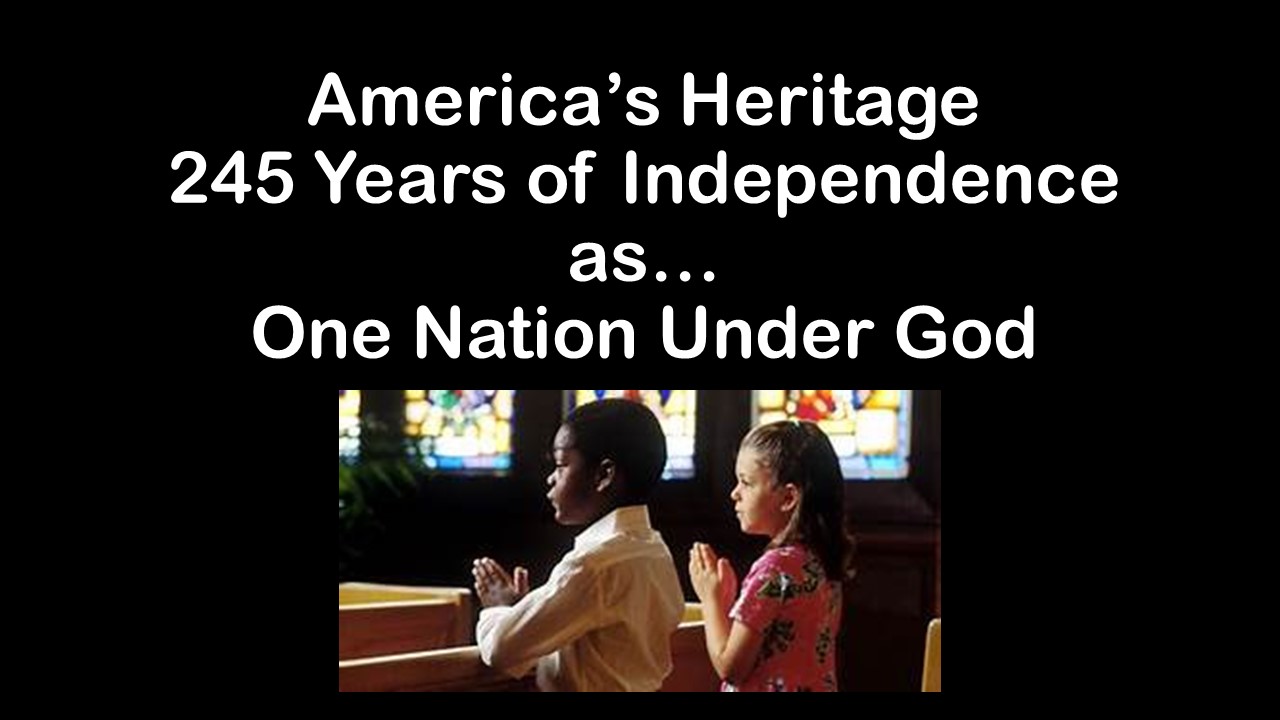
I didn’t want to let this pass without at least putting it into context with Acts. We celebrated 245 years of Independence as a sovereign Nation. In a recent video, interviewing American youth on a California beach, almost all did not know the significance of the 4th of July, or who we gained our Independence from. They could not even give the Year of Independence as 1776. What is the lesson? The answer is stated on the next slide by President Ronald Reagan. Just as it applies to our national heritage, it applies equally to our Christian heritage. 

Will America pass on the heritage of freedom and independence, a gift bestowed on us by God? Or will we like the Jews demand someone else, just as they did with King Saul? As President Ronald Reagan stated, our national heritage (and our Christian faith) isn’t inherited through the bloodstream but must be taught to each generation. We are seeing the relevance and importance of that statement ever single day on the news. 

Proverbs is very clear regarding teaching our children and their children, and not assuming that they will somehow inherit our Christian values.  

In the late 1930s and early 1940s Nazi Germany indoctrinated a whole generation of German children with anti-Semitism and Arian race beliefs—that all others are inferior and do not deserve life or land. It illustrates the importance of school in shaping children’s values. But, what values are our schools passing on to our children today? 

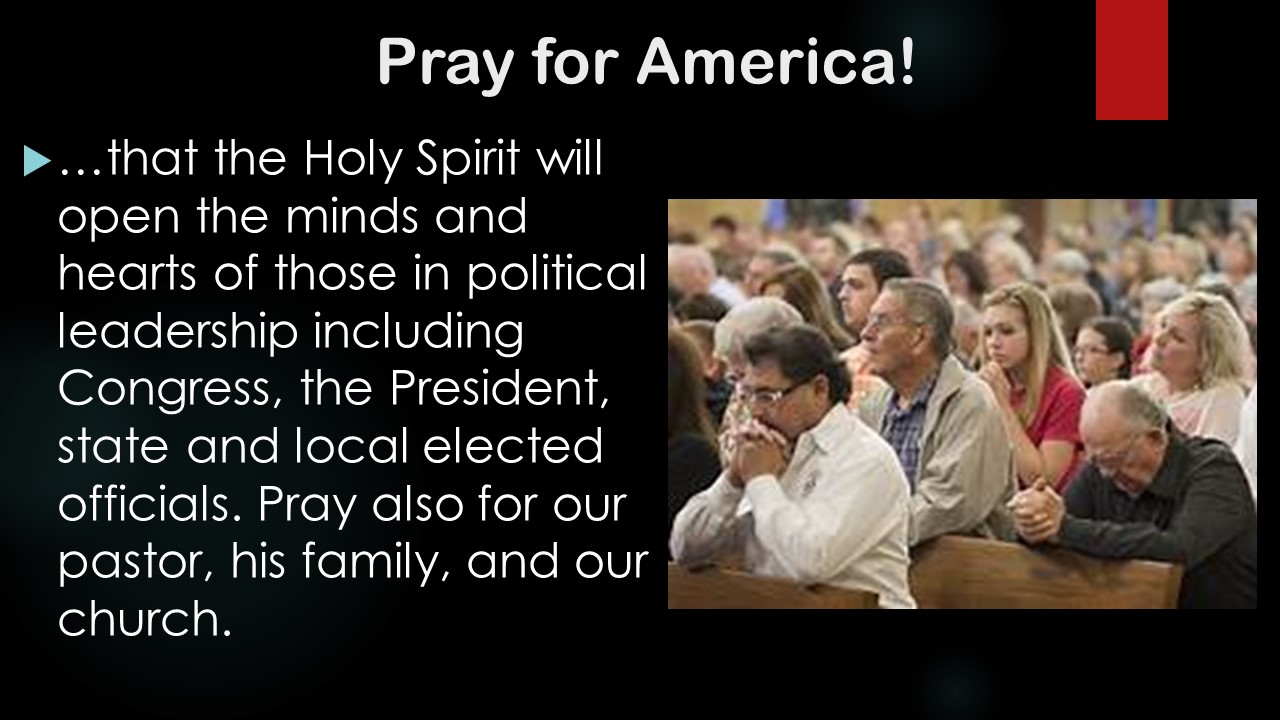
Why do we need prayer? The next slide explains…

Recent statistics show that 18% of Americans are not proud to be American; another 15% only moderately so (a total of 33%). What does this have to do with Acts? Again, the regions of Paul’s missionary trips, where the Gospel was shared, over time became predominantly Christian. Today, those very regions are predominately Muslim. In other words, they lost their Christian heritage. Something we don’t think about. America was founded by Bible believing Christians who included those values in our founding documents, including the Declaration of Independence and the Bill of Rights. If 1/3 of Americans no longer recognize those founding values, they will sooner, rather than later, end up on the trash heap of history. I can’t say it enough: Pray for America. 

What stands out the most is the Jews following their synagogue leadership—who we can refer to as “unworthy authorities”—who rejected Jesus Christ as Messiah; and Paul then bringing the Gospel of Grace to the Gentile world, who welcomed it. Neither Paul nor the Holy Spirit turned back to the Jews as a group as we see throughout the following chapters of Acts. My prayer for the United States on this 245 anniversary of Independence  is that we turn back to God as a people and as a Nation. 

Adrian Rogers’ 37-minute message: The Problem of Unworthy Authorities
https://youtu.be/683Vw6M0CHs
(copy and paste into you web browser)


End of
The Acts of the Apostles
Chapter 13 (part 2)