Friday, June 18, 2021

Chapter 12 opens with the Apostle Peter on trial. 

God sends an angel to rescue Peter, which also serves as a lesson in prayer. 

Herod Agrippa, noted here, saw those who professed Christ, as a threat and had James the brother of John—one of the 12 apostles—put to death (AD 44). Since it pleased the Jewish leaders, he decided to take it a step further by arresting Peter. Herod Agrippa was the son of Herod Antipas who killed John the Baptist. 

Herod placed extra guards as an additional precaution, to ensure that Peter could not escape.

Additional precautions were taken, and Peter was bound with chains between two soldiers—that’s how determined Herod was to put Peter on trial. But God had other plans. An angel of the Lord appeared (v.7) and foiled Herod's evil plot.

Peter was woken up by the angel; the vision was almost like a dream to him, especially being chained to two prison guards, who slept through it all, nor did they wake up when Peter’s chains dropped away. Even the two soldiers standing guard at the prison’s entrance, were not alerted; they most likely dozed off—a capital offense in and of itself. 

The angel continued to escort Peter out of the jail—past both squads of soldiers. It also gave Peter the confidence to leave without fear. Once on the outside, the angel left him. 

Peter’s fear and apprehension vanished, when he realized the angelic rescue was real, and that God sent an angel to lead him out of jail; and perhaps told him to go to Mary's house where they were praying for him. 

So, Peter went directly to Mary’s house, where believers had gathered to pray for his safety, and perhaps even his release. Of course no one anticipated or even suspected that an angel would release Peter from prison. 

When the servant girl went to the door in response to Peter’s knocking, she was so excited that she ran back into the house to tell them that Peter was at the door. Why didn’t she just open the door? The next slide helps to explain. 

We saw back in v.5 that the disciples were earnestly praying for Peter, yet when the servant girl told them Peter was at the door, they doubted it—even thinking it could possibly be his guardian angel. They prayed for something to happen, yet had difficulty believing it actually happened. Q. Have you every prayer fervently for something and yet were astonished when God answered that prayer? Perhaps, even the healing of a friend or loved one? Never be surprised at the power of prayer, which we will study beginning Sunday, June 29th 9:00 A.M. in Heritage Lounge.

We can be certain that the power of prayer became a reality for them. Peter only stayed long enough to explain how he was released by the angel. Perhaps he was directed by the angel to do so to show them that their prayers were not in vain. 

Not knowing what happened regarding Peter’s disappearance, Herod had ordered a search for him. This tells us that the guards had no idea of the angelic visit—and their inability to explain Peter’s escape cost them their lives. Only Peter saw the angel. Did you ever see or hear an angel? Some of us did, really. 

Here Herod quarrels with the people of Tyre and Sidon. These cities (marked by a star on the map) were high-traffic Phoenician port cities, and not agricultural areas, as such they imported their food from Herod. 

Wanting to stay on Herod's good side, they praised him as a god. Herod accepted their praise, a common practice across much of the known world at the time, even in Rome itself, where the emperor was proclaimed a god. Accepting the praise for himself as a god, he was truck down by an angel. Two angels are noted in this chapter, showing the interaction of angels with man. The mid-2020 posting on this blog included a study of angels dated 05/31-06/07. 

At the end of chapter 12, God’s word began to spread to the Gentile world. The first 12 chapters of Acts were focused on Judea & Samaria. Beginning in chapter 13, Acts reaches out to other areas of the Roman world, with the Gospel being spread by Barnabas and Saul, including a mention of John Mark. Who exactly was John Mark?

Barnabas and Mark were cousins. John Mark is noted as the author of the Gospel of Mark. Some commentators speculate that John Mark did not write the Gospel of Mark, that Peter did. But the mainstream of biblical scholars believe he is the author of the Gospel of Mark. Because of their close association, Peter is believed to have been the primary source of information for Mark's Gospel—I’ll stick with that one. Somehow Peter did not come across as an author, even under the inspiration of the Holy Spirit. As an example, 1st and 2nd Peter are relatively short letters compared to Paul’s epistles (letters). 

Since the focus of Acts is shifting from Judea to across the Roman Empire, we will close this chapter with a brief outline of events, as shown on the slide, of the Book of Acts.

One of the principal messages in this chapter, is Peter being released from prison by an angel. An angel appears twice in chapter 12 which clearly tells us that angels do interact with man, even when they are unseen. And I can’t help but think of the power of prayer since Peter first went directly to those praying for him. 

Christianity began spreading across the Gentile world in Acts 13, by word of mouth, since no one had a written Bible at the time. Was the theology being spread always 100% correct? Paul's letters to the churches, often served to correct their beliefs and practices. How can we spot false Christianity in today's church? Does just professing Jesus make one a Christian? Adrian Rogers’ 44-miunute message on "Counterfeit Christianity" explains. We’re you born again? Is it a question you may even be pondering? His message is definitely worth listening too. 
https://youtu.be/JnxeRR9c44U
(copy and paste into your web browser)

For the glory of God, that our Nation and its leaders may turn back to Him in their thoughts, decisions and policies. Pray for our church, our congregation, our Pastor and his family, that God’s glory may prevail. I offer my prayers for everyone viewing this blog, today, yesterday and tomorrow. Amen! 

End of
The Acts of the Apostles
Chapter 12

Friday, June 11, 2021


In Acts 11 the focus shifts from the Jewish-disciples and toward the Gentiles.  

Expansion of the Gospel to the Gentile world would definitely be a surprise to the first Jewish converts who saw the Messiah as strictly for the Jews. 

The Church is now opened to the Gentiles thanks to Peter being led by the Holy Spirit.  At first, all the disciples, including the apostles, believed that Christ came exclusively for the Jews. Peter—actually the Holy Spirit—reacts to Jewish resistance to Christ being shared with the Gentiles. Those who were at Pentecost, couldn’t help but understand the significance of the Holy Spirit coming upon the Gentiles, as He did upon them in tongues of fire (Acts 2:3). 

Peter explains the events previously noted in Chapter 10, repeating the things that Jesus spoke to him. The voice in v.7 is believed to be Jesus (as shown in red letter edition of the Bible, where Jesus’ saying are noted in red text).

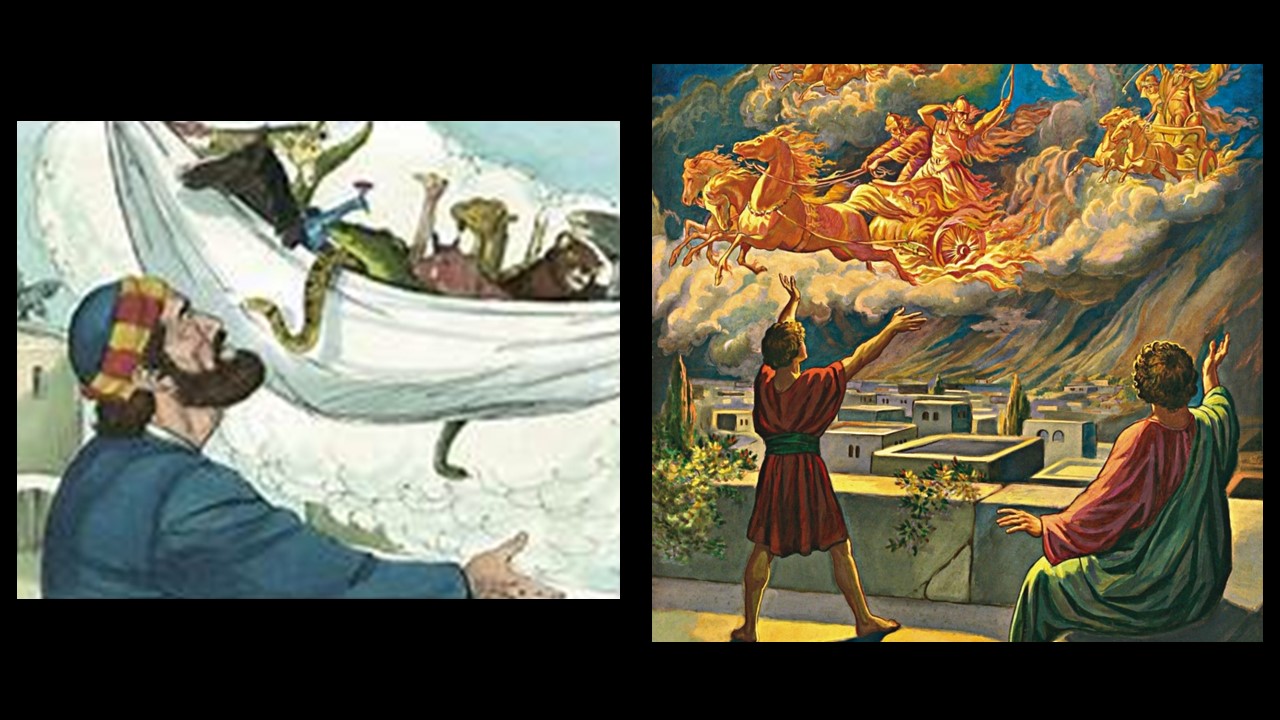
I can’t help but wonder—was it an illusion or were the animal real? If an illusion, why didn’t the vision just disappear after the point was made? Why withdraw the sheet back to heaven? Which raises the question that I have been asked by other Christians, what happens to our pet after death? Animals in the Garden of Eden suffered the consequences of Adam’s sin—yet they died, even though they had not sinned. We know that God is perfect love and perfect justice. Does that also apply to the animal kingdom? (con’t next slide)

Stepping away from Acts for a moment. I find it hard to believe that we love/loved our pets more than their Creator did/does. We can only trust in God’s mercy and love regarding out pets. The Bible doesn’t tell us, other than a hint here in Acts 11 and in 2 Kings 6:17 And Elisha prayed, "O LORD, open his eyes so he may see." Then the LORD opened the servant's eyes, and he looked and saw the hills full of horses and chariots of fire all around Elisha. NIV
Again, this is only speculation. The Bible is for people not animals. If it was, that’s where far too many would focus their attention, instead of its intended purpose sharing the Word with “people” to lead them to Jesus Christ as Lord and Savior. I only raise it, because many have asked my opinion—”Is my pet lost forever?” For those that may be wondering, I deal with this in another blog created in 2011, when I was first asked that question as an active elder, which also looks at the new heaven and new earth:
 http://johnatcpc.blogspot.com  (copy and paste into your web browser)

Back to Acts. Without the Spirit telling Peter not to hesitate going to the Gentiles, he probably would not have gone, since doing so was against Jewish law and custom. The man in v.12 was Cornelius, a Roman centurion. When Peter learned that an angel had appeared to Cornelius, his decision to visit him was affirmed.   

What a revelation this must have been for Peter, taking him back to Pentecost when the Holy Spirit descended on him, the other apostles and the followers of Jesus, highlighting the difference between just physical baptism and spiritual baptism by the Holy Spirit. 

The Church being opened to the Gentiles as well as the Jews, understandably came as a surprise to most Jewish-Christians. These disciples had a hard time believing, since Christ was the Jewish Messiah, and now “the Way” wasn’t exclusively for the Jews, and that Peter of all people would go into a Gentile’s home. But hearing that it was God’s will, convinced them that Christianity was for everyone, both Jew and Gentile alike. Later, Paul had to deal with this same issue with the Judaizes who insisted on circumcision of Gentile-converts to Christianity. 

We view the attack on Jewish-Christians as a tragedy, just as it was with the stoning of Stephen. As Acts unfolds we will see God’s hand on it for spreading the Gospel. Three refuge-cities mentioned in v.19-21 are identified by gold stars. There is an Antioch in Syria, and one in Asia Minor (modern Turkey).

After Stephen’s death, Christians, fearful for their own safety, scattered far and wide as noted in v.19-20. But, they didn’t hide, they spread the Word to other Jews in those regions. Some even began sharing the word with Gentiles. Next slide shows those areas. 

Ancient Cyrene is in modern Libya, north Africa. It was no accident that all of this was part of the Roman Empire. Another example of God’s sovereignty at work in making these areas safe for those Jewish-Christians to escape to, since it was under Roman law, unlike Jewish religious law in Judea, inflicted on Stephen. 

The location of the ancient city of Antioch, which became Christian then, is now part of modern Turkey, a Muslim nation.

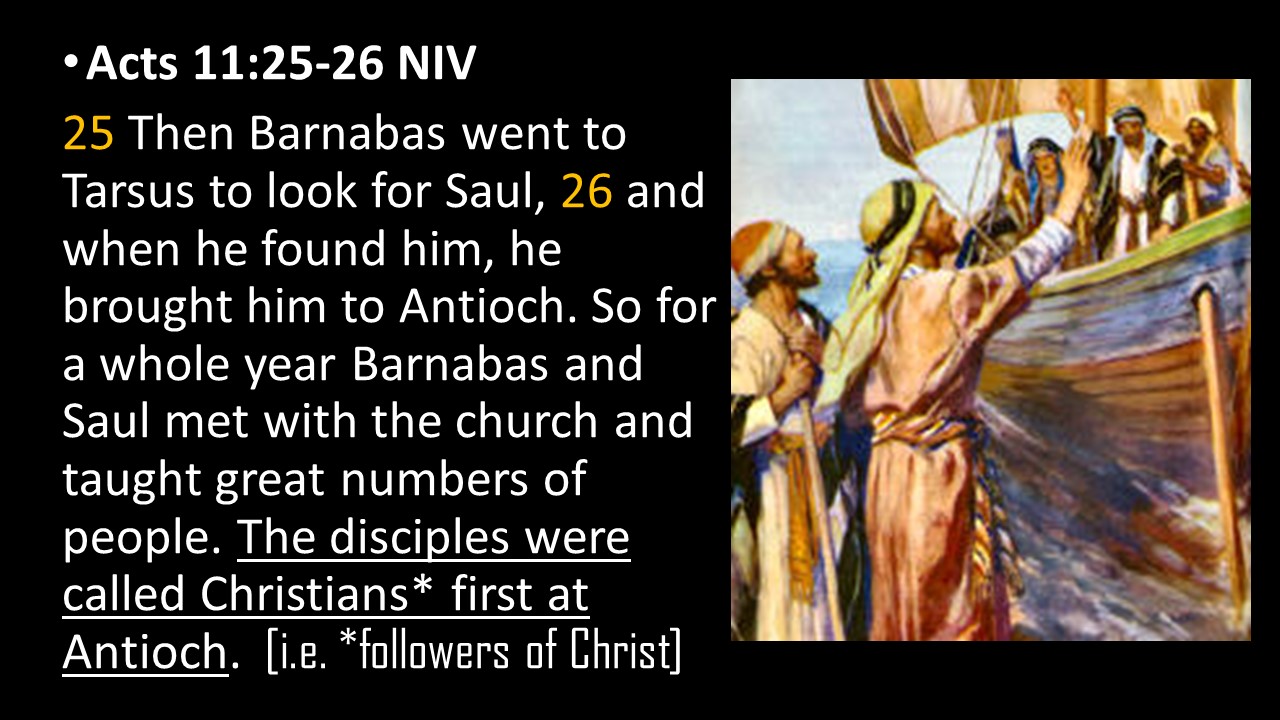
The Gospel began to spread rapidly to the Gentiles. Barnabas was a Cypriot Jew familiar with the regional people. The apostles heard that the scattered Jewish-Christians had spread the Word to Antioch, so they sent Barnabas, familiar with the region, to instruct and baptize them. We are baptized by the Holy Spirit into the Body of Christ, and then baptized with water into fellowship and membership in the visible church. Joseph was nicknamed Barnabas by the apostles (which means “Son of Encouragement”). He was from the tribe of Levi and came from the island of Cyprus. Back in Act 4:36-37, he sold a field he owned and brought the money to the apostles as to aid the Judean Jews.

Saul (later known as the apostle Paul) filled with God’s Holy Spirit, preached boldly that Jesus is the Son of God. Barnabas saw and heard Paul’s love for the Lord when Paul preached in Damascus. So, he sought Paul to accompany him to Antioch. During their stay in Antioch, and Paul's powerful preaching, large numbers came to faith in Jesus Christ. As noted in v.26, this is where the followers of “the Way” became know as Christians. 

Why did Luke even mention Agabus’ prophecy of a severe famine, when he wrote Acts? Why is because it shows God’s sovereignty in directing those events, using the famine to draw the church together as one body, as shown in the next slides.

Again, why was this famine significant enough to even be mentioned in Acts? It provided the occasion for many of the New Testament congregations to co-operate in the chartable giving of material aid to the "brethren which dwelt in Judea." (Acts 11:29.). In other words, it bonded the church across the Roman Empire both Jew and Gentile as members who were united in the Body of Christ! 

Comments noted on slide are from Matthew Henry’s Commentary. 

Chapter 11 saw the Gospel being spread outside of Judea, to other regions across the Roman world—something the Jews didn’t understand or readily accept until Gentiles received the Holy Spirit. Compass represents how far & wide the Gospel was being spread to Jews and Gentiles alike as one Church. 

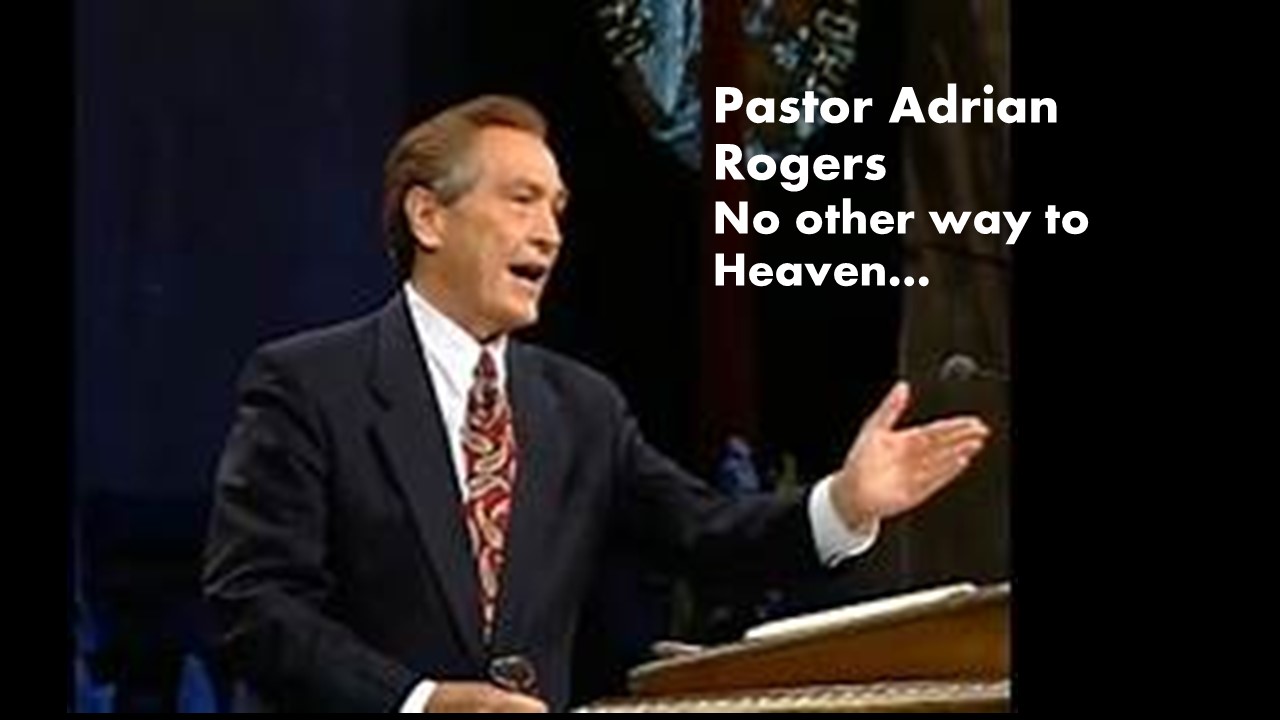
Adrian Rogers' message is the exact same message that was being shared across the Roman Empire during the time of Acts. A message that is as relevant today as it was then. What about the people who never even heard the name of Jesus, and those Paul wrote to and about in his letter to the Romans. Did they go to hell? This may be one of the most important messages you will ever hear & worth repeating. 
Rogers' 44-minute message: No Other Way to Heaven Except Through Jesus speaks volumes to the Church. 
https://youtu.be/Ka2VhgjcP8I 
(copy and paste into your web browser)


Our current Foundations study in Heritage Lounge, Sunday at 9:00 A.M. How important is doctrine? Our faith rest on Jesus Christ, but what other Jesus is also being preached in 21st century America?

Pray for our Nation, that the Holy Spirit may open the minds and hearts of our leaders in Washington DC and at the State level, and just as important, at the School Board level across this Nation. Pray for our Pastor, his family and our church that the Word of God may reach out to those following his sermons, via Livestream on Youtube. 

End of
The Acts of the Apostles
Chapter 11

Friday, June 4, 2021

Opening of chapter 10 takes us to a Roman centurial named Cornelius—commander in the Roman army—which is very significant. 

Chapter 10 takes us to the first Gentile Christians. Caesarea was the Roman capital of Palestine. Cornelius, as a Roman centurion, was someone of stature. Cornelius was singled out by God, Himself. V.4 verse tell us why. 

Being a Roman centurion, most likely Cornelius did not convert to Judaism—doing so, would risk his position. Many Jews believed Gentiles were “fodder” to fuel the fires of hell.  For Peter to meet with Cornelius was a very big deal and out of character for Peter. 

First bullet refers to troops draw from Italy outside the vicinity of Rome, and across the Italian peninsula, as shown on the next slide.  

First century Italy, being part of the Roman Empire, had very defensible borders with the alps in the north and being surrounded by the sea everywhere else. 

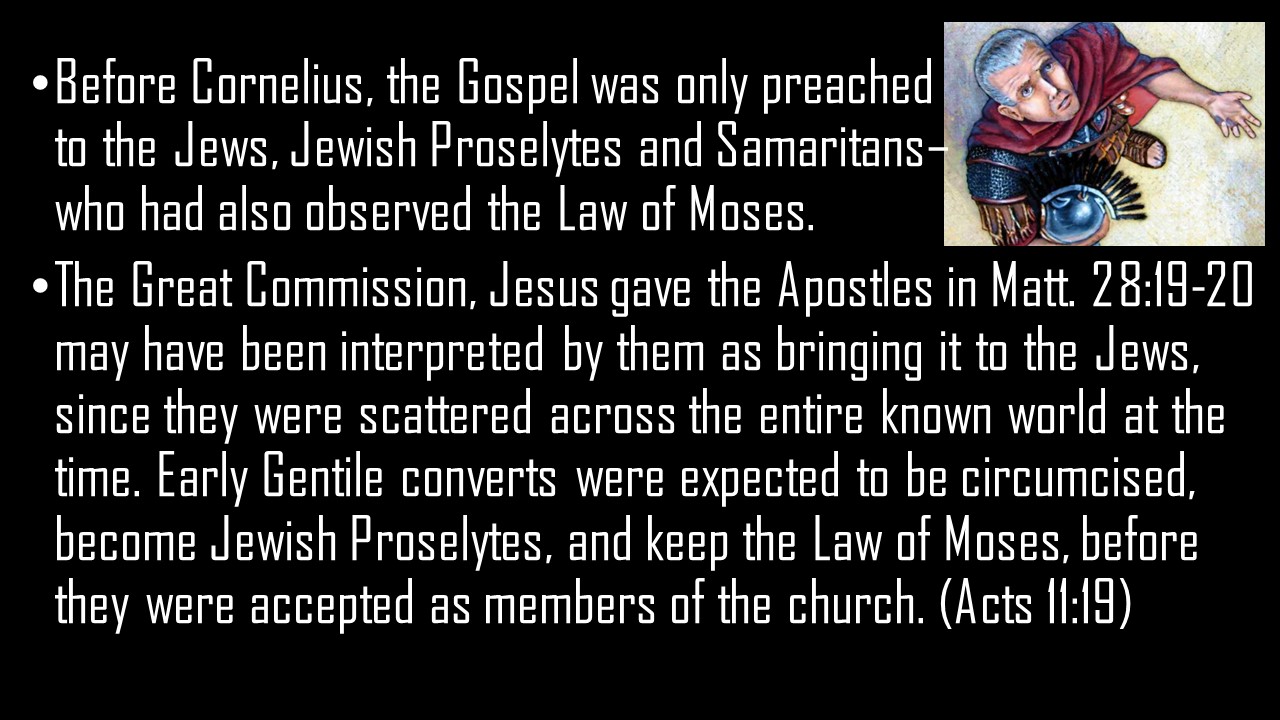
In v.7-19, Peter is prepared in a vision to bring the Gospel to the Gentiles as shown by the mix of unclean animals in the sheet. All of which, prepared him for the arrival of Cornelius’ representatives—all or at the very least most of whom were Gentiles. Up until that time, the Gospel was only preached to the Jews, and then afterward to the Samaritans.    

Joppa was a port city on the Mediterranean, which means a merchant-port of trade and wealth. A 35-mile journey between Joppa and Jerusalem. 

These verses point to Peter’s vision which is an essential lesson regarding the scope of the Gospel. BUT, let’s talk about what’s in the sheet for a moment… Were the animal illusions or real animals? It contained unclean animal by Jewish dietary laws. Scripture doesn’t tell us if it also included clean animals…next slide.

Peter responded like any devote Jew…."You want me to do what?” But the animals had a different lesson in regard to sharing the Gospel… Per the prior slide, were they real animals being taken back to heaven, OR was it an illusion for illustration purposes? If an illusion, why didn’t it just disappear. Why draw it back to heaven?

Were the animals in the sheet real or a mirage? Did all the animals created in the Garden of Eden perish? Since they did not sin, would God have just eradicated them? We are told in several places in the Bible that there will be a new heaven and new earth. Will God create an empty “new earth” unlike the original Garden of Eden, or just replicate its broad scope of creation? If animals aren’t part of the new earth, would that mean Satan won that battle by destroying a significant portion of God’s creation? Satan never wins against God. Are those animals being held elsewhere in God’s creation? It’s a very large universe. Hmmm! I can’t help but wonder about stuff like this. Just an opinion, not doctrine. 

These verses cover Cornelius’ representatives’ visit with Peter. Normally a Jew would not even think about visiting a gentile in their home or inviting them into his home—by Jewish law and custom, Gentiles were unclean! The distance between Joppa and Caesarea varies depending on where one looks. So, it’s anywhere between 24 to 30 miles. 

Photo of the house where these event are believed to have taken place. Peter’s natural inclination as a practicing Jew, would be to hesitate, yet, Peter was obedient to the “Spirit’s” command. 

A God-fearing man, Cornelius’ conversion to Christ began with an angelic vision. No Jew opened their house to Gentiles. Peter obeyed in spite of his natural inclinations to follow Jewish law.  

Arriving the following day (v.24) shows it wasn’t a short walk. Their journey both ways required provisions for the journey.  V.27—obviously the word spread regarding Peter. Most likely because of rumors of his miracles, or possible even eye-witness accounts. 

Map notes the distance between Joppa and Caesarea as 24 miles. Other references note it as 30 miles. So, the distance is somewhere between 24-30. 

 V.28 Peter is referring to the lesson given to him by God, lowering a sheet from heaven filled with a variety of unclean animals. We can be certain that the Holy Spirit revealed what the vision had signified, that Gentiles were not unclean to God in sharing the Gospel. 

Cornelius explains the angelic vision he had, directing him to send for Peter. Apparently, Cornelius, being a Roman official, was well aware of Jewish custom regarding Gentiles. 

During the vision, the angel told Cornelius that Peter’s message was from God. 

In these final verses of Chapter 10, Christianity is no longer a Jewish sect. The door has been opened to share with the entire Roman world.  Cornelius’ soldiers would most likely spread the word, even sharing their new found faith with family and friends. 

Peter explains who Jesus is, as the Son of God, and His crucifixion as a redemption paid for all our sins--both Jew and Gentile. Apparently, news of Jesus and His miracles, had spread throughout the region, during His earthly ministry.  

Peter continues to explain who Jesus is, beginning with "you know what happened..."

It was not just a story of Jesus’ resurrection, but a direct testimony by those who ate and drank with Him after His Resurrection. Why should anyone believe Peter? His own miracles were a strong testimony. 

Not only did Jesus rise from the dead but is the one whom God appointed as Judge, when all those who reject Jesus stand before Him at the Great White Throne Judgment. 

For those who didn't profess Jesus as Savior, they will stand accountable for every sin they every committed. The results will be perfect justice, not too lenient and too harsh, but absolutely perfect in every way. He had to die for our sins, to achieve perfect justice for all those who put their faith and trust in Him as Lord and Savior. 

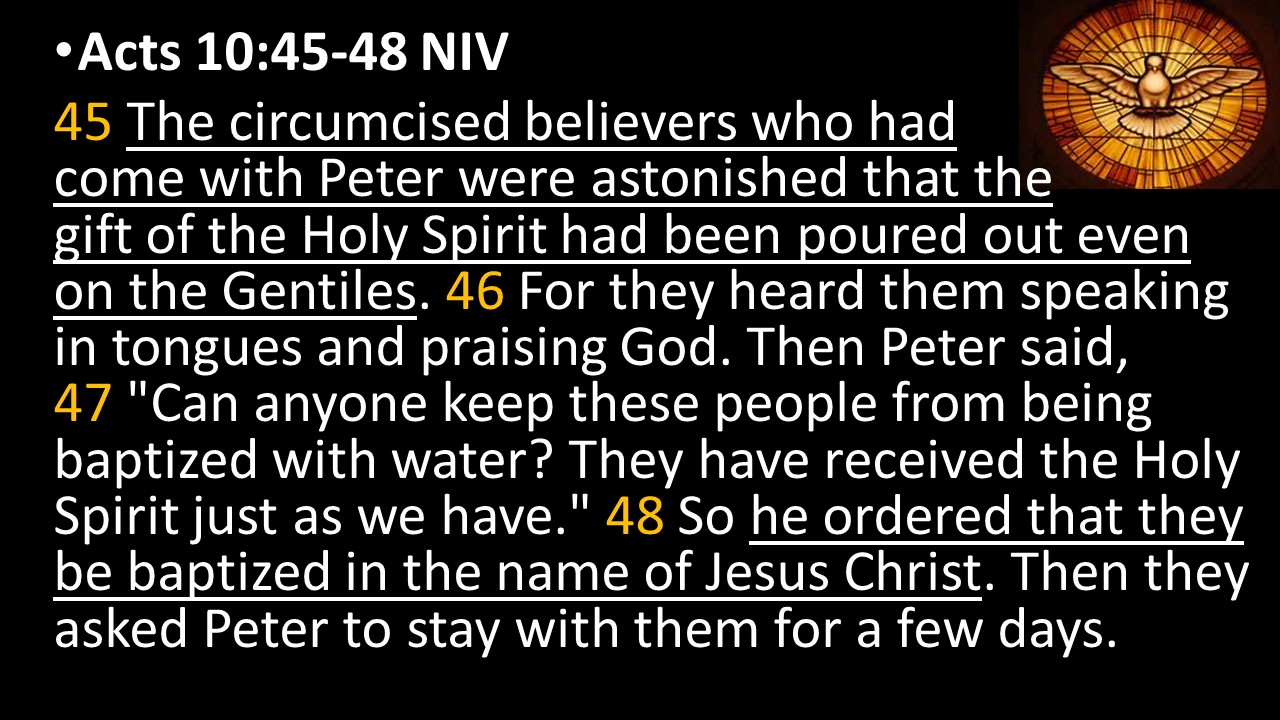
The Holy Spirit was poured out on the Gentiles. The door was opened to the entire Roman Empire. Jesus wasn’t just for the Jews! 

V.47 Baptism with water came after they received the Holy Spirit—i.e., being born again. Even the early Jewish converts viewed Christianity as a Jewish Sect. Why then would it be shared with the Gentiles?  They also had a lot to learn, just as Peter did. 

Let’s end Chapter 10 by looking at Baptism. Why were all believers baptized? Does one have to be baptized to be a Christian? Or even to be saved? In the Roman Catholic religion infants who were not baptized go a place called Limbo, which is a pleasant place but short of heaven's full glory. The Reformation rejected both Limbo and Purgatory, so do I. Perhaps a short study later on. 

Communion being the Lord's Supper. We are not saved by the sacraments. We are saved by grace alone through faith alone in Christ alone. 

I'll let this and the following slide speak for itself. 

The Apostle Paul explains the place of baptism in the Christian life. It is a sign of our new life in Christ. 

Jesus Himself issued the command to the apostles, to make disciples, baptizing them in the name of the Father, Son, and Holy Spirit—the Triune God. In doing so, they are professed members of the visible Church. It also reaffirms our faith in Jesus Christ. 

Just as circumcision welcomes Jewish infants into their Jewish heritage, baptism welcomes believes into the visible Body of Christ, the Church. 

Just as Circumcision was the old covenant, baptism is the new covenant. The circumcision of Jesus is recorded in the Gospel of Luke chapter 2, which states: And when eight days were fulfilled to circumcise the child, his name was called Jesus, the name called by the angel before he was conceived in the womb. 

The main point of Chapter 10 was the Gospel wasn’t just for the Jews. Saul (his Jewish name; Paul his Roman name) was selected and ordained by God (Chapter 9) to go to the Gentile world. 

Pastor Adrian Rogers’ 44-minute message, No other way to heaven except through Jesus Christ, by grace alone through faith alone.
https://youtu.be/Ka2VhgjcP8I
(copy and paste into your web browser, then hit enter)

Pray for America, its leaders and its people that they may turn to Jesus as Lord and Savior. Pray for our pastor, his family and our church. 

End of
The Acts of the Apostles
Chapter 10