Friday, May 14, 2021

A special posting for this week. It is worth your time. Is America a Nation in crisis? 

The early Christians found themselves facing a hostile pagan world, but over time they changed it for good. Can we as Christians do the same for America? Is America a Nation in crisis? How do we make that determination? Can we as individual Christians make a difference? We have the same Holy Spirit if we call on Him. 
(Our study of Acts began with an introduction to Act on 3/19. Click on date in the Blog Archive in upper right hand corner of page)

If you recognize that there is a problem in our society and culture, you, like many others, may be wondering how did we get here? What happened to the America I grew up in? Are we still "One Nation Under God"?

A number of significant Supreme Court decisions have changed America’s relationship with God, which we will look at. Should the Church be interested in politics? If not, others will and their decisions and those they elect to public office, will determine the course of the Nation—for better or for worse. 

Shown on the slide is a list of major Supreme Court decisions that have literally changed America’s relationship with God, perhaps forever. Can we recover? Pray for America.

America’s turning point; the nine Supreme Court justices that changed the Nation. Those justices are named on the next slide. 

A list of the justices of the Warren Supreme Court. Nine men (and the presidents that appointed them) that changed the Nation forever…. Can we recover? Pray for America.

The American Church that stands firm on the Word of God, is the Nation’s first line of defense. The battle for the soul of the Nation isn’t over just yet. 

As Pastor Scott Larson explains in his Wednesday teaching about the Great Commission, it was the Church that changed the pagan world with the Great Commission. We all can’t go on a missionary journey, but we are all in a mission field right here at home. Share Jesus with your friends and neighbors when the opportunity presents itself. Be part of the Great Commission right here at home. The Church has the Holy Spirit and power to change the world, if we call upon Him. The Holy Spirit is not an "it" or a "force". He is the third Person of the Holy Trinity: Father, Son, and Holy Spirit.
https://covp.org/connect/wednesdays-live-lessons
(copy and paste the web address into your web browser, scroll down to the lesson when there)

Pastor Adrian Rogers doesn’t just tell us what’s wrong and how we got here, but what we, as Christians, can and should do. His sermon is just as relevant today as when he made it, maybe more so. 

Pastor Adrian Rogers 35-minute sermon on how we got here: A Nation in Crisis! 
https://youtu.be/E-JP_KFS4qc
(highlight and copy the above web address, and paste into your web browser and hit enter)

My current weekly focus, in our Sunday Foundations classes, is to see today’s world and events from a biblical perspective. Anyone watching Newsmax or One America News (OAN) or Fox will readily recognize that America is a nation in crisis. I believe one basic reason, as explained by Adrian Rogers, is that America has lost its spiritual compass and its GPS. Join us on Sunday to explore this further.

The End

Friday, May 7, 2021

Chapter 7 is the first Christian martyr. Would you die for your faith? How many Christians ever have to face that decision during the course of their life? Many have, even in today’s world, and died for their faith. We are blessed in America that we don’t have to face that decision. But we can live for our faith!  

(Note: our study of Acts began on 3/21. You can access it by clicking on that date on the Blog Archive in the upper right hand corner of the page)

Even if you studied Acts before, why study Acts again? Each section of the Bible provides a different aspect of God’s Word as noted by Pastor Alistair Begg. It's always worth your time. If you studied Acts before and you believe there’s nothing else to learn, you didn’t study it sufficiently…because there is always more to learn.

Much of what happens in Chapter 7 takes place at the temple mount. The image notes the Western Wall, a.k.a. Wailing Wall, which is a place of prayer today for Jews from around the world. “Royal Stoa” situated along the southern wall, is a covered walkway where people gathered. Much of the apostles preaching took place there.

You may want to read the first fifty verses on your own—v.1 is noted on the slide. The overview on the next few slides will give you insight into the first 50 verses, which cover Israel's history, without far too many additional slides being added. It picks up where chap. 6 left off, with Stephen before the Sanhedrin Council.

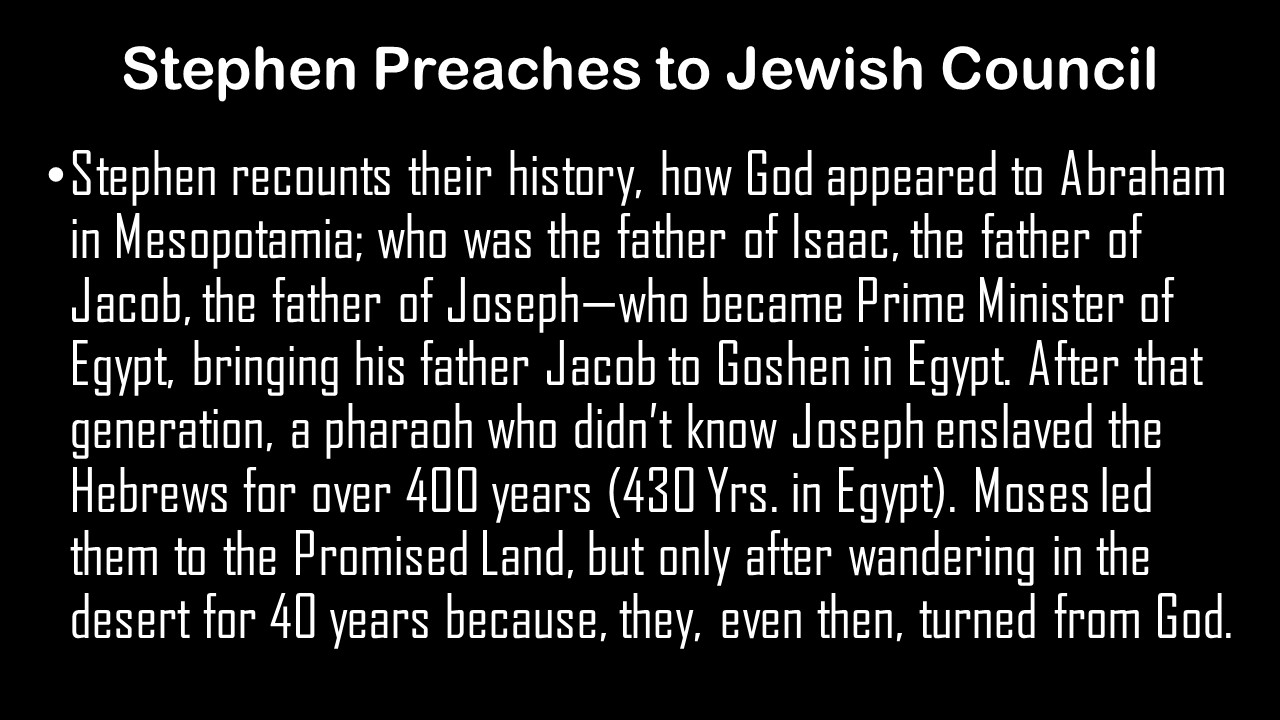
Stephen, begins with Abraham; their 400 years of captivity in Egypt, and that God sent Moses to lead them out of bondage. And yet, they remained a stiff-necked people that turned from God. Without faith in God that generation wandered in the desert for 40 years, and Joshua led a new generation into the promised. 

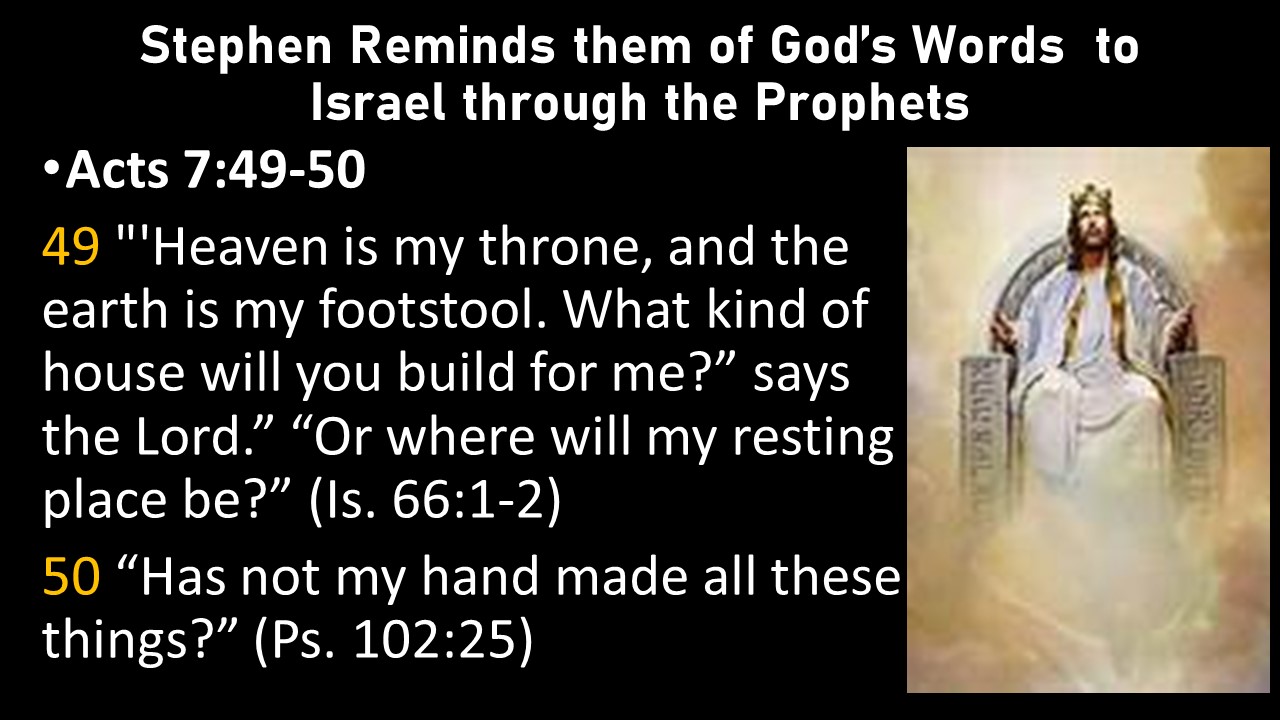
This slide highlights the first 50 verses. Of course, God’s true Tabernacle (v.44-50) is Jesus Christ, which the Sanhedrin rejected, heaping guilt on themselves and the Jewish people.  They too will stand on trial before the Jesus they rejected.
Rev 20:11 Then I saw a great white throne and him who was seated on it.... 12 And I saw the dead, great and small, standing before the throne, and books were opened. Another book was opened, which is the book of life. The dead were judged according to what they had done as recorded in the books. 13....each person was judged according to what he had done. 

The Sanhedrin rejected God’s true Tabernacle, Jesus Christ, and retained the stone temple, which Rome destroyed in 70 AD. Not only was the Jerusalem temple destroyed, but the Jewish people, including the Sanhedrin, were scattered, with many being sold into slavery. 

We can be certain the Sanhedrin Council were very much aware of their history, and it hit a sensitive cord with them. Do you want to see outrage—tell a group of high-ranking officials that they’re wrong, that the very premise of what their organization was founded on, they themselves violated—be it religion or politics. 

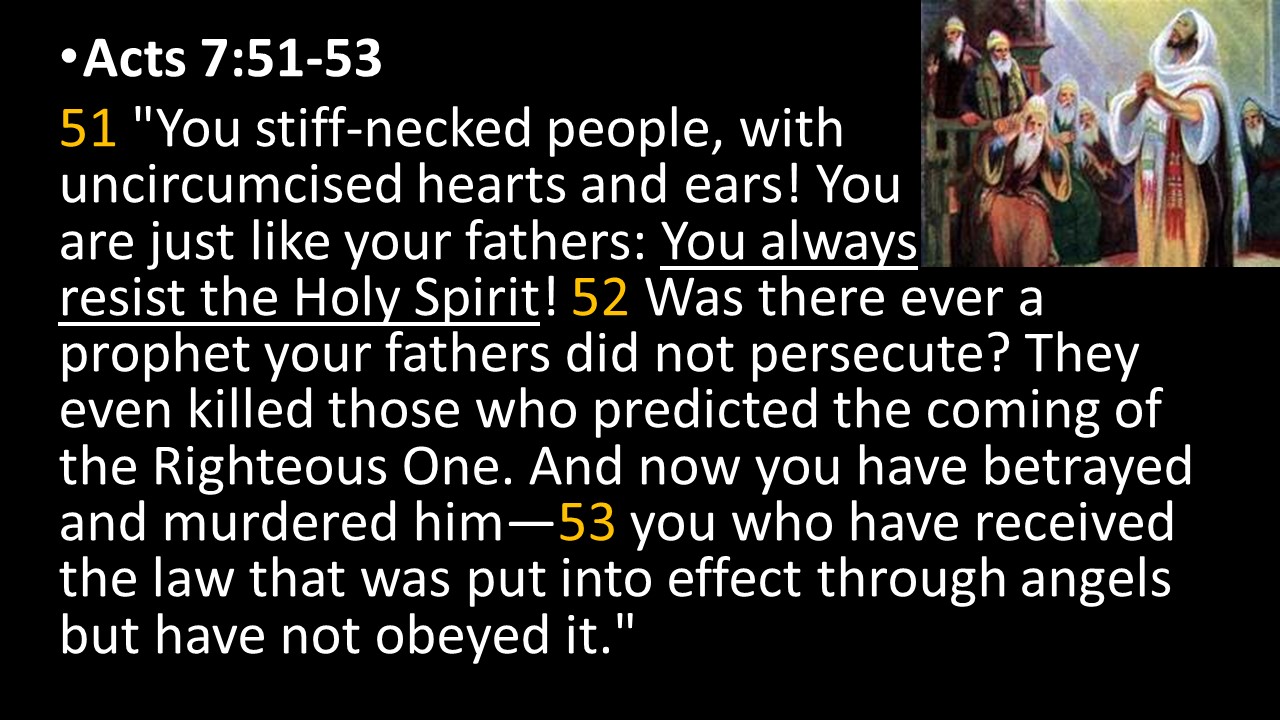
Stephen calls them out for “resisting the Holy Spirit”. In the hardness of their hearts, they covered their ears at everything he said. Their very actions blasphemed against the Spirit of God, which as stated by Jesus in Mark 3:29 is an unpardonable sin. 
Mark 3:29 "But whoever blasphemes against the Holy Spirit will never be forgiven; he is guilty of an eternal sin."   

Stephen’s accusations angered them (v.54). In denying Stephen’s words about Jesus, they were resisting the Holy Spirit (v.51). Rather than repent—or even pondering it—they lashed out at Stephen. Satan was active on planet earth from the very beginning, in the Garden of Eden, at the crucifixion of Christ, and at that very moment in stirring up sinful man against the things of God. Their verdict was based on lies. Satan was a liar from the beginning and the father of lies. (John 8:44)

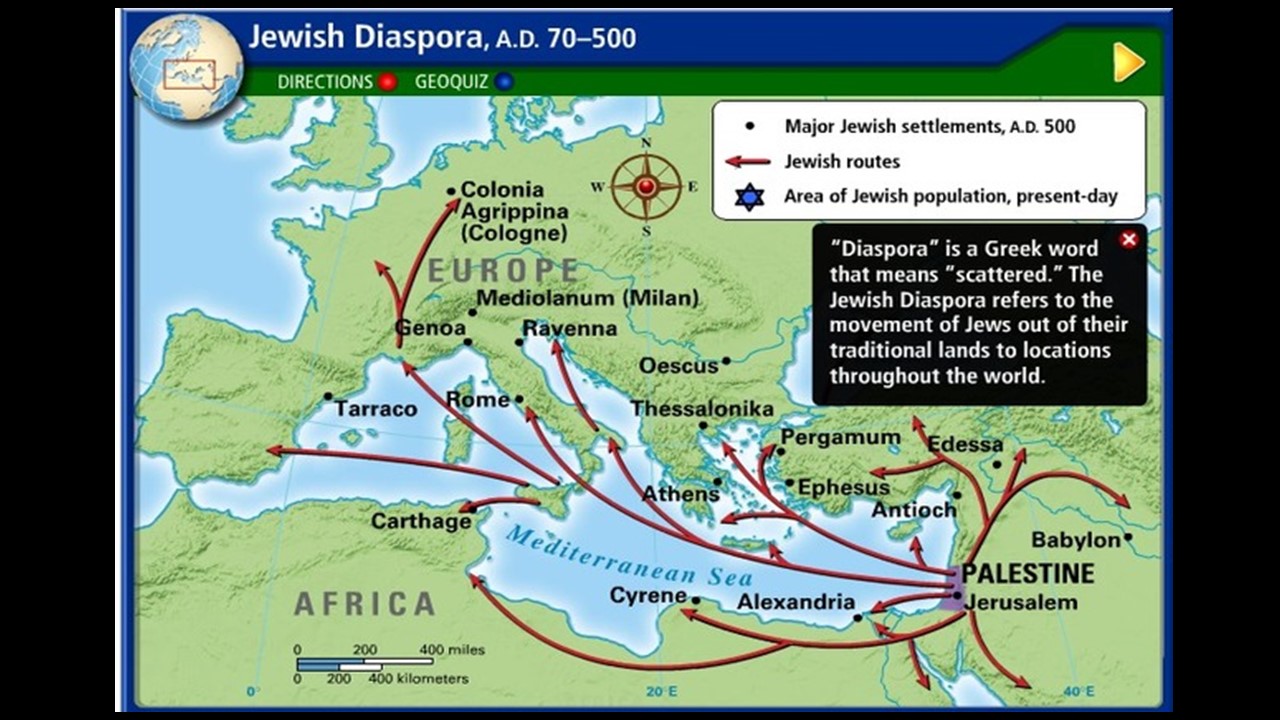
There were both temporal and eternal consequences in resisting the Holy Spirit. We see such a warning in Zechariah 7:11-14 (this and next slide). Every word came true about 40 years later when Rome destroyed Jerusalem, and the Jews were scattered across the Roman world, and into slavery. 

In A.D. 135 the remaining remnant of Judea was destroyed, and those Jews were also scattered across the Roman world and beyond. 

Their scattering as a people, wasn’t just a one-time occurrence, as noted on the map. Did God know they would reject Jesus as Messiah? Of course. Even though God knows our sins, past, present and future, there are still consequences for sin. The Jews were even scattered centuries later at many other places, such as Czarist Russia and Nazi Germany. 

We can assume that the Council heard, or heard of, Peter’s preaching and of his miracle cures (prior chapters), and yet, in a similar manner, Stephen was rejected by that same religious Council, whose hearts were hateful at anything that threatened their authority, power and prestige. How could they possibly justify themselves if they acknowledged Jesus as the Messiah? 

Consequently, their anger overflowed into pure rage, in their hearts they knew the truth but out of pride, they rejected it. In v.60 Stephen asked the Lord not to hold their sin against them. He fell asleep, meaning he died. We know of one whose sin was not held against him—Saul of Tarsus, a participant (Acts 8:1), who not only accepted Christ as Messiah and Savior, but dedicated his life to telling others. 

Our life and time has been predetermined by God, even before the foundation of the world was laid. He has been merciful to us to be born in the U.S.A. in the 20th century. There are Christians still being stoned to death in certain Islamic countries. Hold them up in your prayers. 

Christians, like Stephen, are still facing persecution for their faith, even death across the world. Nevertheless, the rewards God has planned, far outweigh the cost of standing firm in the faith that Jesus is the Messiah, not just for the Jews but also for the Gentiles. 

Has the modern church lost its interest in praying in the Spirit? We can pray in the Spirit, asking the Holy Spirit to intercede on our behalf as a church and as a people—as the Body of Christ.

Why did they stone Stephen? Because he told the truth that contradicted their lies. 
Pastor Adrian Rogers 37-minute sermon: Four Lies That Ruined the World
https://youtu.be/-O3rQ9LdCe4
(copy and paste into your web browser)

Our study of Acts began on March 21, 2021. Click on the 
Blog Archive in the upper right hand corner on that date (03/21-03/28).

Hope to see you there. 


Friday, April 30, 2021

In chapter 6 the church was growing, and so was its charity to the needy, which—human nature being what it is—doesn’t go as well as expected. The question that needs to be asked often, what is the primary role of the Church?  What happens when the church fails or just loses it biblical focus? 

The Grecian Jews were from outside Judea, and Greek was their vernacular—i.e., everyday language, just like German Jews before WWII spoke German as their vernacular, and American Jews speak English. They were not totally embraced by the Hebraic Jews—those native to Jerusalem and Judea. 

The twelve included Matthias (Acts 1:26), since Paul still wasn’t an apostle. Waiting on tables is a worthwhile ministry for the Church, but the primary purpose of the apostles and the Church is prayer and ministry of the Word. If it fails in doing so, it fails as the Church. Certain mainline denominations have embraced today's cultural norms even when contrary to the Word of God. 

Nicolas, from Antioch in Syria (v.5), was just one of a number of converts from other regions of the Roman Empire. He was selected to serve as one of the first seven deacons. As God’s Word spread, the number of disciples in Jerusalem multiplied, which posed a threat to the Sanhedrin’s authority, especially with a large number of temple priests converting (v.7). The Sanhedrin couldn’t accuse or prosecute all of the priests without raising suspicion with the people, who may in turn question the judgment of the Sanhedrin themselves. Then and now, those in power will do anything to retain power. We have even seen it within our own federal government. 

Map shows the location of Antioch in Syria (red arrow) where Nicolas was from. Syria was annexed to Rome by Pompey in 64 B.C. Antioch was the capital of the Roman province of Syria. All of Asia Minor, modern day Turkey, and the Middle East were then situated in the eastern region of the Roman Empire, where Greek was the principal spoken language because of Alexander the Great who conquered the region in 334-333 B.C. The New Testament was written in Greek, a language most of the people within that region, and even Rome itself, understood. Just as today, English is understood across most of the western world. Do you see God’s sovereignty in all of this? How He preordained a common language to spread the Church and share the written Word. 

Those first century Christians shared the Gospel with family and friends, and three centuries later, the entire Roman Empire was officially proclaimed as Christian. But there's a downside, both as a church and as a nation—addressed in Adrian Rogers’ message at the end of this lesson—definitely worth your time. 

Those from Cilicia were Jews or proselytes (Gentile converts to Judaism) who may have been former Roman slaves that were set free—as implied in their synagogue title. Or from a place called "Libertina“ (Latin for freedom), a town of the Roman province of Byzacena in North Africa, not far from ancient Carthage; all of whom were members of the “Synagogue of the Freedmen”. 

Members of this synagogue were devout Jews, adhering to Jewish law and tradition. They opposed Stephen professing Jesus as Messiah and Savior, which they considered heretical. All religious organizations, right or wrong, will always defend their teachings. 
 
The same could be said of the 16th century Christian Church (Roman Catholic Church) when Martin Luther proclaimed, from the Book of Romans, that we are saved by grace alone through faith alone in Christ alone, and nothing could be added to it for salvation. The Church leaders, at that time, were selling indulgences to set people free from Purgatory, which Luther proclaimed as contrary to the Word of God, which led to his trial and excommunication, which then led to the Protestant Reformation. 
Rom 3:22 This righteousness from God comes through faith in Jesus Christ to all who believe. There is no difference, 23 for all have sinned and fall short of the glory of God, 24 and are justified freely by his grace through the redemption that came by Christ Jesus. 
 
As the Church grew, its influence spread far and wide. Over time there were four major theological centers, Jerusalem, Alexandria, Antioch and Rome, each with a bishop residing over it. Christianity became the official religion of the Roman Empire in 381 AD. Perhaps a future study in Heritage lounge or the blog, depending on feedback. 

Constantine the Great, was Rome’s first Christian emperor from 306 to 337 AD. He legalized Christianity. But Theodosius decreed it as the official religion of the Roman Empire in 380 AD. Was it good? No! Remember Ananias and Sapphira in chapter 5? Why did their sin cause the Holy Spirit to strike them dead? Lying to the Holy Spirit would have opened to door for Satan’s lies and deceit to enter the infant Church. By legalizing Christianity, it decreed everyone as a Christian—opening that same door, since not all were born-again Christians—therefore, not Christian at all. 

The Emperor’s intentions were good, but there was a cost. When the emperor declared Christianity as the official religion of Rome, many officials and even pagan priests jockeyed for position and power under the guise of being Christian. Pagan temples and priests were then incorporated into the Christian Church. When the Church embraces the culture, it ceases to be the Church. 

Pictures show the library of ancient Alexandria, Egypt, which was the principal city of the Hellenistic Greek-speaking Jews—who used the Septuagint, O.T. Bible. The Septuagint (also known as the LXX) is a translation of the Hebrew Bible into Koine Greek. The name Septuagint comes from the Latin word for “seventy.” The tradition is that 70 (or 72) Jewish scholars were the translators behind the Septuagint, which was translated in the third and second centuries BC in Alexandria. Latin was the official language of Rome, but Greek was the common language within the Roman Empire, the Septuagint was popular among Jews living under Roman rule. Many of the early Christians didn’t know Hebrew, and embraced this popular Greek translation. Septuagint was used by the Christian church as its Old Testament for over 1,500 years (future study?).

When you want to accuse someone of something, lying becomes an effective means of doing so. They even produced liars to condemn Stephen (v.13).  Even in today’s culture, the principal weapon to accuse someone of something, are lies. The key accusation today is labeling someone a racist. In v.11, their hatred of Christ was set in concrete. Nothing could persuade them otherwise. Their hearts were hardened, encased in pride and hatred.

The lies continued. Even Stephen’s radiant face, being compared to that of an angel did not dissuade them or mitigate their hatred. 

There will be a day of judgment for those members of the Sanhedrin and the liars that testified against Stephen. 

Stephen and the early church were powerful in prayer and deed. The Holy Spirit gave power to their prayers, spreading Christianity to far and wide. Are our prayers, today, just as powerful? Can they be?

When the church embraces the culture, it is no longer the church, and as such, its prayers lose their relevance. 


The role of the Church isn’t to condone and embrace sin, but to share the Gospel of saving grace with a fallen world. God’s Words and biblical morality do not change. Pastor Adrian Rogers’ sermon: “Wake Up” at the end of this lesson addresses when the church loses its standing with God and embraces the culture. 
Heb 9:27 Just as man is destined to die once, and after that to face judgment.

Sinners’ hearts remains hardened even when the evidence says otherwise, unless the Holy Spirit changes their heart. 

Pastor Adrian Rogers’ 32-minute message to the church and those in the pews: “Wake Up”. 
https://youtu.be/k-SWj3-JoK4 
(copy and paste into your web browser)

Pray for our Nation, its elected officials that they may be awakened by the Holy Spirit to do what’s right for the Nation, its people, and it’s roll in the world. Pray for our Pastor, his family, and our church. 

Hope to see you there. 


End of
The Acts of the Apostles
Chapter 5