Friday, May 7, 2021

Chapter 7 is the first Christian martyr. Would you die for your faith? How many Christians ever have to face that decision during the course of their life? Many have, even in today’s world, and died for their faith. We are blessed in America that we don’t have to face that decision. But we can live for our faith!  

(Note: our study of Acts began on 3/21. You can access it by clicking on that date on the Blog Archive in the upper right hand corner of the page)

Even if you studied Acts before, why study Acts again? Each section of the Bible provides a different aspect of God’s Word as noted by Pastor Alistair Begg. It's always worth your time. If you studied Acts before and you believe there’s nothing else to learn, you didn’t study it sufficiently…because there is always more to learn.

Much of what happens in Chapter 7 takes place at the temple mount. The image notes the Western Wall, a.k.a. Wailing Wall, which is a place of prayer today for Jews from around the world. “Royal Stoa” situated along the southern wall, is a covered walkway where people gathered. Much of the apostles preaching took place there.

You may want to read the first fifty verses on your own—v.1 is noted on the slide. The overview on the next few slides will give you insight into the first 50 verses, which cover Israel's history, without far too many additional slides being added. It picks up where chap. 6 left off, with Stephen before the Sanhedrin Council.
Stephen, begins with Abraham; their 400 years of captivity in Egypt, and that God sent Moses to lead them out of bondage. And yet, they remained a stiff-necked people that turned from God. Without faith in God that generation wandered in the desert for 40 years, and Joshua led a new generation into the promised. 

This slide highlights the first 50 verses. Of course, God’s true Tabernacle (v.44-50) is Jesus Christ, which the Sanhedrin rejected, heaping guilt on themselves and the Jewish people.  They too will stand on trial before the Jesus they rejected.
Rev 20:11 Then I saw a great white throne and him who was seated on it.... 12 And I saw the dead, great and small, standing before the throne, and books were opened. Another book was opened, which is the book of life. The dead were judged according to what they had done as recorded in the books. 13....each person was judged according to what he had done. 
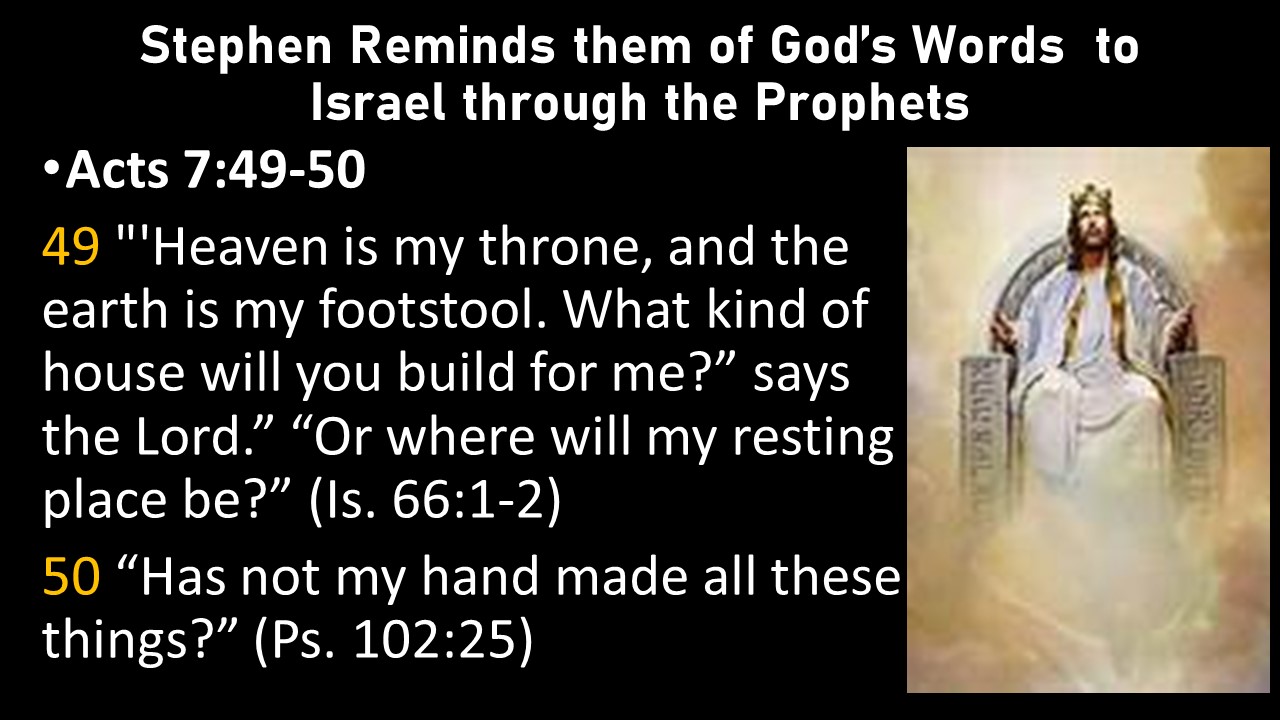
The Sanhedrin rejected God’s true Tabernacle, Jesus Christ, and retained the stone temple, which Rome destroyed in 70 AD. Not only was the Jerusalem temple destroyed, but the Jewish people, including the Sanhedrin, were scattered, with many being sold into slavery. 

We can be certain the Sanhedrin Council were very much aware of their history, and it hit a sensitive cord with them. Do you want to see outrage—tell a group of high-ranking officials that they’re wrong, that the very premise of what their organization was founded on, they themselves violated—be it religion or politics. 
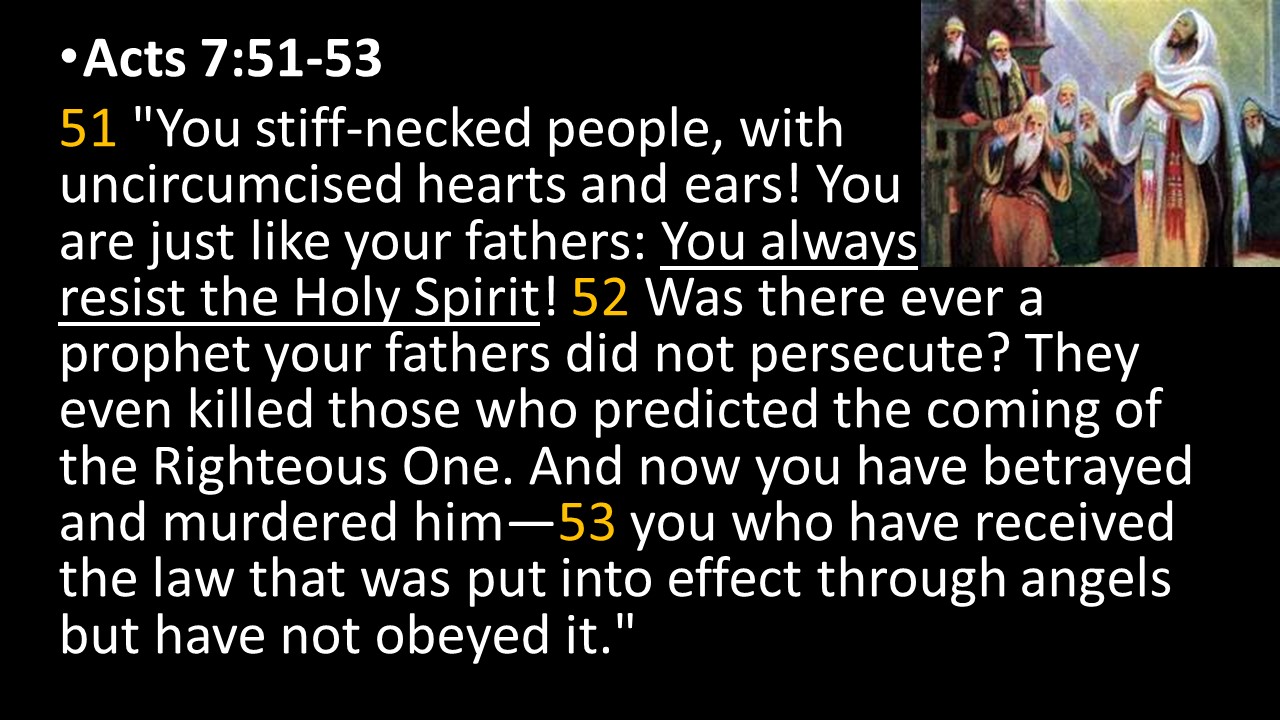
Stephen calls them out for “resisting the Holy Spirit”. In the hardness of their hearts, they covered their ears at everything he said. Their very actions blasphemed against the Spirit of God, which as stated by Jesus in Mark 3:29 is an unpardonable sin. 
Mark 3:29 "But whoever blasphemes against the Holy Spirit will never be forgiven; he is guilty of an eternal sin."   

Stephen’s accusations angered them (v.54). In denying Stephen’s words about Jesus, they were resisting the Holy Spirit (v.51). Rather than repent—or even pondering it—they lashed out at Stephen. Satan was active on planet earth from the very beginning, in the Garden of Eden, at the crucifixion of Christ, and at that very moment in stirring up sinful man against the things of God. Their verdict was based on lies. Satan was a liar from the beginning and the father of lies. (John 8:44)

There were both temporal and eternal consequences in resisting the Holy Spirit. We see such a warning in Zechariah 7:11-14 (this and next slide). Every word came true about 40 years later when Rome destroyed Jerusalem, and the Jews were scattered across the Roman world, and into slavery. 

In A.D. 135 the remaining remnant of Judea was destroyed, and those Jews were also scattered across the Roman world and beyond. 

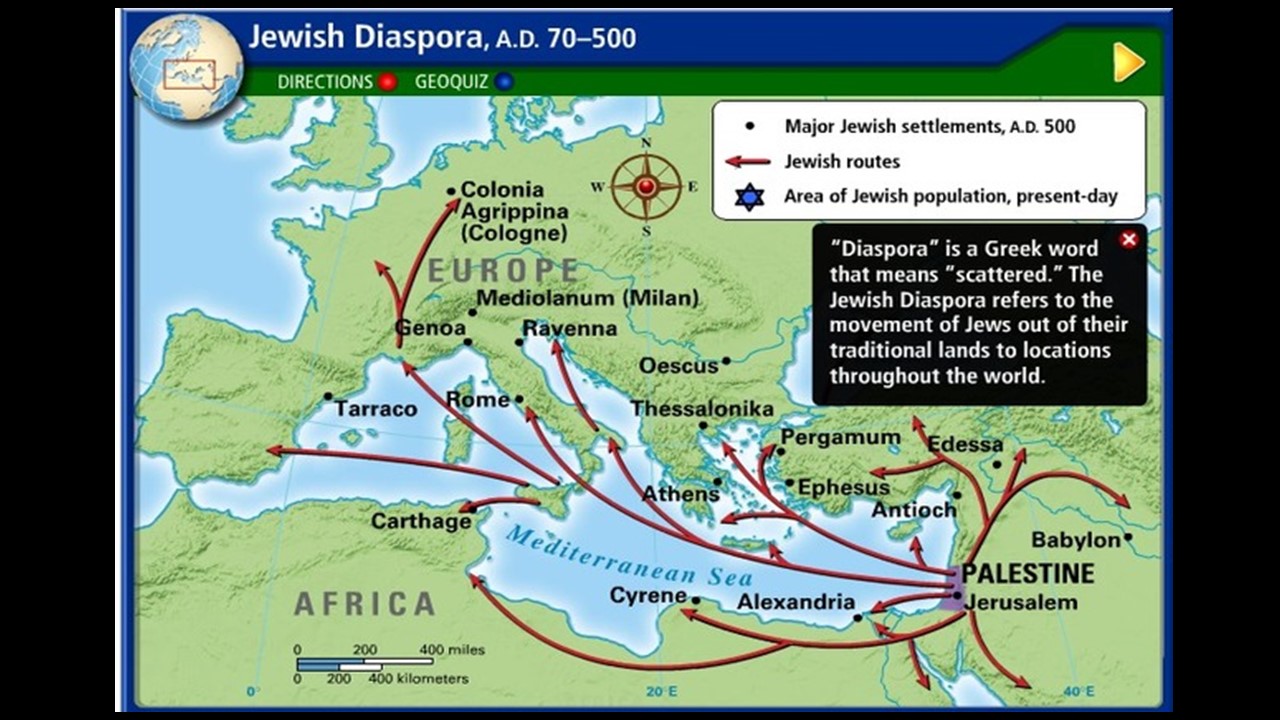
Their scattering as a people, wasn’t just a one-time occurrence, as noted on the map. Did God know they would reject Jesus as Messiah? Of course. Even though God knows our sins, past, present and future, there are still consequences for sin. The Jews were even scattered centuries later at many other places, such as Czarist Russia and Nazi Germany. 

We can assume that the Council heard, or heard of, Peter’s preaching and of his miracle cures (prior chapters), and yet, in a similar manner, Stephen was rejected by that same religious Council, whose hearts were hateful at anything that threatened their authority, power and prestige. How could they possibly justify themselves if they acknowledged Jesus as the Messiah? 

Consequently, their anger overflowed into pure rage, in their hearts they knew the truth but out of pride, they rejected it. In v.60 Stephen asked the Lord not to hold their sin against them. He fell asleep, meaning he died. We know of one whose sin was not held against him—Saul of Tarsus, a participant (Acts 8:1), who not only accepted Christ as Messiah and Savior, but dedicated his life to telling others. 

Our life and time has been predetermined by God, even before the foundation of the world was laid. He has been merciful to us to be born in the U.S.A. in the 20th century. There are Christians still being stoned to death in certain Islamic countries. Hold them up in your prayers. 

Christians, like Stephen, are still facing persecution for their faith, even death across the world. Nevertheless, the rewards God has planned, far outweigh the cost of standing firm in the faith that Jesus is the Messiah, not just for the Jews but also for the Gentiles. 

Has the modern church lost its interest in praying in the Spirit? We can pray in the Spirit, asking the Holy Spirit to intercede on our behalf as a church and as a people—as the Body of Christ.

Why did they stone Stephen? Because he told the truth that contradicted their lies. 
Pastor Adrian Rogers 37-minute sermon: Four Lies That Ruined the World
https://youtu.be/-O3rQ9LdCe4
(copy and paste into your web browser)

Our study of Acts began on March 21, 2021. Click on the 
Blog Archive in the upper right hand corner on that date (03/21-03/28).

Hope to see you there. 


Friday, April 30, 2021

In chapter 6 the church was growing, and so was its charity to the needy, which—human nature being what it is—doesn’t go as well as expected. The question that needs to be asked often, what is the primary role of the Church?  What happens when the church fails or just loses it biblical focus? 

The Grecian Jews were from outside Judea, and Greek was their vernacular—i.e., everyday language, just like German Jews before WWII spoke German as their vernacular, and American Jews speak English. They were not totally embraced by the Hebraic Jews—those native to Jerusalem and Judea. 

The twelve included Matthias (Acts 1:26), since Paul still wasn’t an apostle. Waiting on tables is a worthwhile ministry for the Church, but the primary purpose of the apostles and the Church is prayer and ministry of the Word. If it fails in doing so, it fails as the Church. Certain mainline denominations have embraced today's cultural norms even when contrary to the Word of God. 

Nicolas, from Antioch in Syria (v.5), was just one of a number of converts from other regions of the Roman Empire. He was selected to serve as one of the first seven deacons. As God’s Word spread, the number of disciples in Jerusalem multiplied, which posed a threat to the Sanhedrin’s authority, especially with a large number of temple priests converting (v.7). The Sanhedrin couldn’t accuse or prosecute all of the priests without raising suspicion with the people, who may in turn question the judgment of the Sanhedrin themselves. Then and now, those in power will do anything to retain power. We have even seen it within our own federal government. 

Map shows the location of Antioch in Syria (red arrow) where Nicolas was from. Syria was annexed to Rome by Pompey in 64 B.C. Antioch was the capital of the Roman province of Syria. All of Asia Minor, modern day Turkey, and the Middle East were then situated in the eastern region of the Roman Empire, where Greek was the principal spoken language because of Alexander the Great who conquered the region in 334-333 B.C. The New Testament was written in Greek, a language most of the people within that region, and even Rome itself, understood. Just as today, English is understood across most of the western world. Do you see God’s sovereignty in all of this? How He preordained a common language to spread the Church and share the written Word. 

Those first century Christians shared the Gospel with family and friends, and three centuries later, the entire Roman Empire was officially proclaimed as Christian. But there's a downside, both as a church and as a nation—addressed in Adrian Rogers’ message at the end of this lesson—definitely worth your time. 

Those from Cilicia were Jews or proselytes (Gentile converts to Judaism) who may have been former Roman slaves that were set free—as implied in their synagogue title. Or from a place called "Libertina“ (Latin for freedom), a town of the Roman province of Byzacena in North Africa, not far from ancient Carthage; all of whom were members of the “Synagogue of the Freedmen”. 

Members of this synagogue were devout Jews, adhering to Jewish law and tradition. They opposed Stephen professing Jesus as Messiah and Savior, which they considered heretical. All religious organizations, right or wrong, will always defend their teachings. 
 
The same could be said of the 16th century Christian Church (Roman Catholic Church) when Martin Luther proclaimed, from the Book of Romans, that we are saved by grace alone through faith alone in Christ alone, and nothing could be added to it for salvation. The Church leaders, at that time, were selling indulgences to set people free from Purgatory, which Luther proclaimed as contrary to the Word of God, which led to his trial and excommunication, which then led to the Protestant Reformation. 
Rom 3:22 This righteousness from God comes through faith in Jesus Christ to all who believe. There is no difference, 23 for all have sinned and fall short of the glory of God, 24 and are justified freely by his grace through the redemption that came by Christ Jesus. 
 
As the Church grew, its influence spread far and wide. Over time there were four major theological centers, Jerusalem, Alexandria, Antioch and Rome, each with a bishop residing over it. Christianity became the official religion of the Roman Empire in 381 AD. Perhaps a future study in Heritage lounge or the blog, depending on feedback. 

Constantine the Great, was Rome’s first Christian emperor from 306 to 337 AD. He legalized Christianity. But Theodosius decreed it as the official religion of the Roman Empire in 380 AD. Was it good? No! Remember Ananias and Sapphira in chapter 5? Why did their sin cause the Holy Spirit to strike them dead? Lying to the Holy Spirit would have opened to door for Satan’s lies and deceit to enter the infant Church. By legalizing Christianity, it decreed everyone as a Christian—opening that same door, since not all were born-again Christians—therefore, not Christian at all. 

The Emperor’s intentions were good, but there was a cost. When the emperor declared Christianity as the official religion of Rome, many officials and even pagan priests jockeyed for position and power under the guise of being Christian. Pagan temples and priests were then incorporated into the Christian Church. When the Church embraces the culture, it ceases to be the Church. 

Pictures show the library of ancient Alexandria, Egypt, which was the principal city of the Hellenistic Greek-speaking Jews—who used the Septuagint, O.T. Bible. The Septuagint (also known as the LXX) is a translation of the Hebrew Bible into Koine Greek. The name Septuagint comes from the Latin word for “seventy.” The tradition is that 70 (or 72) Jewish scholars were the translators behind the Septuagint, which was translated in the third and second centuries BC in Alexandria. Latin was the official language of Rome, but Greek was the common language within the Roman Empire, the Septuagint was popular among Jews living under Roman rule. Many of the early Christians didn’t know Hebrew, and embraced this popular Greek translation. Septuagint was used by the Christian church as its Old Testament for over 1,500 years (future study?).

When you want to accuse someone of something, lying becomes an effective means of doing so. They even produced liars to condemn Stephen (v.13).  Even in today’s culture, the principal weapon to accuse someone of something, are lies. The key accusation today is labeling someone a racist. In v.11, their hatred of Christ was set in concrete. Nothing could persuade them otherwise. Their hearts were hardened, encased in pride and hatred.

The lies continued. Even Stephen’s radiant face, being compared to that of an angel did not dissuade them or mitigate their hatred. 

There will be a day of judgment for those members of the Sanhedrin and the liars that testified against Stephen. 

Stephen and the early church were powerful in prayer and deed. The Holy Spirit gave power to their prayers, spreading Christianity to far and wide. Are our prayers, today, just as powerful? Can they be?

When the church embraces the culture, it is no longer the church, and as such, its prayers lose their relevance. 


The role of the Church isn’t to condone and embrace sin, but to share the Gospel of saving grace with a fallen world. God’s Words and biblical morality do not change. Pastor Adrian Rogers’ sermon: “Wake Up” at the end of this lesson addresses when the church loses its standing with God and embraces the culture. 
Heb 9:27 Just as man is destined to die once, and after that to face judgment.

Sinners’ hearts remains hardened even when the evidence says otherwise, unless the Holy Spirit changes their heart. 

Pastor Adrian Rogers’ 32-minute message to the church and those in the pews: “Wake Up”. 
https://youtu.be/k-SWj3-JoK4 
(copy and paste into your web browser)

Pray for our Nation, its elected officials that they may be awakened by the Holy Spirit to do what’s right for the Nation, its people, and it’s roll in the world. Pray for our Pastor, his family, and our church. 

Hope to see you there. 


End of
The Acts of the Apostles
Chapter 5

Friday, April 23, 2021

What happens when someone who isn’t born-again joins the Church and then lies to the Holy Spirit? As we saw in chapter 4, early Christians were overwhelmed with joy, demonstrated by an outpouring of charity for each others’ needs. 

Ananias and Sapphira was trying to emulate Joseph the Levite (Acts 4:36-37) to be praised for their comparative generosity. In doing so, they weren’t just lying to Peter and the church, they were lying to the Holy Spirit (v.3). The property was theirs' to do with as they pleased. They could have given 10% to the church and that would have been okay. Most likely they expected praise as being great, generous people, by lying that they gave the full amount to the church. By proclaiming they gave it all and then holding it back, in reality, they were stealing from God. Their sin was covetousness and religious hypocrisy that the Lord readily purged from the church. The early church had to have a core of true believers, and biblical values; not liars and hypocrites.

I remember visiting a major cathedral where all the pews had plaques with the names of each of the donors. Did they donate to honor God or for personal recognition and honor for their generosity? Each pew must have been expensive. I'm sure that were some of each, but God is always the judge. 

The Holy Spirit struck Ananias dead. V.8, three hours later, Sapphira not knowing what happened to Ananias, also lied to Peter. Was her sin so grave to warrant death (v.10)? These verses show how God was preventing lying and deception—Satan’s tools for destruction—from entering the infant church. 

Sapphira didn’t realize the consequences for their lie. Was such a severe punishment warranted? Satan was attempting to enter the church through Ananias and Sapphira, with deceit and lies. As stated in v.11, the event created fear throughout the church. We can be certain that the message was clear for those who were not born-again, who had entered the Church to capitalize on the Apostles charity, even professing Christ verbally for personal gain. But the Holy Spirit put a stop to that false Christianity. This was the infant Church and God took measures to protect it from Satan’s influence and deceit, which would have been like a cancer and sure to spread if allowed to to unchecked. 

The Jews were a religious people, and the apostles’ signs and wonders attracted their attention, many of whom heard of Jesus or even had witnessed Him preaching and performing miracles. V.13 is especially important. The death of Ananias and Sapphira accomplished exactly what the Holy Spirit intended. Only those born-again would join into fellowship as we are told in v.14. 

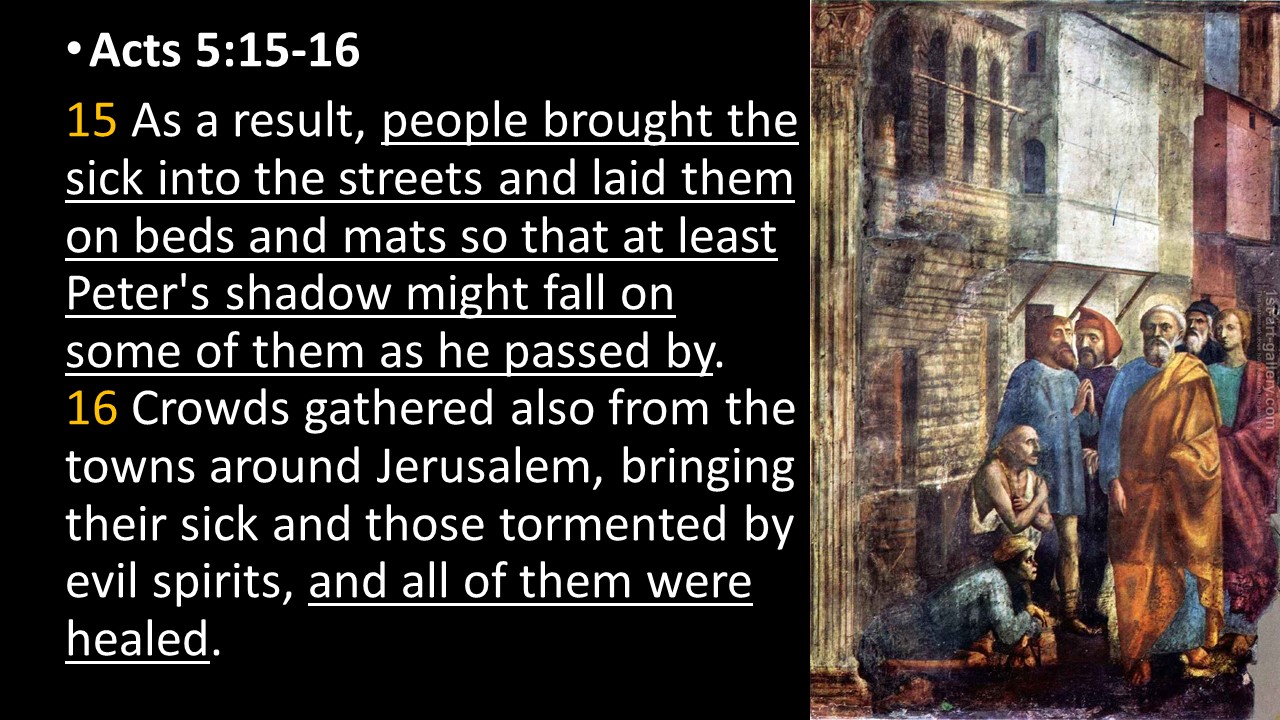
We can be certain the lame man healed at the temple Gate called Beautiful was still sharing his story joyfully with everyone he knew. Even those demon-possessed were being healed. The word spread far and wide around Jerusalem. V.16 tells us that “all’ of them were healed; not just some. The apostles continued to profess Jesus, with many signs and wonders, the church cont’d to grow, and healing of the sick was even occurring by Peter’s shadow passing over them. It wasn’t Peter’s shadow, but the Holy Spirit that healed them as a sign that what Peter professed was of God.  

One can only imagine what the scene would have looked like with sick and even demon-possessed lining the roads and streets to just get a glimpse of Peter so as to allow his shadow to fall on them or their loved ones. 

The Sadducees were both angry and filled with jealousy at the attention the apostles were getting, as they praised and taught Jesus. It was seen by the Sadducees as disrespect to their position and authority as the religious leaders of Judea and worse yet, as an accusation that they were responsible for killing the Christ/Messiah. The Sadducees also had hostility to Christ’s resurrection, because it confirmed and established the doctrine of the invisible world and the resurrection of the dead, which was strongly denied by them. 

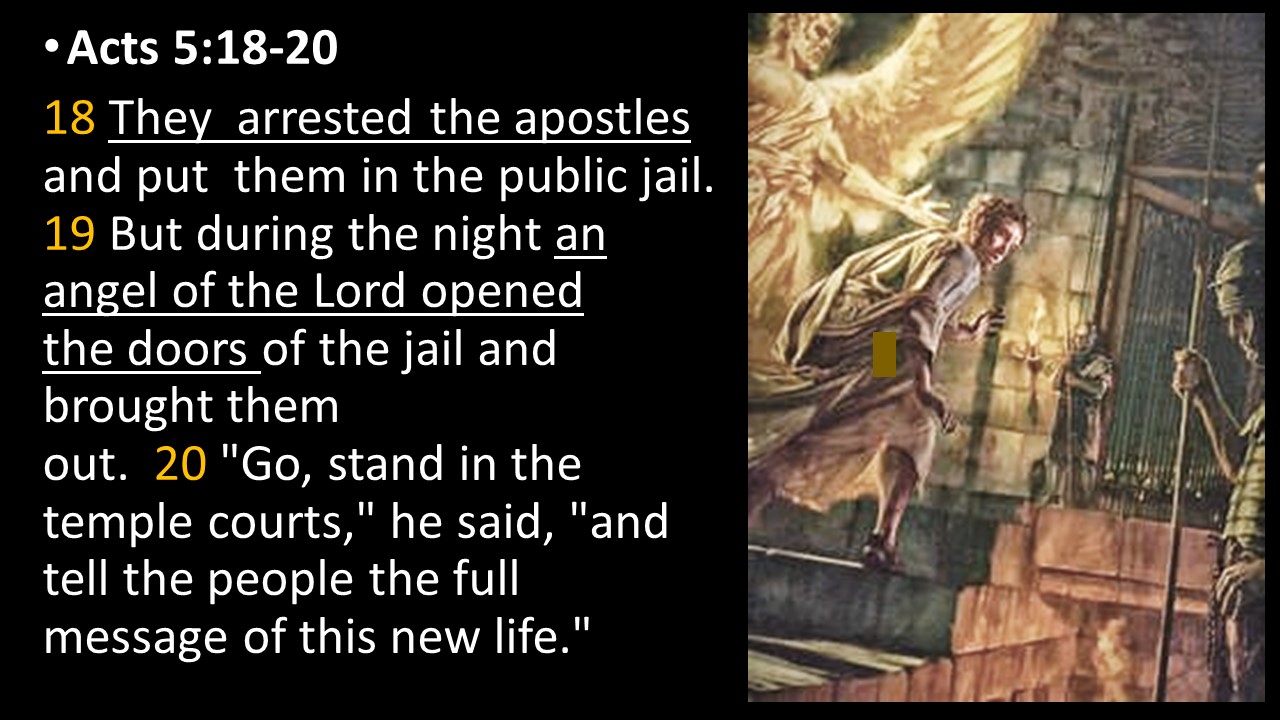
The Sadducees had their own temple police, and had the apostles put in jail. But, not for long. God sent an angel to release them. Empowered by the Holy Spirit the apostles left the Jail and continued preaching Jesus as Savior and Messiah and used the temple courts for doing so—the Sanhedrin’s backyard, so to speak. An average person would have feared the Sanhedrin’s authority, but they were empowered by the Holy Spirit to be bold and courageous.  

What the public jail in Acts 5:18 was most likely like. 

Peter and John resumed preaching as instructed by the angel. The Sanhedrin, the great Jewish religious council (comprised of 71 men), had broad authority in Palestine under Roman authority, with enough influence to compel Pontius Pilate to bend to their will and crucify Christ. Roman Emperors measured the competence of their assigned regional governors by their ability to maintain order and prevent uprisings to keep the regime peaceful AND collect taxes. One way of doing so in Judea was to not butt heads with the religious leaders who carried a great deal of influence with the people, enough to incite demonstrations and even demand the crucifixion of Christ.  

The priests and captain were puzzled and most likely alarmed, that the apostles had escaped since the door was locked and the guards still in place. The Sanhedrin ignored the healing miracles by the apostles. Even their unexplained escape from jail did not sway them to even consider what the apostles were saying about Jesus. Their minds were made up: don’t upset the status quo! We see the same thing in the world of politics today, even in our own Congress. It all gets down to retaining and enhancing one’s power. 

Fearing upsetting the people, the guards had brought them quietly to the Sanhedrin by request and not by force. Peter, who has been performing miracle-healings before the people, professes Christ yet again to the Sanhedrin. They accuses Peter and John of making false accusations against them as being guilty of Jesus’ blood—after all, wasn’t it the Romans who crucified Him? We know Pontius Pilot would have released Jesus if the Sadducees had not incited the people to demand Jesus’ death. 

As Peter boldly declared, their message was from God, the evidence of which was that Jesus rose from the dead and as such, they performed miracle-healings before the people testifying in His name that Jesus was from God. Many people believed them and accepted Christ as Messiah and Savior. Did any of the Sadducees convert? Jealously and pride hardened their hearts and prevented it. They would have had to step down from the Sanhedrin and give up the authority and power associated with it.

The Sanhedrin were furious because a Resurrected Jesus would make Him equal with God, something the Jewish Council had previously denied, and still denied despite Peter’s miracles. Their anger stirred their desire to kill them just as Jesus was killed, and for similar reasons—loss of prestige and power over the people. 

Gamaliel (Ga-meal-li-ul) (v.34) is the same rabbinical teacher Saul of Tarsus studied under. Gamaliel cited several cases to the Sanhedrin of other leaders who also had a following like Jesus, but eventually faded away. 

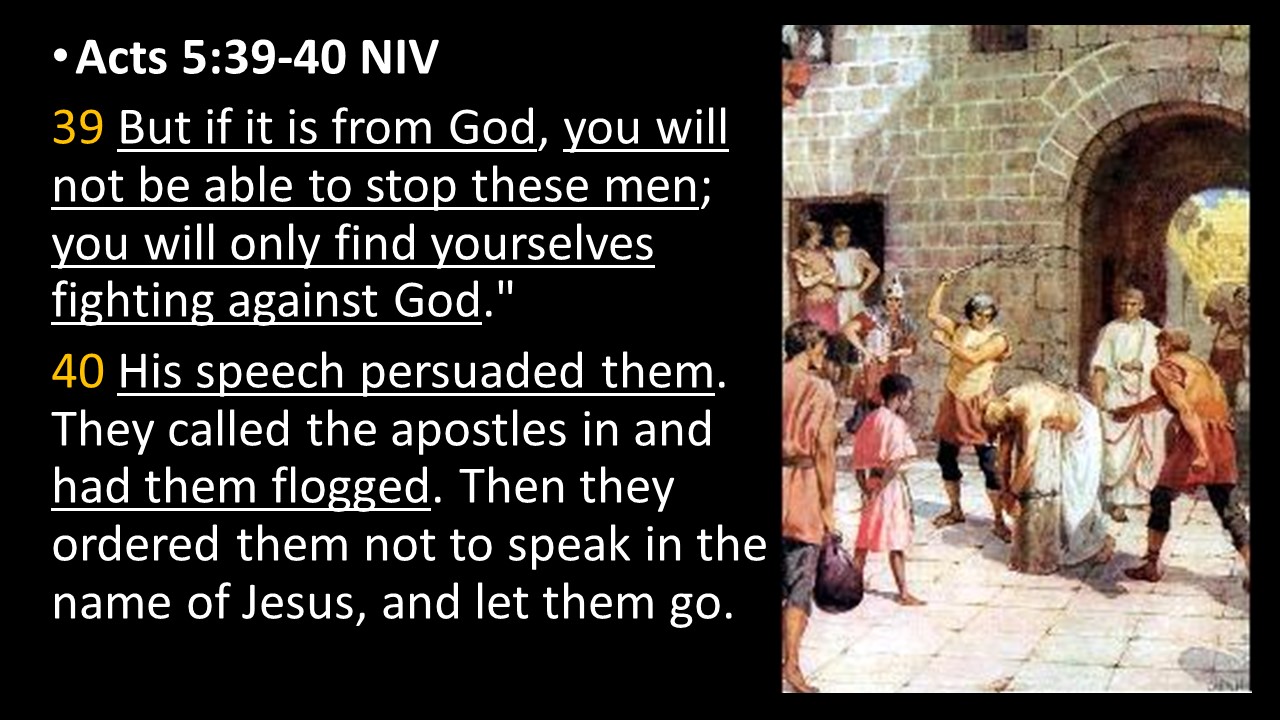
Gamaliel continued to caution them that the Jesus, Peter and John preached, would also go away, unless what they professed was from God, which, if so, you can’t defeat. The Sanhedrin decided that they had to punish them in some way, which was flogging with a warning not to speak of Jesus again. 

Gamaliel continued to caution them that the Jesus being professed by Peter, and His followers, like many others, named in v.36-37, would go away if what they preached was of human origin—without any basis except their own opinions.  

Even under threat, the apostles continued to proclaim Jesus as the Messiah and Savior. Point of information, Gamaliel is venerated as a saint in the Eastern Orthodox Church. Like Roman Catholics, they also pray for the saints to intercede on their behalf to God. Yet, our Intercessor before God is Jesus Christ Himself. Even under threat, the apostles continued to proclaim Jesus as Messiah, and Savior. 

Amen!

Acts 1:7 He said to them: "It is not for you to know the times or dates the Father has set by his own authority. 8 But you will receive power when the Holy Spirit comes on you; and you will be my witnesses in Jerusalem, and in all Judea and Samaria, and to the ends of the earth."  

Was is the goal of worship, entertainment or God’s glory? Worship music is to uplift our spirit and minds to glorify God! It’s also a renewing of our mind towards and our relationship with Almighty God under the power of the Holy Spirit and through faith in Jesus Christ as Lord and Savior. Perhaps these images are necessary to draw young people to church, but it is empty without the Gospel of Grace being preached. Of course, God is the judge, not me.

Acts isn’t just about early church history, it’s also a guide for how we should live as Christians, and as a measure to gauge how our society is doing in regard to how God would have us live as a people and as a nation. 

Adrian Rogers’ 39-minute sermon: Counterfeit Christianity. 
Professing Jesus as Lord and Savior doesn’t require any act, even an altar call, but it is a matter of focusing our mind and heart on Him in true repentance. 
https://youtu.be/4OWuSu95i3g
(copy and paste into your web browser)

Praying for America should not be a momentary prayer at the end of a lesson. It should be a state of mind whenever watching the news. Pray also for our Pastor, his family and our church that the Holy Spirit may empower us to share the Word when the opportunities arise. 

There will be a different study in Heritage Lounge. Coffee will be available. Hope to see you there. Yes, I will continue our study of Acts on the blog. 

End of
The Acts of the Apostles
Chapter 5