Friday, April 23, 2021

What happens when someone who isn’t born-again joins the Church and then lies to the Holy Spirit? As we saw in chapter 4, early Christians were overwhelmed with joy, demonstrated by an outpouring of charity for each others’ needs. 

Ananias and Sapphira was trying to emulate Joseph the Levite (Acts 4:36-37) to be praised for their comparative generosity. In doing so, they weren’t just lying to Peter and the church, they were lying to the Holy Spirit (v.3). The property was theirs' to do with as they pleased. They could have given 10% to the church and that would have been okay. Most likely they expected praise as being great, generous people, by lying that they gave the full amount to the church. By proclaiming they gave it all and then holding it back, in reality, they were stealing from God. Their sin was covetousness and religious hypocrisy that the Lord readily purged from the church. The early church had to have a core of true believers, and biblical values; not liars and hypocrites.

I remember visiting a major cathedral where all the pews had plaques with the names of each of the donors. Did they donate to honor God or for personal recognition and honor for their generosity? Each pew must have been expensive. I'm sure that were some of each, but God is always the judge. 

The Holy Spirit struck Ananias dead. V.8, three hours later, Sapphira not knowing what happened to Ananias, also lied to Peter. Was her sin so grave to warrant death (v.10)? These verses show how God was preventing lying and deception—Satan’s tools for destruction—from entering the infant church. 

Sapphira didn’t realize the consequences for their lie. Was such a severe punishment warranted? Satan was attempting to enter the church through Ananias and Sapphira, with deceit and lies. As stated in v.11, the event created fear throughout the church. We can be certain that the message was clear for those who were not born-again, who had entered the Church to capitalize on the Apostles charity, even professing Christ verbally for personal gain. But the Holy Spirit put a stop to that false Christianity. This was the infant Church and God took measures to protect it from Satan’s influence and deceit, which would have been like a cancer and sure to spread if allowed to to unchecked. 

The Jews were a religious people, and the apostles’ signs and wonders attracted their attention, many of whom heard of Jesus or even had witnessed Him preaching and performing miracles. V.13 is especially important. The death of Ananias and Sapphira accomplished exactly what the Holy Spirit intended. Only those born-again would join into fellowship as we are told in v.14. 
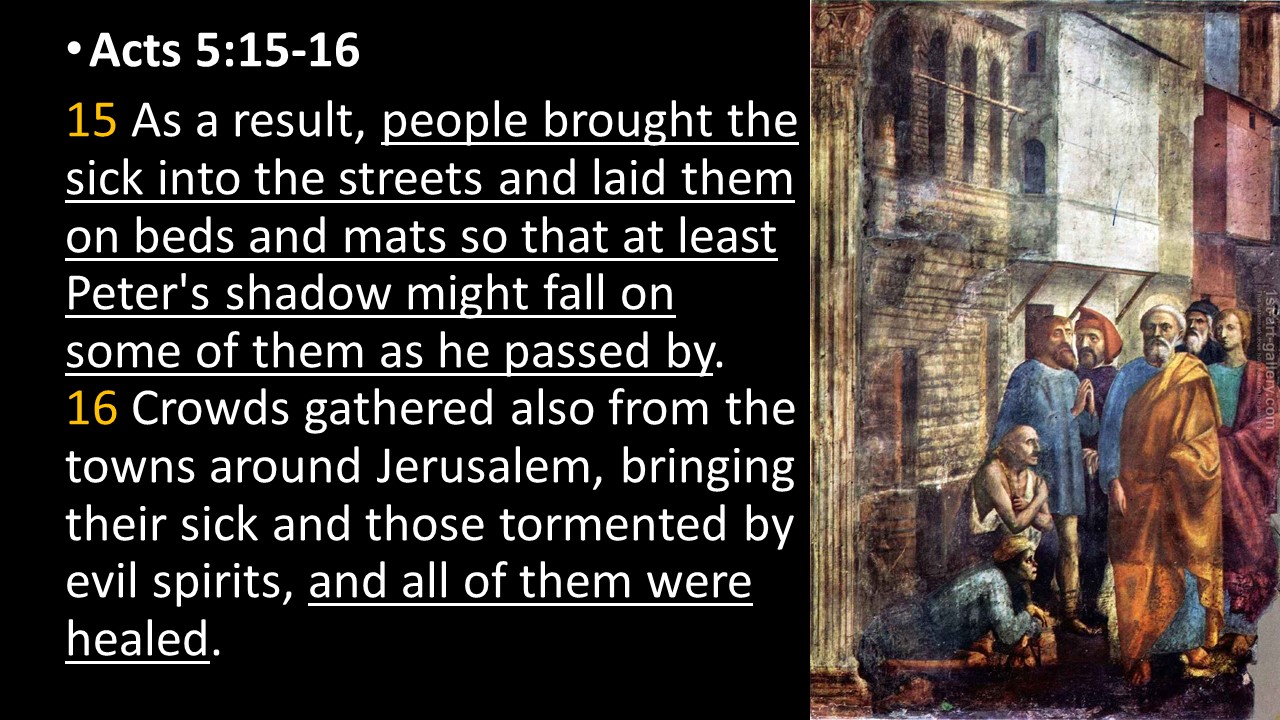
We can be certain the lame man healed at the temple Gate called Beautiful was still sharing his story joyfully with everyone he knew. Even those demon-possessed were being healed. The word spread far and wide around Jerusalem. V.16 tells us that “all’ of them were healed; not just some. The apostles continued to profess Jesus, with many signs and wonders, the church cont’d to grow, and healing of the sick was even occurring by Peter’s shadow passing over them. It wasn’t Peter’s shadow, but the Holy Spirit that healed them as a sign that what Peter professed was of God.  

One can only imagine what the scene would have looked like with sick and even demon-possessed lining the roads and streets to just get a glimpse of Peter so as to allow his shadow to fall on them or their loved ones. 

The Sadducees were both angry and filled with jealousy at the attention the apostles were getting, as they praised and taught Jesus. It was seen by the Sadducees as disrespect to their position and authority as the religious leaders of Judea and worse yet, as an accusation that they were responsible for killing the Christ/Messiah. The Sadducees also had hostility to Christ’s resurrection, because it confirmed and established the doctrine of the invisible world and the resurrection of the dead, which was strongly denied by them. 
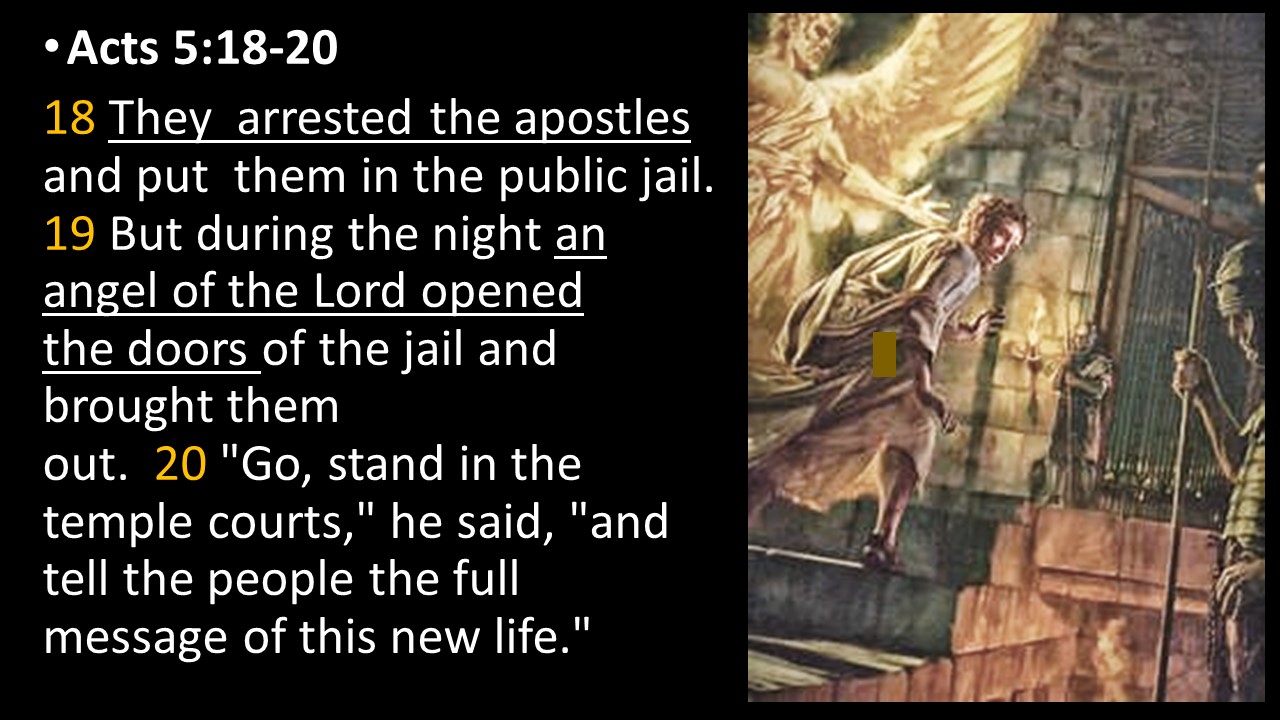
The Sadducees had their own temple police, and had the apostles put in jail. But, not for long. God sent an angel to release them. Empowered by the Holy Spirit the apostles left the Jail and continued preaching Jesus as Savior and Messiah and used the temple courts for doing so—the Sanhedrin’s backyard, so to speak. An average person would have feared the Sanhedrin’s authority, but they were empowered by the Holy Spirit to be bold and courageous.  

What the public jail in Acts 5:18 was most likely like. 

Peter and John resumed preaching as instructed by the angel. The Sanhedrin, the great Jewish religious council (comprised of 71 men), had broad authority in Palestine under Roman authority, with enough influence to compel Pontius Pilate to bend to their will and crucify Christ. Roman Emperors measured the competence of their assigned regional governors by their ability to maintain order and prevent uprisings to keep the regime peaceful AND collect taxes. One way of doing so in Judea was to not butt heads with the religious leaders who carried a great deal of influence with the people, enough to incite demonstrations and even demand the crucifixion of Christ.  

The priests and captain were puzzled and most likely alarmed, that the apostles had escaped since the door was locked and the guards still in place. The Sanhedrin ignored the healing miracles by the apostles. Even their unexplained escape from jail did not sway them to even consider what the apostles were saying about Jesus. Their minds were made up: don’t upset the status quo! We see the same thing in the world of politics today, even in our own Congress. It all gets down to retaining and enhancing one’s power. 

Fearing upsetting the people, the guards had brought them quietly to the Sanhedrin by request and not by force. Peter, who has been performing miracle-healings before the people, professes Christ yet again to the Sanhedrin. They accuses Peter and John of making false accusations against them as being guilty of Jesus’ blood—after all, wasn’t it the Romans who crucified Him? We know Pontius Pilot would have released Jesus if the Sadducees had not incited the people to demand Jesus’ death. 

As Peter boldly declared, their message was from God, the evidence of which was that Jesus rose from the dead and as such, they performed miracle-healings before the people testifying in His name that Jesus was from God. Many people believed them and accepted Christ as Messiah and Savior. Did any of the Sadducees convert? Jealously and pride hardened their hearts and prevented it. They would have had to step down from the Sanhedrin and give up the authority and power associated with it.

The Sanhedrin were furious because a Resurrected Jesus would make Him equal with God, something the Jewish Council had previously denied, and still denied despite Peter’s miracles. Their anger stirred their desire to kill them just as Jesus was killed, and for similar reasons—loss of prestige and power over the people. 

Gamaliel (Ga-meal-li-ul) (v.34) is the same rabbinical teacher Saul of Tarsus studied under. Gamaliel cited several cases to the Sanhedrin of other leaders who also had a following like Jesus, but eventually faded away. 

Gamaliel continued to caution them that the Jesus, Peter and John preached, would also go away, unless what they professed was from God, which, if so, you can’t defeat. The Sanhedrin decided that they had to punish them in some way, which was flogging with a warning not to speak of Jesus again. 
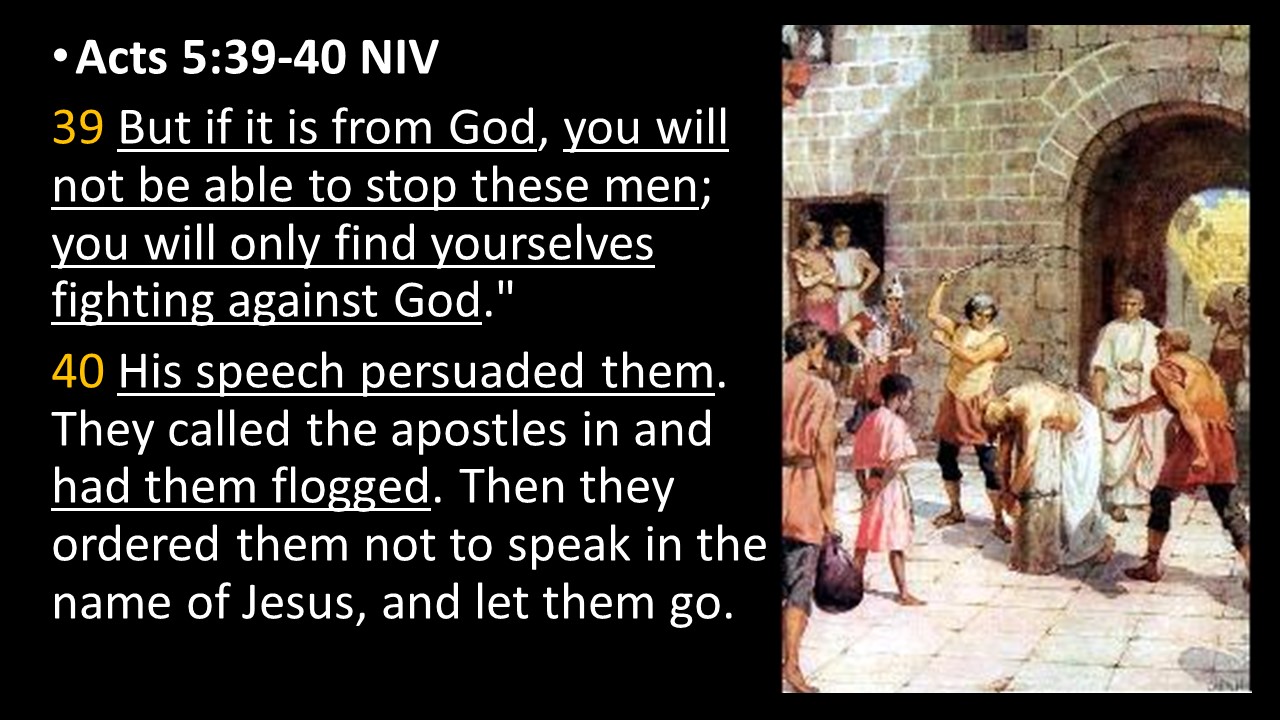
Gamaliel continued to caution them that the Jesus being professed by Peter, and His followers, like many others, named in v.36-37, would go away if what they preached was of human origin—without any basis except their own opinions.  

Even under threat, the apostles continued to proclaim Jesus as the Messiah and Savior. Point of information, Gamaliel is venerated as a saint in the Eastern Orthodox Church. Like Roman Catholics, they also pray for the saints to intercede on their behalf to God. Yet, our Intercessor before God is Jesus Christ Himself. Even under threat, the apostles continued to proclaim Jesus as Messiah, and Savior. 

Amen!

Acts 1:7 He said to them: "It is not for you to know the times or dates the Father has set by his own authority. 8 But you will receive power when the Holy Spirit comes on you; and you will be my witnesses in Jerusalem, and in all Judea and Samaria, and to the ends of the earth."  

Was is the goal of worship, entertainment or God’s glory? Worship music is to uplift our spirit and minds to glorify God! It’s also a renewing of our mind towards and our relationship with Almighty God under the power of the Holy Spirit and through faith in Jesus Christ as Lord and Savior. Perhaps these images are necessary to draw young people to church, but it is empty without the Gospel of Grace being preached. Of course, God is the judge, not me.

Acts isn’t just about early church history, it’s also a guide for how we should live as Christians, and as a measure to gauge how our society is doing in regard to how God would have us live as a people and as a nation. 

Adrian Rogers’ 39-minute sermon: Counterfeit Christianity. 
Professing Jesus as Lord and Savior doesn’t require any act, even an altar call, but it is a matter of focusing our mind and heart on Him in true repentance. 
https://youtu.be/4OWuSu95i3g
(copy and paste into your web browser)

Praying for America should not be a momentary prayer at the end of a lesson. It should be a state of mind whenever watching the news. Pray also for our Pastor, his family and our church that the Holy Spirit may empower us to share the Word when the opportunities arise. 

There will be a different study in Heritage Lounge. Coffee will be available. Hope to see you there. Yes, I will continue our study of Acts on the blog. 

End of
The Acts of the Apostles
Chapter 5


Friday, April 16, 2021

 Chapter 4 of The Acts of the Apostles. Ready to dig in? 

We pick up where chapter 3 left off, with Peter at the temple preaching about Jesus after the beggar was healed. The crowd caused a stir which attracted the captain of temple guard along with the temple police. 

V.3, because it was evening, they put Peter and John in jail, closed the temple doors and postponed all official business till the next day. Temple sacrifices ended at 4:00 P.M. The miracle healing and Peter’s message about Christ’s resurrection resonated with another 5,000 (v.4) who converted to accept Jesus as Messiah, Lord and Savior. 

Temple priests had oversight over the temple guards. The Sadducees did not believe in a physical resurrection; the Pharisees did. Sadducees also rejected spirits and angels. They were of the upper social and economic class and were responsible for maintenance of the temple including appointing the temple guard. They rejected Oral Law but observed the written Torah as sole authority. They did not believe that the soul was immortal, nor did they believe in an afterlife. Peter’s preaching was an affront to the Sadducees’ leadership, prestige, authority, and even their pride. 

Layout shows where Sanhedrin met, which was also the place where they put Jesus on trial leading to His crucifixion. And now Peter and John stood trial before the Sanhedrin in that same location. 

Room where the Sanhedrin met was in the temple complex as indicated, which we will explore further in the next slide. 

Photo shows a scale model of the Jerusalem Temple. Arrow points to temple gate called Beautiful where the beggar sat daily (v.3:2).

V.5 tells us there were 3 groups in the Sanhedrin—rulers, elders and scribes (i.e., teachers of the law) that constituted the Jewish religious council. V.7 Instead of seeing the miracle as something good, they instead asked “by what power did you do this?”—cure the lame man; which they meant as an accusation. Annas was high priest for 10 yrs. Caiaphas was the one that organized the plot to kill Jesus. He was appointed in AD 18 by the Roman Prefect (governor)—who preceded Pontius Pilate. Caiaphas was Annas’ son-in-law. They kept power within their own family. Sound familiar, even today? Those listed in these verses constituted what might be called the “executive committee”. All teaching had to be approved by them and Peter’s profession of Christ’s resurrection was an affront to them. 

Peter’s comments (v.10) was a direct affront to them, that the healing of the beggar was by the name of Jesus Christ, whom they killed. Once again Peter emphasized Jesus’ resurrection from the dead. Like Peter, we too came to Christ in faith, and also filled with the Holy Spirit.
1 Cor 12:13 For we were all baptized by one Spirit into one body — whether Jews or Greeks, slave or free — and we were all given the one Spirit to drink. 

The term “Capstone” is that Jesus is the fulfillment of the Old Testament. We can be certain the Sanhedrin didn’t take kindly to Peter’s words. In v.11 “capstone” is equivalent to “cornerstone”. God chose Jesus to be the “living stone”; the true cornerstone of what they professed as religious leaders, but in rejecting Jesus, they also cast aside the cornerstone of the faith that was handed down to them in the O.T. Scriptures. 

The apostles were uneducated, yet, their manner of speech and conviction awed the Jewish leadership. They also took note that they were associated with Jesus—and would have loved to convict them of something, but the cured beggar standing with them was a testimony to the miracle, and the Sanhedrin were cautious not to insight outrage with the people who were praising Peter and John for healing the beggar. 

They had Peter and John removed from the chamber so they could confer (or conspire) on what to do with them. It was tricky because of their miracle; word of healing of the lame man was spreading widely. There was no legitimate charge they could bring against them. So all they could do was warn them not to preach about Jesus.

After the Sanhedrin’s command not to speak or teach anything about Jesus, (v.19) Peter and John, being empowered by the Holy Spirit stood firm on God’s Word. Remember when Peter denied knowing Jesus, out of fear (Matt. 26:69-75). Pentecost was the turning point where courage in Jesus’ name replaced fear for his own safety. Fearful of angering the people, like true politicians, the Sanhedrin felt compelled to let them go as we see in the following verses. 

They were religious leaders, but also very skilled politicians who again, did not want to provoke the people who were praising the apostles for curing the lame beggar, many of whom now professed Jesus as the Messiah, which the Sanhedrin were still not aware of. 

The whole scene was intended to intimidate, just being in the temple chambers and facing the Sanhedrin, would have been intimidating for anyone, yet Peter and John remained bold through the power of the Holy Spirit. 

Upon their release they reported everything to the other apostles and disciples. Instead of fear, they all praised God. 

V.24-31 shows the boldness of the apostles and disciples in prayer and willingness to profess Jesus Christ before both Jews and Gentiles as the Lord’s Anointed One, as had been prophesied by King David. 

They continue proclaiming how King Herod and Pontius Pilate together conspired against Jesus, yet, as stated in v.28, it was all in accordance with God’s will and His preordained plan of salvation. Their prayer in v.29 was that they may preach the name of Jesus, not just with boldness, but with great boldness. 

V.31 the Holy Spirit manifested Himself, not with tongues, but with a mild earthquake to reveal His presence. 

Their collective burst of joy was manifested in charitable giving. There was a time when charity was almost exclusively by the Church, until the government took over that role with President Johnson’s Great Society. Then the church and individual Christians stepped back and took a much smaller role since the government had filled the larger void. The bottom line, those early Christians had a rock-solid faith and mission to spread the Word.

The tribe of Levi (the Levites) could not own land in Israel/Judah. Since Joseph was from Cyprus, perhaps he had latitude to own land, which he sold to donate to the Jewish Christians in Jerusalem, who were viewed as outsiders by orthodox Jews, with a corresponding loss of income.   
The widow and her mite had greater value before God, because it was all she had. The size of the gift is measured by one’s heart in giving. 
Mark 12:41 Jesus sat down opposite the place where the offerings were put and watched the crowd putting their money into the temple treasury. Many rich people threw in large amounts. 42 But a poor widow came and put in two very small copper coins, worth only a fraction of a penny. 43 Calling his disciples to him, Jesus said, "I tell you the truth, this poor widow has put more into the treasury than all the others. 44 They all gave out of their wealth; but she, out of her poverty, put in everything — all she had to live on."  

There is much to learn from Acts, as the Church. Only 24 more chapters to go. 

We are the Church—the Body of Christ—collectively and individually, young and old alike, being of one heart and one mind, like the disciples in v.32

Having a rock-solid faith is essential if the church is to be effective in sharing the Gospel with those around us. Adrian Rogers sermon points us in that direction. 
Adrian Rogers 36-minute sermon: How to Have a Rock-Solid Faith
https://youtu.be/jEVWBFkWw30
(copy and paste in your web browser)

Pray for our Pastor, his family and our church, as well as wisdom for the American people in choosing their elected representatives. 
2 Chron 7:14 if my people, who are called by my name, will humble themselves and pray and seek my face and turn from their wicked ways, then will I hear from heaven and will forgive their sin and will heal their land. 

It’s been way too long. Time to get back together. Hope everyone shows up. We are studying the Book of Acts on the blog, but there will be a different study in Heritage Lounge. I believe coffee will be available. Hope to see you there. Yes, I will continue our study of Acts on the blog. 

End of
The Acts of the Apostles
Chapter 4