The Acts of the Apostles
Chapter 1

Christians were still a small Jewish sect at the beginning of Acts. The name Christian is used three times in the New Testament. The first mention is in Acts 11:26, noting that they were first referred to as Christians in the City of Antioch. Presumably, the early followers of Christ referred to themselves as followers of “the Way” because of Jesus’ statement in John 14:6 that He is “the way and the truth and the life.”

As noted, the Holy Spirit plays a crucial role in the opening chapters of Acts and spreading of the Church. The Church would not have spread as far and wide across the Roman Empire, without the Holy Spirit.

In v.1 Luke begins mentioning his former book—the Gospel of Luke—addressed to the “most excellent Theophilus” (Luke 1:3). Acts is a follow up to Luke’s testimony about Jesus Christ. Some commentaries believe Luke’s Gospel and Acts may have been a single document—but if so, I can only wonder why he would address Theophilus again in Acts if it was a continuation of the Gospel and not a follow-on book—which I believe it is. It’s believed that Theophilus, whose name is Greek and means "loved of (philus) God (Theo),“ was a government official, since he is addressed as a dignitary, “as most excellent" indicating a position worthy of respect. Theophilus” is obviously a Christian convert, perhaps through the influence of Luke who was a physician. In v.2 Luke noted that Jesus chose the apostles. Another important point in v.2 notes that Jesus was taken up to heaven. In that after being crucified, Jesus not only physically rose from the dead, but He also ascended bodily into heaven, signifying His divinity.
Luke 1:3 Therefore, since I myself have carefully investigated everything from the beginning, it seemed good also to me to write an orderly account for you, most excellent Theophilus...

Over a period of forty days (v.3) Jesus appeared to His followers, proving to them He had indeed risen. One of the ways He proved He has physically risen was to eat with them—spiritual bodies don’t eat material food. In John 21, at the Sea of Tiberius, Jesus prepared a breakfast of fish cooked over a fire that He served with bread to His disciples. Luke doesn't cover the entire 40 days noted in v.3.
John 21:11 Simon Peter climbed aboard and dragged the net ashore. It was full of large fish, 153, but even with so many the net was not torn. 12 Jesus said to them, "Come and have breakfast." None of the disciples dared ask him, "Who are you?" They knew it was the Lord. 13 Jesus came, took the bread and gave it to them, and did the same with the fish. 14 This was now the third time Jesus appeared to his disciples after he was raised from the dead.

The apostle Thomas had to see for himself before He believed in the physical resurrection of Jesus. One can only wonder why Thomas doubted after he was told by the other apostles that Jesus had risen. The same is true today in that not all who profess to be Christian believe in a literal physical resurrection of Jesus Christ, and see Easter as more of a spiritual awakening, which we will look at briefly in the next slide.

Thomas isn’t the only one who didn’t believe in the physical resurrection of Jesus Christ. This chart has to do with Great Britain but may be a broader representation that extends beyond Britain, showing that within the Christian Church there are those who profess to be Christian yet reject/deny the physical resurrection of Jesus Christ. The saddest part is that even those noted as active Christians, who attend church regularly, just over half believe in the physical resurrection of Jesus Christ as stated in the Bible, and more than 40% do not believe the Bible version. What would it take for them to believe? What did it take for Thomas to believe? The Anglican Church is the national church of Great Britain.

We have to turn to John for the details regarding Thomas. This particular event isn’t included in Acts, but as stated in John it certainly substantiates the apostles’ and disciples’ belief in a resurrected Jesus Christ. It isn’t a matter of their opinion or conjecture, but a record of facts recorded in the Gospel of John as the Word of God. (con’t on next slide)

Jesus’ resurrection was demonstrated to Thomas by Jesus Himself, not only visually, but by actual touch. Thomas’ unbelief was used by God to demonstrate the reality of the physical resurrection of Jesus Christ….and it forever stands as a testimony of the risen Jesus Christ. Not everyone who professes to be Christian, even some pastors (from my personal experience) accept the Bible as the inerrant Word of God. Thomas’ unbelief was changed to belief because of his personal experience in seeing Jesus and touching His wombs. The Holy Spirit ensured that this was recorded in the Bible to show it as an actual event and not just by word of mouth.

Jesus’ message to Thomas is for all who believe in the Bible as the Word of God. There is no ambiguity here, it is a stated fact and verbal warning to anyone that professes to be Christian (v.31): God’s Word is true and the very foundation of what we believe and why we believe it. Jesus knew the future that some who profess to be Christian, would not believe. They may profess to be Christian and even go to church, but they are not Christian in that they are not born again as we see in Acts.

Back to Acts. We can be certain that the apostles didn’t quite understand what Jesus meant, that they “will be baptized with the Holy Spirit” (v.5). As a Roman Catholic kid we made our Confirmation, which we believed was the receiving of the Holy Spirit, a ritual performed by the local bishop. Confirmation is defined as a Sacrament in the Catholic Church in which the one who is confirmed, usually children around the age of 7, considered the age of reason, receives the gifts of the Holy Spirit through the imposition of an anointing with oils by the bishop. It was a big deal for us kids and our families.

In Christian theology, baptism with the Holy Spirit, also called baptism in the Holy Spirit, has been interpreted by different Christian denominations in a variety of ways due to differences in the doctrines of salvation. Some see it in terms of water baptism, i.e., being dunked. Many, including those in the Reformed Faith, see “the baptism of the Holy Spirit” defined as that work whereby the Spirit of God places the believer into union with Christ and into union with other believers in the body of Christ at the very moment of regeneration–the moment we believe and accept Jesus as Savior. Do you remember that moment? Few do. Baptism is being joined with other believers in the Church, i.e. Body of Christ.
John 3:3 In reply Jesus declared, "I tell you the truth, no one can see the kingdom of God unless he is born again."

A little bit of Church history. Before the 16th century Reformation, there were two branches of Christianity: Roman Catholic and Greek Orthodox that split in 1054. Up until the Reformation the rites of the Roman Catholic prevailed in Western Europe, and Greek Orthodox rituals and traditions in Eastern Europe. Here’s an illustration of Confirmation in the Roman Catholic Church, i.e., a ritual for receiving the Holy Spirit—in which the one who is confirmed receives the gifts of the Holy Spirit through the anointing with oils by the bishop. It's considered a sacrament of initiation which brings one deeper into communion with the Church. Before the Reformation, this was the common practice in the Church.

These are Jesus’ words in John 3:3. We are only born again with and by the Holy Spirit. Unless one is born again, even if they belong to a church, they are not part of the Body of Christ. One must prayerfully and sincerely repent and profess faith in Jesus Christ as Lord and Savior, and regeneration by the Holy Spirit. The next couple of slides put these words into context.

The scene in John 3:1-8 (con’t on next slide) takes place in Jerusalem for the Jewish Passover of 30 AD. Nicodemus, a Pharisee and member of the Jewish high court called the Sanhedrin, visited Jesus in the dark of the night—most likely because he feared recrimination of the other Pharisees if he did so during the day and was seen. V.2 explains why he's asking, because Jesus was performing miracles that could only come from God. In v.3 Jesus goes one step further, with the statement that one must be “born again”.

Nicodemus questions Jesus further, about what does it mean to be “born again”? Some Christians use v.5 to support that water baptism is necessary for being born again. But Jesus made this comment long before Christian baptism was instituted. This combination of water and Spirit occurs in the O.T. in representing the outpouring of God’s Spirit in the end times, something Nicodemus would be quite familiar with (Is. 32:15, 44:3; Ezek. 36:25-27)—but that’s a whole different study. Jesus describes the Holy Spirit as a wind that cannot be seen. If water baptism was necessary for salvation, that would make salvation a work’s righteousness—dependent on what we do, and not on what God does by grace alone through faith alone in Christ alone.

In v.6 Jesus doesn’t deny Israel’s kingdom being restored—something we explored in our prior End Times study. The Holy Spirit was going to make a major difference in their lives and mission, in that they would receive spiritual power when He comes to them at Pentecost (tongues of fire; not water baptism). We can only wonder what was going through their minds. We can be certain that no one could have imagined that tongues of fire would descend on each one (Jesus’ description to Nicodemus). Something that was visible for everyone to witness, signifying that each one of them was born again as the body of Christ, divine proof directly from God; and as witnesses to the very ends of the earth.
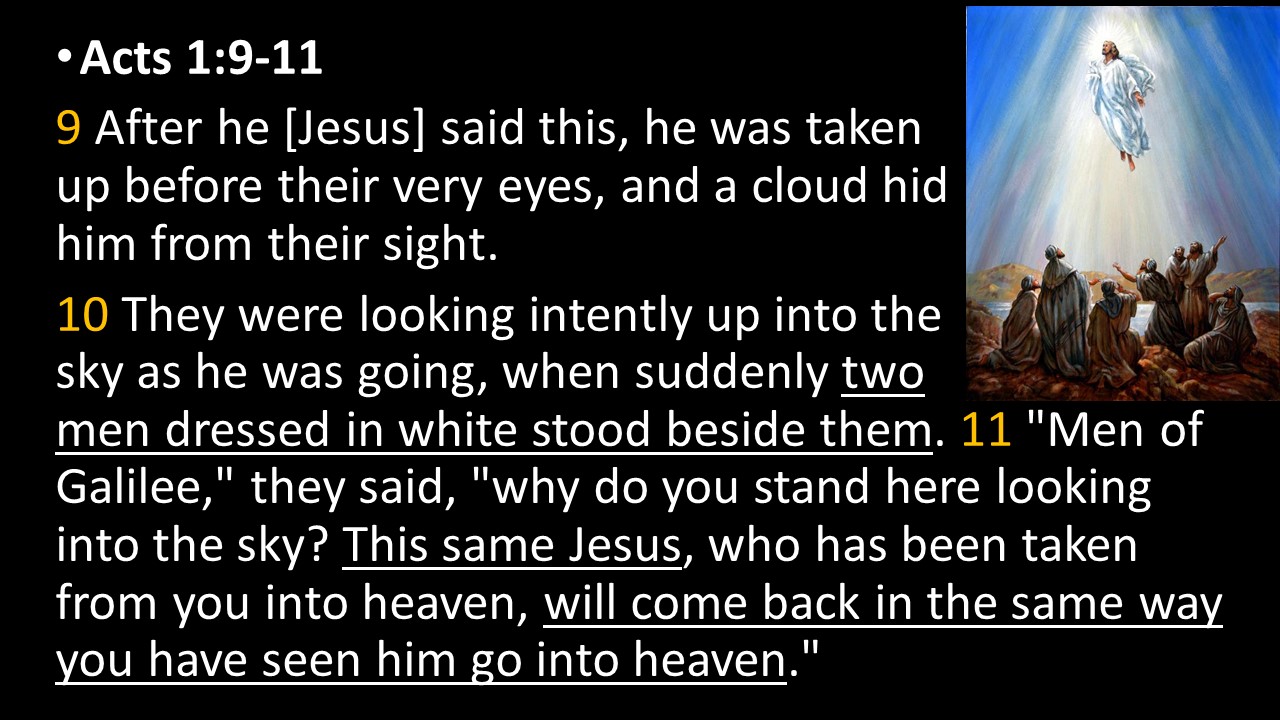
In v.10 two angels appear in the form of men dressed in white, stood beside them. Their message: Jesus will return in the same why that He ascended—prophesying the Second Coming of Christ, that we discussed in our prior End Times study, following the Tribulation The next verses tell us that this took place on the Mount of Olives. Dressed in white generally means supernatural or glorified beings, i.e. angels.

It seems that they had to pace themselves returning to Jerusalem in accordance with Jewish law. The "oral" law indicated a Sabbath day's walk (Acts 1:12) which was 2,000 cubits or about 3,000 feet; however, this was a manmade rule, not a regulation ordained by God in the Old Testament. All eleven apostles are mentioned in v.13, as was Jesus’ mother, Mary in v.14.

Three views of the Mount of Olives in relationship to the Temple Mount in Jerusalem. It shows the distance they had to travel back to Jerusalem. The bottom right photo is probably the best in regard to perspective of distance traveled.

Once back in Jerusalem they went to the upper room (v.13). Images show what’s commonly believed to be the “upstairs room” (NIV), more commonly referred to as the “upper room” (NKJV) looked like, also where the Last Supper was held prior to Jesus death.

Peter raises the issue of Judas, who betrayed Jesus. Peter apparently though that since Jesus picked twelve apostles, and now there were only eleven, the situation had to be rectified. Peter was the apparent leader of the apostles based on a number of Bible verses including Matt. 16:19. What exactly did Jesus mean when He gave Peter the keys of the kingdom? The Roman Catholic Church believes the Pope is Peter’s successor, who now has that authority as sanctioned in the R.C. Church and its sacrament (next slide).
Matt 16:19 "I will give you the keys of the kingdom of heaven; whatever you bind on earth will be bound in heaven, and whatever you loose on earth will be loosed in heaven."

In v.18, Peter describes Judas Iscariot’s suicide, and the field that was purchased with the 30 pieces of silver Judas received for betraying Jesus, which became a potter's field (burial place for paupers and strangers).
Matt 26:14 Then one of the Twelve — the one called Judas Iscariot — went to the chief priests 15 and asked, "What are you willing to give me if I hand him over to you?" So they counted out for him thirty silver coins. 16 From then on Judas watched for an opportunity to hand him over.

Peter is quoting Psalm 109:8. He is noting it as the reason why they must select a replacement to fill Judas’ role as an apostle. It raises the question, is it man’s role to fill that vacancy or God’s? Where did Peter get the authority to make this decision? We see the answer in Matthew 16 (next slide). The image shows Peter holding a “key”, just as stated in Matt. 16:19. The Catholic Church uses this to justify the Pope’s authority over the Church, even in regard to forgiving sin, which is called the Sacrament of Penance (a.k.a., Confession), now called the Sacrament of Reconciliation in which the faithful are absolved from sins committed after Baptism. Without it, if one had committed a “mortal sin” and dies, they cannot enter heaven and are destined for hell. If one does not confess venial (minor) sins, they would have to make restitution for them in Purgatory—a teaching rejected by Martin Luther after studying Romans, ultimately leading to the Protestant Reformation.

A brief look at Matthew 16. The Roman Catholic Church points to these verses as the reason the Pope’s authority is directly from Peter, who is described as the first Bishop of Rome (a.k.a., Pope—a title first used in the 9th century). The Bishop of Rome was recognized as the head of the church up until the 16th century Protestant Reformation. Protestants understand the "rock" in v.18 to be Jesus Himself. Jesus could be referring back to Peter's confession that Jesus is "the Christ, the Son of the living God" (Matthew 16:16) or perhaps He was pointing to Himself when He made the statement. Why do Protestants believe this? First, Jesus would not build His church upon any person other than Himself; and Paul took the Church to the Gentile world, not Peter. Nor does Paul mention building the Church upon Peter in any of his epistles, nor in Acts during his missionary work.

As noted in v.21, it was Peter’s decision to install someone in the position vacated by Judas Iscariot. In v.22 “taken up from us” refers to Jesus’ ascension. In the decision process, Peter spells out the criteria for the position of apostle. Each apostle, including Judas Iscariot was hand-picked by Jesus. No human decision was involved, other than Jesus Christ. Yet this would get down to exactly that, a human decision. They had valid criteria, but one must wonder why they felt it was necessary to fill Judas’ vacancy at that particular time. The number 12 is said to signify completion. Twelve is found in 187 places in the Bible, including the number of Tribes in Israel, and is used with special significance in regard to the Jerusalem Temple (Leviticus 24). All of which is what most likely compelled Peter to make that decision. If you recall in our prior study on the End Times, there was Twelve thousand Jewish evangelists from each of the twelve tribes of Israel (144,000 total) during the end time's Great Tribulation (Revelation 7). One important point, it was Jesus who selected the next apostle, his name was Saul which we will see later on in Acts 9.

In v.23-26 (con’t next slide) it was decision time. There were two candidates, Barsabbas (Barsabas in NKJV) and Matthias. Each had been with Jesus from the beginning along with the apostles, but, what I see as an important distinction, Jesus knew each one but didn’t choose either one to be an apostle. Who else could they choose? Did they even consider this factor? Apparently not.

The final decision was made by casting lots (something like throwing dice), and Matthias was selected by a throw of the dice (or something like that—but nevertheless, by chance). Did the Holy Spirit do the choosing? He certainly could have; at least the apostles thought so. Matthias is short for Mattathias, which means “gift of Yahweh.” Matthias isn’t mentioned anywhere else in the Bible, New or Old Testaments—or once even in the four Gospels.

Remember back in v.1:1, Luke reported that Jesus chose the apostles, yet the apostles chose Matthias. Much of what we “know” about Matthias is rooted in legend or speculation. I think there is an analogy regarding filling the office of elder in the church, because the elders with the pastor, determine the direction of a church. Who’s doing the calling, man or Holy Spirit?
Acts 1:4 On one occasion, while he was eating with them, he ][Jesus] gave them this command: "Do not leave Jerusalem, but wait for the gift my Father promised, which you have heard me speak about. 5 For John baptized with water, but in a few days you will be baptized with the Holy Spirit."

We can envision the laying on of hands to anoint Matthias. In the New Testament the laying on of hands was associated with Christ healing the sick (Luke 4:40) and after his ascension the receiving of the Holy Spirit (Acts 8:14–19). Initially the Apostles laid hands on new believers (Acts 6:5–6). In the early church, the practice continued and is still used in a wide variety of church ceremonies, such as during ordination of elders and deacons.

Since chapter 3 had to with the replacement of Judas, it raises the question, why did Jesus pick Judas knowing he would betray Him? Actually, he picked Judas as part of His preordained plan, knowing Judas would betray Him. Adrian Rogers explains in his sermon at end of this lesson.

Acts isn’t just early church history, it’s also a guide for how we should live as Christians, and a measure for how our society is doing in regard to how God would have us live. It's also a call to start meeting again as the church.
Don't skip Adrian Rogers' sermon that follows.
May 2nd looks like an appropriate date for returning to Heritage Lounge. The blog will continue with our study of the Book of Acts in the meantime.

I believe Adrian Rogers’ sermon (next slide) was preached about 1999, based on content. We have drifted that much further over the last twenty years.
Psalm 80:7 Restore us, O God Almighty; make your face shine upon us, that we may be saved.

Judas betrayal of Jesus was foreordained by God. He used Judas’ betrayal, but didn’t make Judas betray Jesus. Which raises the question: Why did Jesus choose Judas to be one of the twelve? The question is addressed in Adrian Rogers’ sermon.
Adrian Rogers’ 40-minute sermon: Why did Jesus choose Judas?
https://youtu.be/FVeaVLdJIeA
(copy and paste into your web browser)

Pray also that our study of Acts and Pastor Scotts’ Wednesday studies may empower us with the Holy Spirit to follow God’s will in sharing His word, just as was done in the early church.
End of
The Acts of the Apostles
Chapter 1


