
We ended chapter 26 with both Festus and Agrippa finding Paul not guilty…and yet, chapter 27 is the political answer to the Jewish opposition, with Paul being sent to Rome to stand trial. Chapter 27 is somewhat of a travel log of Paul’s journey to Italy, but worth your time. My goal here is, instead of just reading the Word, to live in the Word as best can, always prayerfully.

Although not mentioned, Luke, as the author of Acts, is believed to have accompanied Paul on his trip to Rome. As we saw in chapter 26, neither Festus nor King Agrippa could find probable cause to convict Paul. Being a Roman citizen, gave them an easy out to grant his request and send him to Rome, under guard, to stand before Caesar. The Augustan Regiment was an auxiliary regiment of foreign troops who served in the Roman army, led by a Roman officer. They served a number of designated roles, such as guarding prisoners.

This particular centurion may have been on temporary assignment in Judea, or on special assignment to Rome, thus assigned to bringing Paul and possibly other prisoners there, as implied in v..42.

Chapter 27 begins with Paul boarding the ship for his journey to Italy under Roman Imperial Guard. The “we” in v.1 and “us” in v.2, includes Paul and Luke. The “When it was decided” was by Festus. We don’t know if Aristarchus was also a prisoner or perhaps a companion of Paul. Most likely, a companion—if so, he would have to pay his own passage. The ship would sail from Caesarea to Asia Minor as shown on the following map.

Map shows the sea route taken for Paul’s journey to Italy, beginning at Caesarea on a ship from Adramyttium in Asia Minor. The final leg of the journey would be by land up to the City of Rome.

It’s interesting that Luke in writing the account, named the ship and port city it belonged to. That entire region of Roman Asia is now part of modern Turkey. The image shows what the ship, typical of its day, is thought to have looked like.

The location of the Asian port city of Adramyttium is shown on the maps. Ships carried trade goods in both directions. Again, the ancient Roman province of Asia is now modern day Turkey, shown in the lower right corner of the map in relationship to Italy.

Beginning their trip, after loading the ship in Caesarea, they sailed up the coast and stopped at Sidon, probably for more cargo or to pick up more passengers, or both. The purpose of the arrow is to put the two maps into perspective since Sidon is farther north, beyond Galilee, than is Caesarea. So, lets get aboard with Paul and Luke, but brace yourself for a bumpy ride.

As previously noted, Julius was the Roman centurion (v.3). As stated, their first stop from Caesarea was at Sidon, as shown on previous slide. From there they sailed to Cyprus. The “lee” side (v.4) is the sheltered side of the island. Was Julius converted by Paul (v.3)—which led to his kindness and trust? We won’t know until we get to heaven and see him face to face.
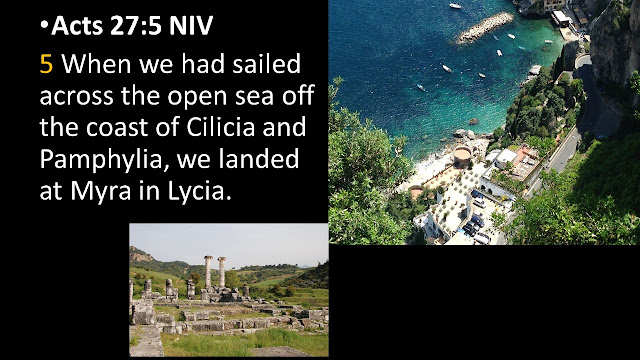
Their next stop was Myra in Lycia. Myra was the capital city of Lucia, located on the southern coast of Roman Asia (modern day Turkey).

Headwinds hindered travel of the ship which depended on a tail wind to propel it. The lee side is the sheltered side of the island away from the wind, as described in v.12.

The “Fast” noted in v.9 was the Jewish great day of atonement, which was always celebrated on the tenth day of the seventh month, which would coincide with the latter end of our September (from Adam Clarke's Commentary). V.11 tells us that the owner was also onboard. We shouldn’t be surprised at the centurion’s decision to follow the advice of the pilot and the owner, especially since Paul did not have any nautical experience.

At this time the storm was churning the sea and making it dangerous. Their current location wasn’t suitable for a long winter stay, and it was best thought to head to the more appropriate harbor city of Phoenix also on Crete as show on next slide.

Red arrows point to the Cape of Salmone (Sal-mo-ne) (v.7) and Fair Haven near Lasea (La-se-a) (v.8) The insert on this map shows the location of the island in regard to their final destination of Italy.

A “promontory” is a point of high land that jots out into the sea.

It’s interesting the amount of detail Luke provides, regarding the pending storm. It’s almost like we are there with them. Maybe that’s the Holy Spirit’s intent. The map shows the direction of the northeaster (dark blue arrow) sweeping across the island pushing them further out to sea.

Luke even goes so far as to name the small island they passed. This is the Word of God inspired by Holy Spirit, even in detail. Have you ever wondered why? Not just here, but elsewhere in the Bible. I believe it’s because God wants us to engage with the words and its message. In this case, the cost of sharing the Gospel came at a great price, something we’re not faced with, but many others around the world deal with it on a regular basis. That’s why our prayers should always be part of our reading of the Word, and for those Christians facing similar challengers.

This map provides a visual representation of Luke’s description passing the small island of Cauda, of this leg of their journey. Instead of sailing directly to Phoenix, as intended (v.12), the wind drove them south past Cauda.

In such a raging storm, it would be easy to lose hope. The storm was so fierce that they had to lighten their load by dumping cargo overboard, and lose the profit associated with its value (v.18). A big loss for both the cargo and the ship owners.

They spent three days wrestling with the storm. The crew most likely were experienced sailors, yet it was a struggle to the degree that they gave up any hope of being saved from the storm’s ravages. But Paul’s faith wasn’t in the ship or the weather, or the crew, it was in God Almighty.

If you were ever in a storm, you can get a sense of what it was like. I was in such a storm on a fishing boat in the Atlantic ocean. It was truly scary. It is hard to imagine unless you experience it or an event like it. Is the Holy Spirit’s message, that we need to experience the Word and have faith in Jesus Christ to guide us? I believe so.
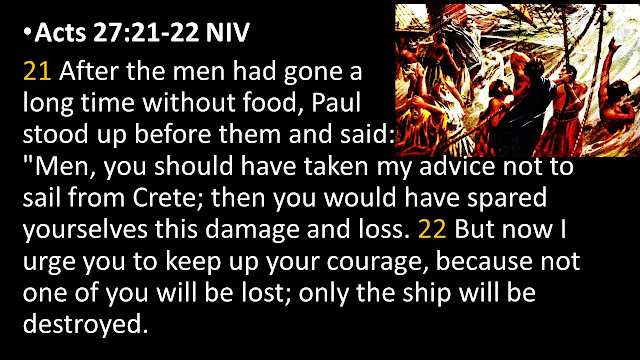
Luke describes the event clearly….on how Paul encouraged the crew. They were still in the storm as Paul spoke, and still very fearful. So, why should they get any comfort from Paul’s words? We can be certain Luke was comforted by Paul’s words.

Here we see an angelic visit. It implies that Paul was asleep when the angel appeared. It also indicates his confidence in God’s protection. How do we respond in the storms of life? Like Paul or like the crew?

Paul once again encourages the crew and all those onboard, but not without cost to the ship and its cargo. We can be certain that the owner may have lost heart realizing all of his cargo and its profits will be lost. Perhaps he had to pay some for the lost of their products. Either way it was a great weight for him. If he professed Jesus Christ in this event, he gained greater riches.

The sailors were at their last hope, as Luke emphasizes the depth of the sea to show that they were approaching land. Who were those aboard praying to, perhaps their pagan gods? Perhaps Paul had shared to gospel of Jesus Christ with them, before the storm. And now they are praying to Him.

The centurion believed Paul and ordered the soldiers to cut the ropes. With that cut, any hope that went with the lifeboats was gone along with the boats. Did this strengthen their hope in Christ? Luke doesn’t tell us.

In a time of uncertainty and danger, Paul offered encouragement and gave thanks to God, breaking bread as he spoke. Was it the Lord Supper? We’re not told. Perhaps his angelic vision literally brought additional encouragement to all aboard. Did it bring them to Christ? I think we can be sure it did for some, perhaps even most of them. This again, brings us to election and predestination, regarding whom God has chosen.

The fact that they ate food under the circumstances, in and of itself is encouraging. His encouragement worked and they followed his instructions to eat to retain their strength. Their last meal on ship, while the storm was still raging.

Last hope! Luke gives a detailed account that a sailor would recognize…neither Paul nor Luke were sailors. Unlike the other apostles, Paul was a Pharisee, Luke was a physician.

Can you picture yourself in this situation or something close to it? Did they lose their encouragement when they hit the sandbar, hoping instead to have reached the shore? For those who accepted Christ, it definitely would be a test of their faith in this new found God.

The soldiers were attempting to follow their training and not let prisoners escape under any circumstance (v.42). A soldier that disobeyed was severely disciplined, except for their order from the centurion. What did this centurion know about Paul to spare his life? It raises the question again, did he come to faith in Jesus Christ? Was he, Julius, the same centurion from Caesarea? Again, Luke’s account is jam packed like an adventure novel.

Julius’ kindness to Paul…and trust. The sailors, soldiers and prisoners onboard, did they come to faith? Since all of human history is laid out before God, past, present and future, at one time, can we pray for past events and people? If we prayed now, would God have taken it into consideration then? Just a thought.
End of
The Acts of the Apostles
Chapter 27


