Friday, October 15, 2021

Paul took the Gospel to a pagan world. Today’s America is every bit as much in need of God’s Word, as was the Roman world of Paul’s day. Too many of our young people have left the faith during their formative years at college. Can we as parents and grandparents make a difference? The next two slides tells us how. If not us, then who? 

Who would have thought that America could change so dramatically so quickly? America’s future depends on the direction of our youth, with far too many being indoctrinated on college campuses by left leaning college professors and student activists. What can we do as parents and grandparents? Visit Ratio Christi’s website at https://ratiochristi.org/about/

Ratio Christi, sharing Christ and Christian values with the college generation. What’s happening in America is a religious-secular movement, and the answer is Jesus Christ, at church and the college campus. 

Chapter 24 closed with Porcius Festus replacing Marcus Antonius Felix as Procurator, (a.k.a. governor) of Judea. The year was 59 AD. Upon leaving, Felix left Paul in confinement because he did not want to create unrest with the Jews. Chapter 25 opens with Festus traveling to Jerusalem, but first a brief review of the closing of chapter 24. 

A flashback to Chapter 24, with Paul under house arrest. No politician wants to be criticized, especially if it could damage their reputation and position. Such was the case with Felix. He could not afford to let the Jewish leaders’ criticism reach Caesar. It would signal unrest and potentially damage—i.e., diminish—his standing and reputation as governor of Judea. 

Early in chapter 24, Paul was taken by the Romans from Jerusalem to Caesarea following the route shown on the map. This is the route the Romans traveled—a distance of about 64 miles. Since bandits were common, we can be certain Festus traveled with a compliment of soldiers. Camels 30 miles/day. Donkeys 20 mi./day. Horses 25-35 mi./day. 

Chapter 25 opens in Caesarea Maritima and then onto Jerusalem. Once again, we see the Jewish religious leaders conspiring against Paul. Even though Jerusalem in south of Caesarea (map on previous slide), it is situated at a higher elevation, therefore going up to Jerusalem is noted.

Festus invited the Jewish leaders to accompany him to Caesarea to confront Paul face-to-face. If he is truly guilty, it would be determined there, and not in Jerusalem. Most likely he was aware of Paul’s Roman citizenship. 

Caesarea was the Roman capital of Judea, built by Herod the Great in 22-10 BC. You can see the temple near the bay. Our goal is to step into the events with visual aids, as we read about them. This is where most of chapter 24 took place. 

What it’s believed to have looked like. Most of which is in ruins today. 

A closer look at the temple, shown in the right image. Again, it was built by Herod the Great and dedicated to Caesar Augustus. At the time, Roman Emperors were glorified as gods. Pagan gods were worshipped in Palestine by the Romans and other Gentiles. We can be sure the temple priests in Jerusalem, not only hated but despised visiting that Roman pagan city. This helps set the stage for Paul’s trial. It had also been the headquarters of Pontius Pilot. 

So much biblical history noted in Acts are in ruins, equally true of the Roman Empire of Jesus’ day. Think about it as putting history into perspective. God has a plan, He always did. 

The goal of the temple restoration is to triple tourists visits to the area. It currently draws about 1 million tourists annually. Those pagan gods are no longer worshiped, and the temples devoted to them are mostly in ruins. 

Modern man’s fascination with the past. If you had visited that site, I would like to hear from you. Luke’s message written in the Acts of the Apostles is as relevant today as it was then. The Word of God endures forever, and is relevant for each generation. 

We’re not told how many members of the Sanhedrin were there, but enough to "stand around Paul". They viewed Paul as a threat to their position and their belief that there was no resurrection. If Jesus truly rose from the grave as professed by Paul, their belief would be in error, which would undermine their authority and credibility; something they would not tolerate. 

Just as Felix wanted to avoid confrontation with the Jewish leaders, the same was true of Festus for similar reasons, especially as the new governor whose primary role was to maintain order. So here we see Paul facing yet another potential trial in Jerusalem, where local mobs could and would be incited to create a hostile situation and even riot, shouting accusation against Paul, just as they had against Jesus. 

Paul states that if he was guilty, then he deserved to die, but he proclaimed his innocence. He reminds Festus that as a Roman citizen he is under Roman law—and not mob rule as would happen in Jerusalem. Paul, as a Roman citizen, is not just proposing, but demanding to be sent to Rome to appear before Caesar. 

The decision let Festus off the hook. He thus avoids getting himself in how water with Rome, that complaints against him by the Jewish leaders would have caused. He could have freed Paul, but not without Jewish backlash, who most likely would have forwarded their complaints to Rome and Caesar, something Festus certainly did not want. 

Another dimension takes place with King Agrippa arriving. He most likely traveled from Caesarea Philippi where his palace was located. Bernice was Agrippa’s sister. He was appointed as King of Judea by Rome—and grew up in Rome. 

Agrippa is also called King Herod in Acts 12 where he arrested members of the Church, intending to persecute them. He also had James, the brother of John, put to death. More information on the next slide. 

(Chal-cis) (A-ris-to-bu-lus) 


Festus explains the guidelines of Roman law, in regard to Paul. Charges against Paul were religious, not legal in accordance with Roman law that applied equally throughout the Roman Empire. 

Festus continues his explanation. Once again, his goal is to maintain peace and order in Judea and yet, stay on the good side of the Jews. As he explained, their charges were religious concerning a dispute over Jesus’ death, and not legal under with Roman law. 

Yet, releasing Paul would be like pouring gasoline on an open flame. There were two options: the Sanhedrin in Jerusalem or Caesar in Rome. Since Paul was a Roman citizen, sending him to Rome was the safest choice politically. 

It may have been late in the day, so speaking to Paul would be delayed until the next day. Most likely Agrippa was tired from his trip. 

I’ll let this slide speak for itself regarding how Agrippa and Bernice traveled to Caesarea. It was noted that Bernice was living with him as his wife and later she became mistress to Emperor Vespasian and Emperor Titus. 

The following day, Paul was brought in to present his case to King Agrippa. 

Here, Paul addresses King Agrippa, while Festus and Bernice listened. Agrippa, being appointed king by Rome, had a lot of authority and ability to assert it. 

Once again Festus states that Paul did not break any Roman laws and therefore did not deserve death; so at Paul’s request, he would be sent to Rome to appear before Caesar, which left the Jews without a trump card against Festus for not turning Paul over to them. 

Even King Agrippa would not voice opposition to Roman law. Since Paul didn't break Roman law, Festus had no legal charges against Paul for the Emperor. What charge does one lay on an innocent man? We won’t know until chapter 26. / chapter 25 ends here at v.27.

Just the facts! The value of Roman citizenship is once again Paul’s defense against the Jewish religious leaders who were destined to have him killed. We see God’s sovereignty from the moment of Paul’s birth, being born of Jewish parents who held Roman citizenship in the city of Tarsus, a principle Roman city in the province of Cilicia, Asia minor.  

We close chapter 25 with Paul before King Agrippa. Rome’s power, like a modern day politician, is swayed by unrest or pushback by the people. Yet Paul’s Roman citizenship by God’s sovereignty, was his escape from the Jewish religious leadership, opening the door for sharing of Christ with a pagan world. A similar challenge exist on our college campuses today. 

See Adrian Rogers message on the next slide. Think about Ratio Christi’s efforts on college campuses as you watch Adrian Rogers message. America’s future rests in the hands of our young people, especially those in colleges across the country who are being influenced and even indoctrinated by the far-left secular world.

A message that is very relevant today. Pastor Adrian Rogers 43-minute message, “The Generation to Come and the America of Tomorrow.”  https://youtu.be/ucf444GCFzM  (copy and paste in your web browser)

End of
The Acts of the Apostles
Chapter 25

Friday, October 8, 2021

The Bible is the inerrant Word of God, Who gave it to us, not just to read in our spare time, but to pray over and ponder. As we approach the final chapters of Acts, there is a constant message about sharing Jesus with the world. Our world is a lot smaller than Paul’s and yet a lot larger than Paul’s, and just as wanting for Jesus Christ. Paul shared Jesus by word of mouth; we have so many other means of doing so. Think about it and pray about it. I do exactly that every time I post to this blog. Our faith in Christ is from God through the Holy Spirit. As Pastor Adrian Rogers said in one of his sermons, we are the 29th chapter of Acts. God never asks us to do what He doesn’t enable us to do. 

Ratio Christi is Latin for “The reason of Christ”. The darkness entering America began on college campuses decades ago. Students in our churches are often ill-prepared for the challenges to their faith that they face on today’s college campuses. We as Christian parents and grandparents can help make a difference by supporting Ratio Christi. Just as Paul brought Christ to a darkened pagan world, we can help bring Christ to today’s darkened college campuses. 
https://ratiochristi.org/about/  (copy and paste into your web browser)

Have you every really thought about Acts and where it is taking us?  It’s history of the infant church, written via the Holy Spirit’s inspiration, and a roadmap for us today. It’s also about sharing Jesus with a world in need of a Savior. See Adrian Rogers message at the end of this chapter AND visit Ratio Christi’s website regarding how we can help, right here and right now, as parents and grandparents of college age youths. If we don’t care, who will?

When and how did the infant Christian Church, professed by Peter, Paul and the other Apostles, become the Roman Catholic Church? What led to the 16th century Protestant Reformation? Join us Sunday morning as we explore this question. 

John 14:26, in the NKJV the Holy Spirit is called “Helper”. As we read God’s Word, we can call on the Holy Spirit, the Counselor and Helper, to guide our understanding and its relevance to today’s world. 

Chapter 23 ended with Paul being brought before Governor Felix in Caesarea and placed under arrest in Herod’s palace. As we go through Acts, keep in mind, it was written by Luke as inspired by the Holy Spirit. Chapter 24 marks a turning point for Paul. 

May the Holy Spirit, the Helper and Comforter, open our minds and hearts to His Word and the wisdom in applying it in our life in thought, word and deed. 

V.1 picks up five days after the soldiers brought Paul before Felix with a letter of complaint against Paul. Ananias, the high priest arrived with their lawyer, Tertullus (Ter-tul-lus)—who was versed in Roman law, and who was to present their case against Paul. He begins with compliments to the Roman governor (v.2-3). The reality is that the Jews had no love for the Roman nor any desire to be under Roman rule. 

Rome was very sensitive to riots in their provinces, and it was the responsibility of the Roman governor to maintain peace and order. The case being made against Paul, though untrue, was that he had created disorder, not just in Jerusalem but elsewhere in the Roman Empire, a violation of Roman law. 

V.7 which appears in the NKJV, but not in the NIV, reflects the mood of their charges, with a degree of exaggeration to further enhance the charges. Lysian (Ly-si-as) was the Roman commander who rescued Paul from the crowd in Chapter 22:23, where the Roman soldiers carried Paul away. The violence was on the Jewish side and certainly not the Roman side. 

The way to make a lie sound like the truth is to emphasize it over and over, especially with loud accusations—something we would label as “fake news” on the mainstream media when something political is misrepresented and repeated almost verbatim on the other like-minded networks. 

Paul states his case noting that the charges are untrue. 

Paul states that he is a follower of “the Way,” thus proclaiming his belief in a physical resurrection. And that he has done nothing wrong in the eyes of God or man, nor did he violate Roman law. 

In v.17 Paul recounts his absence from Jerusalem—the time of his three missionary journeys. And that there was nothing in his actions when he was arrested, that warranted those charges. 

Paul continues to emphasize that there was absolutely no reason for the charges against him other than his stated view of the resurrection of the dead; which we know refuted the Sadducees' belief that there wasn't a resurrection nor an afterlife. 

Felix wanted commander Lysias’ testimony and postponed the hearing until his arrival. 

Scripture doesn’t explain whey Felix asked to see Paul at this time. Perhaps his Jewish wife’s curiosity concerning Paul and the rumors she may have heard concerning him and what he professed regarding "the Way". 

The truth comes out. Like many holding high office throughout history, Felix expected a bribe from Paul to dismiss the charges against him. These verses show Felix’ true colors as we conclude chapter 24.

The injustice against Paul is pretty revealing of the character of the Sanhedrin and Roman governor Felix to weight his decision regarding Paul, based on a bribe. The same is true in much of global politics today. 

The Holy Spirit is our Comforter, as He was Paul’s Comforter. Ask the Holy Spirit for direction for our life as He would have us live it. Today’s world is every bit in need of the Gospel message as was the first century Roman world of Paul. Which takes us to Pastor Adrian Rogers’ message via the next slide. 

Pastor Adrian Rogers 38-minute message on “learning to share Jesus”. Let me pause for a moment to reflect back on Ratio Christi, whose goal is to share Jesus Christ on college campuses, which is only possible with the support of those who share their goal. 
https://youtu.be/YjXj7P0kv3c  (copy and paste into your web browser).

End of
The Acts of the Apostles
Chapter 24

Friday, October 1, 2021

We are called to be a light in a darkened world. 

Many people never heard the good news of Jesus Christ. Oh, they heard His name—generally as an expletive—but were never told that we are sinners in need of a Savior. We heard about Jesus because someone reached out to us; perhaps a parent, a friend or even a neighbor, who first shared the gospel with us, that led us to faith in Jesus Christ. Perhaps in these uncertain times, Jesus is calling us to do the same. 

God could very well be talking to the USA, proclaimed throughout our history as "One Nation under God". His Word is eternal. How do we, as a Nation, turn back to God? Perhaps one person at a time. 

Our Sunday class was not held in 2020 due to the covid-19 shutdown, which is why I created this blog. The question before us is how can we be a light in a darkened world. We have resumed in 2021 with our Sunday morning studies. Please join us.

Chapters 23–26 covers a two-year period of time from the summer of AD 58 to the fall of AD 60. There is a lot of background information in this chapter, so it was divided into two parts. Yes, I know you read Acts several time, but did you also delve into the background information to further understand its message? Now is your opportunity, as we continue with Chapter 23. 

The Sanhedrin were the Jewish religious leaders, the very ones responsible for Jesus' crucifixion. 

They retained the same sense of pride and jealously that killed Jesus. If they accepted Jesus as Messiah, their authority would cease. No one in power, readily relinquishes their power, and generally will do anything to retain it. Sadly, we are seeing it in our own federal government. Definitely a call for prayer. 

But, their power was to cease a lot sooner than they anticipated when Jerusalem was destroyed by the Romans in AD 70, only a decade later than the events reported in the Book of Acts. 

Jewish outrage against Paul did not subside, yet the Pharisees found no guilt in Paul, especially being a Pharisee, himself. The Sadducees claimed there was no after life, and no angels. If Jesus had risen, as Paul claimed, their denial of an afterlife would be totally debunked. 

While still under arrest, Jesus appeared to Paul. We see the sovereignty of God in this verse. Paul would now be going to Rome in accordance with the Sovereign will of God. God used both Jewish hatred and Rome’s adherence to law to achieve it. 

A contingency of Jews conspired to kill Paul. If you can’t win the debate, then you kill the opposition—in this case, Paul. They are religious leaders of the Jewish people and nation, yet, lying and murder was acceptable to them for the circumstances. 

Deceit was their principal weapon. It is still a weapon in the very halls of Congress and even promoted by some of the mainstream media—referred to as fake news. All of which reflects Adam's fallen nature, and why repentance of sin and faith in Jesus is so important.

This is the first mention of Paul’s family members—in this case his sister’s son—who were in Jerusalem at the time. Paul asked the soldier on duty to take his nephew to the commander. We will take a further look at Paul’s family at the end of this chapter. 

It probably didn’t surprise the commander, who most likely was well aware of the Jewish leaders’ methods even in their dealings with the Romans. 

The young man, Paul’s nephew—his sister’s son—reports to the Roman Commander, the plot against Paul. 

The Jews, 40 of them, took an oath not to eat or drink until after they killed Paul. We can only wonder how long their fast lasted, after Paul’s escape. 

God protects Paul, using a large contingency of Roman soldiers, who take him to Caesarea, the Roman capital of Judea—where the first Gentile convert, a Roman centurion, accepted Christ by Peter's witness (Acts 10). It was the most important city of Roman Palestine. The military detail wasn’t to fight the 40 Jews waiting in ambush, but to serve as a deterrent against their attempt to kill Paul. 

God protects Paul using the Romans to take him to Caesarea to stand before Governor Felix, with a letter explaining the situation. 

Here the commander’s letter continues. God’s sovereign hand can be seen in this situation. Being born a Roman citizen was God’s plan to both guide Paul on his missionary journeys and to protect him as such. 

They had traveled at night to avoid ambush and the trouble it would cause if they killed those Jews. When it came to religious disputes, they were often a volatile people and most likely there would have been mob outrage and ensuing chaos, which Rome wanted to avoid. 

(Anti-pa-tris) (Ci-li-cia). Paul being a Roman citizen, the governor agreed to hear the case against him. The next slide shows the journey. End of Chapter 23. 

Romans took Paul from Jerusalem, stopped in Anti-pa-tris and then on to Caesarea—a total of about 64 miles. 


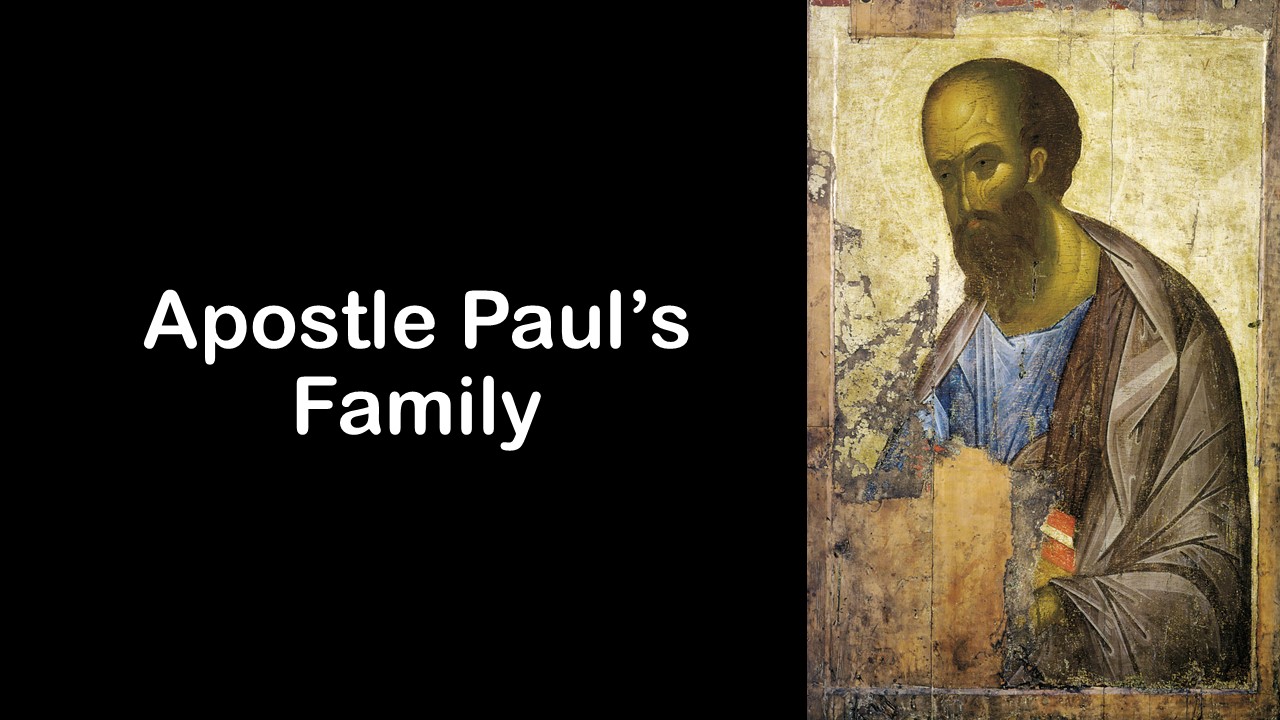
Since so much of Acts focuses on the Apostle Paul, have you ever wondered about his personal life, or if he had a wife? I have. I don’t just want to know about him, but I want to know him. Some day we will meet Paul in heaven, and the other apostles, as well. I think it would be nice to greet Paul on a more personal level. The background of Paul’s family was taken from gotquestions.org.   

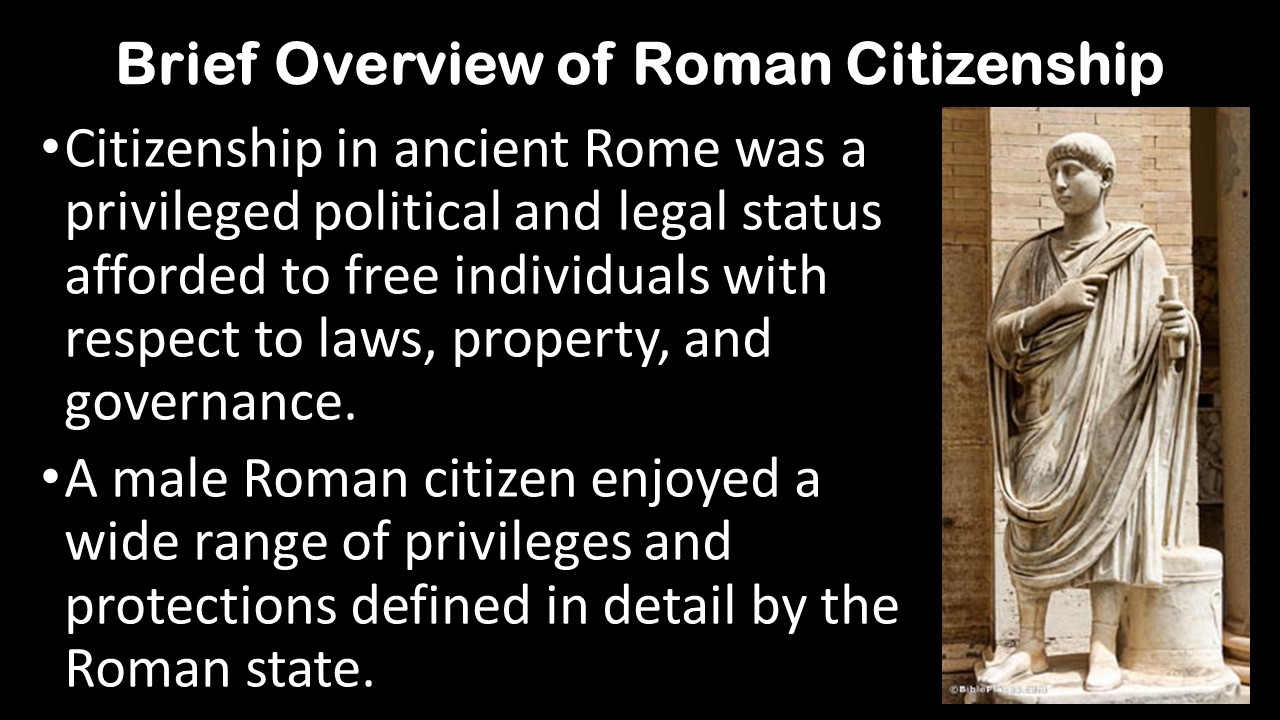
Paul’s birthplace, Tarsus was an important city in the Roman Province of Cilicia (modern Turkey). His father was Roman citizen and thus Paul was born a Roman citizen. The extent of the Roman Empire was much like the USA growing to 50 states from 13 colonies—like every other civilization, not everyone living there was awarded citizenship. 

Brief overview of the privileges of Roman citizenship. (Continued on next slide).

Women in Rome. 

Chap. 23 provided insight into the Jewish religious leadership, the Sanhedrin, being divided into two groups: Sadducees and Pharisees. Often typical of such leaderships, they were filled pride and a thirst for power and retaining that power. Also the importance of Roman citizenship. Paul as a Roman citizen from Tarsus, spoke Greek the common language of much of the Roman Empire, thus he could converse and write in Greek, equipping him to share the Gospel across the Roman world; a reflection of God’s sovereignty. 

End of 
Acts of the Apostles
Chapter 23