Friday, September 24, 2021

Chapters 23 – 26 covers a two-year period from the summer of AD 58 to the fall of AD 60. A lot of background information is included to further enhance our understanding. It makes for a long read, so I divided the chapter into two parts. Why is the background info important? It helps us to better understand God’s written Word, which doesn’t contain the background information, but definitely helps us to better understand the situation being written about. Since the chapter is being split, I suggest you read the entire chapter on your own. Understanding who the Sanhedrin is, is an important part of the New Testament Gospels and the Book of Acts. Since they were the religious leaders responsible for Jesus’ crucifixion.  

I see a lack of background information as watching someone read a script on an empty stage, versus going to the play with full costumes and period-stage-sets. But first and foremost, prayer should definitely be part of the Word, be it a quiet reading of the Bible, a formal Bible study, or the postings on this blog. It is the Holy Spirit that opens our hearts and minds to what He is telling us—better yet, what He is teaching us. 

We ended chapter 22 with Paul being brought before the Sanhedrin. His preaching at the temple created a disturbance. This led to Paul’s arrest by the Roman centurion, who brought him to the Roman commander because Paul was a Roman citizen. The commander brought him before the Sanhedrin to determine the cause for the disturbance, which is where we find Paul now. 

Standing before the Jewish leaders, Paul, being a Pharisee and knowing Jewish law, called them out for the hypocrites they were. 

By Jewish law and culture, the high priest was to be respected. Paul’s comment was disrespectful, for which he apologized, not recognizing him as the high priest. Not only does Paul apologize but quotes the very Jewish law he had unintentionally violated. 

Other Jewish leaders were also gathered there as we see in v.6. The gathering consisted of two groups that comprised the Sanhedrin, the Pharisees and the Sadducees. Paul played on his knowledge of their different beliefs, which we will see in the next few slides. Their different beliefs were significant resulting in a long-standing split between them. 

The two distinct religious groups held very different views of the afterlife, which we will be discussing in our Sunday Foundation’s study in Heritage Lounge at 9:00. It would be well worth your time.
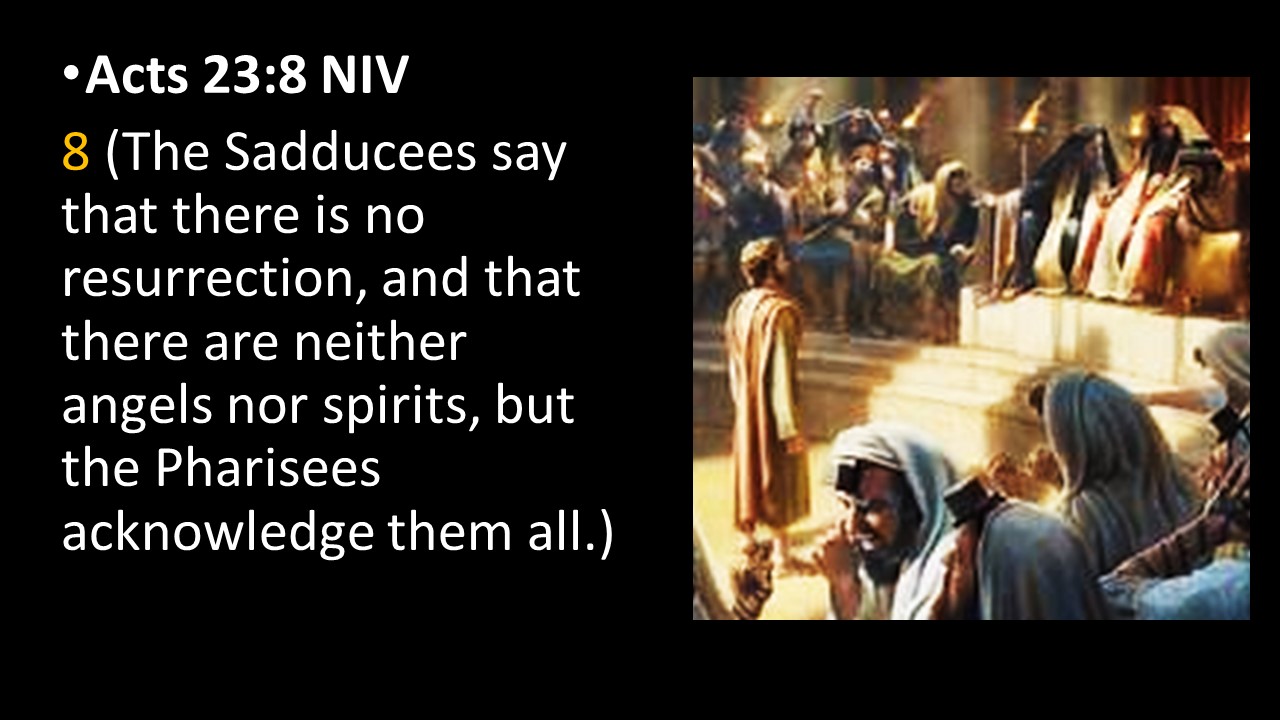
This verse gives a brief explanation of the differences between the two groups. Since the Sadducees did not believe in the resurrection of the dead, it’s surmised that they did not believe in an afterlife. Does that mean they would strive for all the gusto they could get in this world? Highly probable. The proud generally strive for power and prestige. We see the same in the political arena of today, with a lust for power outweighing policy. 

We will pause here to provide insight into the two groups that comprised the Sanhedrin, the Jewish ruling religious class. Both of whom played a significant role in the life of Christ including His crucifixion. 

The Jewish leadership was comprised of these two groups as previously noted. We’ll explore the differences in the next couple of slides. Image shows where the Sanhedrin met within Jerusalem's temple in a place known as the "chamber of hewn stones"—enlarged on next slides (although they sometimes met in the house of the High Priest). 

Images show where the opening verses of chapter 23 took place. 

Another view of the Sanhedrin’s meeting chamber.

The Sadducees were what we would refer to as the “aristocrats”, the upper-class Jews of the day. A member of whom served as the High Priest (image). 

The Sadducees, who didn’t believe in an afterlife, wanted to retain their authority, which also meant staying on the right side of the Romans. Does a similar attitude seem to be increasingly prevalent in today’s political world, with some, perhaps many, seeking power and fortune first and foremost. We can learn a lot about the world around us from God’s Word. Keep our Nation in your prayers. 

The Sadducees power was based on Rome’s approval, and consequently, they did everything to avoid Rome’s displeasure. Rome was interested in maintaining order, and the Sadducees did everything to avoid situations that would stir a group’s anger, that could incite a riot. This is why Jesus Christ had to be eliminated, too many people were starting to follow Him instead of them. And now Paul, may be doing likewise professing this same Jesus once again as the promised Messiah, especially with Paul being a Pharisee. 

A reminder, Saul (aka Paul) was a devout Pharisee in faith and practice, so much so that he participated in the stoning of Stephen, the first Christian martyr, as a Jewish heretic (Acts 7:57-59). 

We see something similar in the Christian Church. The Roman Catholic Church put long-standing church traditions on par with Scripture for faith and practice. The Protestant Reformation was predicated on Scripture alone. We will be looking at this further in our Sunday morning Foundation studies at 9:00 in Heritage Lounge. 
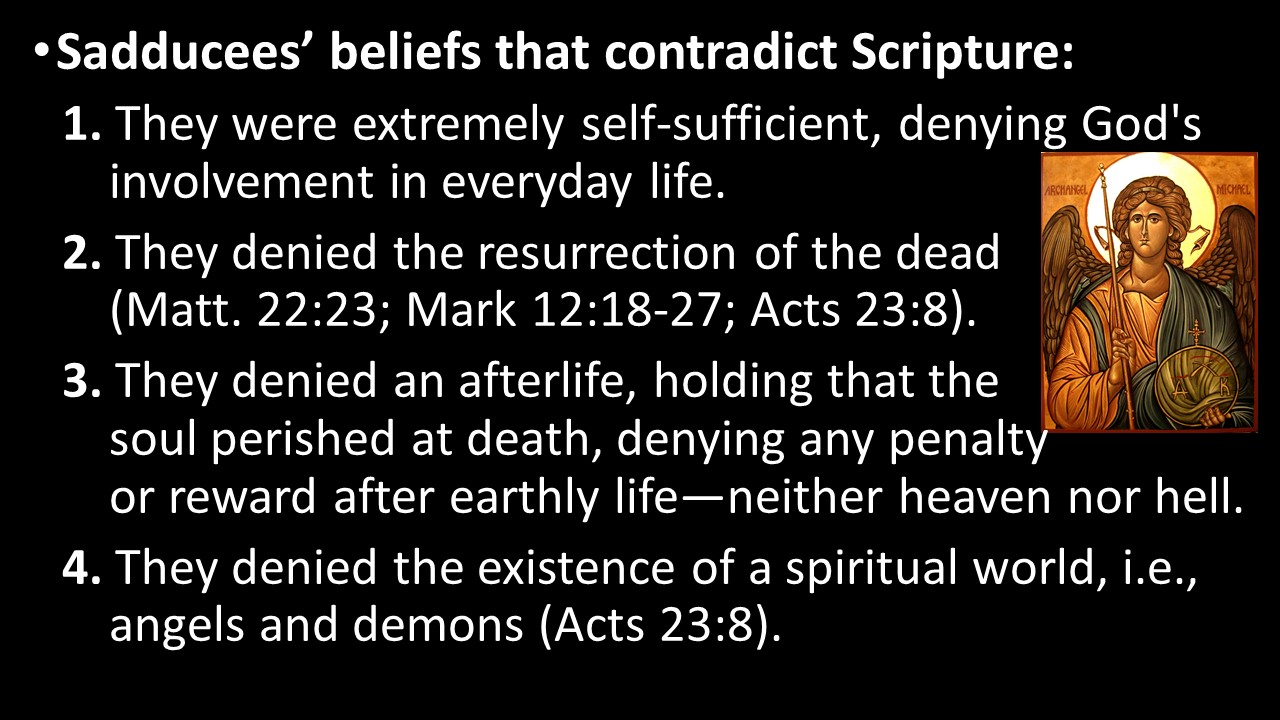
Acts 23:7-8 (The Sadducees say that there is no resurrection, and that there are neither angels nor spirits, but the Pharisees acknowledge them all.). Early church icon of Michael the Archangel (Jude 9; Rev. 12:7).

Pharisees were not from aristocratic families, but generally from those who conducted trades, such as Saul of Tarsus family, who were tent makers. 
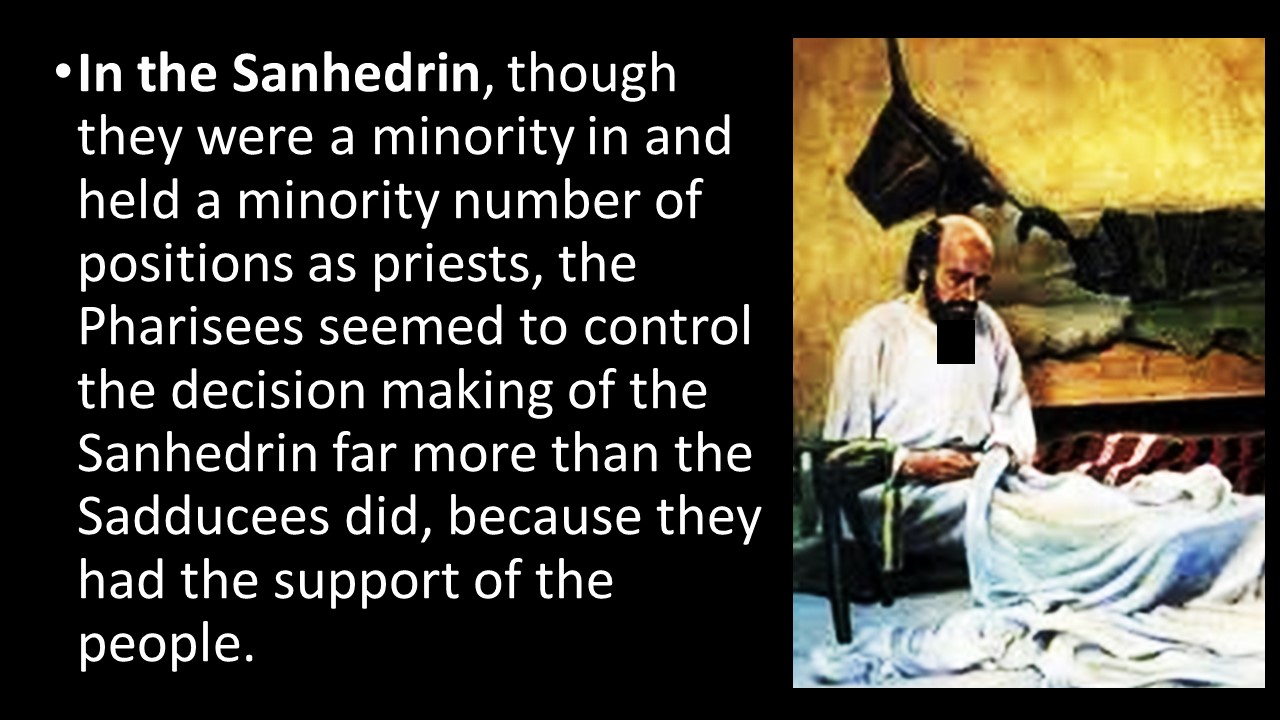
As we saw in Acts 18:3, Paul performed the trade of tentmaker.

Jewish law at the time was based on Mosaic law and tradition. The Mosaic Law consisted of 365 negative commands and 248 positive for a total of 613 commands.

In bringing Christ to the Gentile world, Paul rejected the premise that Jewish law was essential for salvation as demanded by the Judaizers. The Protestant Reformation came about based on Scripture alone for faith and practice, part of our Sunday study. 

As the religious leaders, Pharisees couldn’t afford to allow Paul to profess Christ, and have the people turn away from their authority.


What the Pharisees believed, continued from previous slide. 

Again, the Sanhedrin couldn’t afford to allow Paul to profess Christ. If the people accepted Jesus, they would reject the authority of the Sadducees and Pharisees and condemn them for killing the promised Messiah—thus they would no longer be the religious leaders of Israel, and perhaps even cause a Roman backlash. 

Our country is drifting to a dark place, and only God can help us, or even save us as the Nation we were created to be as One Nation Under God. Pray that the Holy Spirit will open the minds of those in Congress and the White House to realize the damage that is being done by poor decisions and misguided policies. Pray for our pastor and his family, for our church and its Session. In Jesus' name, Amen!

End of
The Acts of the Apostles
Chapter 23 (part 1 of 2) 

Friday, September 17, 2021


Chapter 22 opens where chapter 21 ended with Paul’s speech to the Jerusalem Jews on the temple steps.

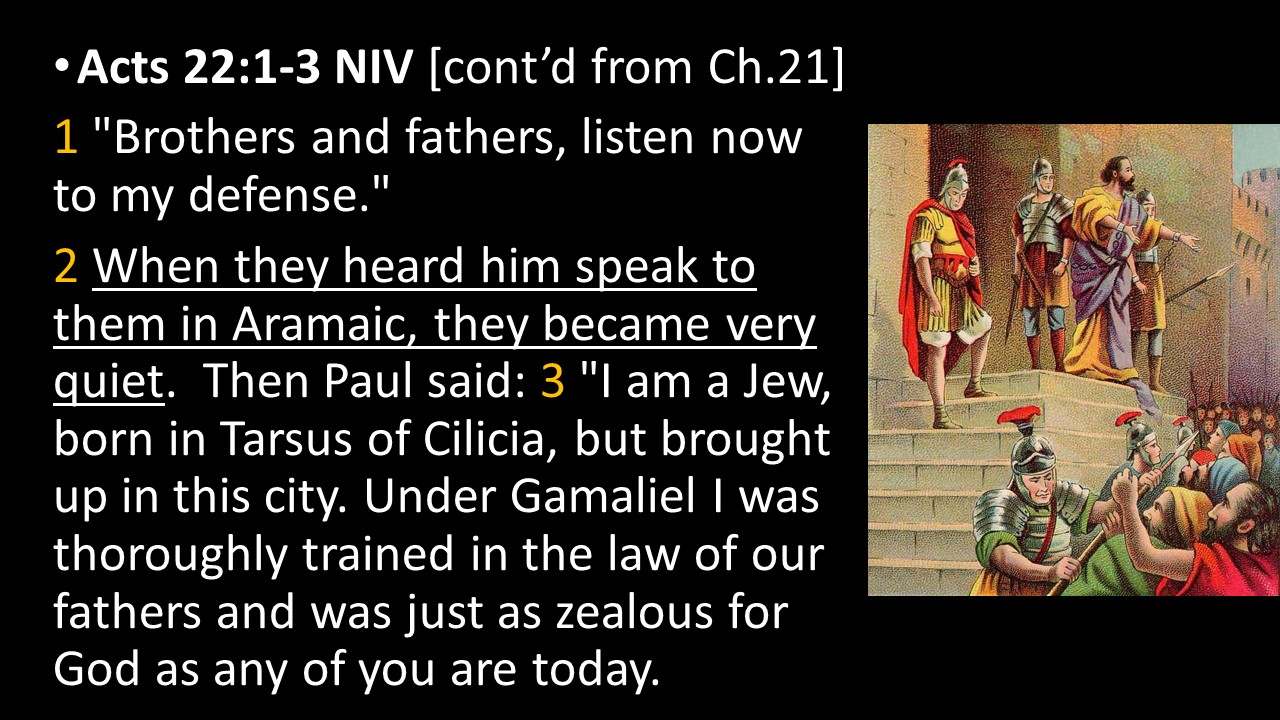
In the closing verses of chapter 22, Paul, being under Roman arrest, stood facing the angry Jewish crowd. V.1 picks up at that point, with Paul still facing them from the temple steps, as shown. He continues to address them in Aramaic, explaining his background as a Jew, that he studied under Gamaliel (a respected leading authority in the Sanhedrin) and as such Paul was thoroughly knowledgeable about Jewish law, and had been just as zealous as they were for the law. 

Continuing in Aramaic, Paul tells them that he once believed as they do, even persecuting those of “the Way”—what Christians were called, believed to be a heretical Jewish sect. He tells them that the High Priest and Temple Council could testify to the truth of his statement, having been originally authorized by them to do so. 

Paul explains how Jesus appeared to him while he was traveling to Damascus to arrest those of the Way, and bring them back for punishment and possibly even stoning as they had done with Stephen (Acts 7:57-59). 

Paul continues explaining his encounter with Jesus. Ananias, though a Jewish-Christian, still observed Jewish law. Does it contradict grace alone through faith alone? As I would see it, being a true born-again follower of Christ, he knew he was saved by grace and not by religious observances. How significant is that? If you join us on our study of Galatians, Sunday at 9:00 in Heritage Lounge, you will see the full significance of this issue, and how it changed the Christian church in the 4th century, and why. 

Most likely Ananias saw Jesus as the fulfillment of the Old Testament including His compliance with and perfect observance of the Mosaic Law. What does it mean (v.14) to be “chosen?” Why baptism? Was it necessary for salvation? If so, it was contrary to everything Paul taught so far in Acts (and Galatians and his other letters to the church). Again, join us each Sunday at 9:00 in Heritage Lounge, as we discuss these important topics, for a deeper understanding of our faith. 

Explanation of Acts 22:16, downloaded from “Got Questions” on the web:  https://www.gotquestions.org/baptism-Acts-22-16.html

A further explanation from “Barnes’ Notes, commentary”. Baptism is symbolic of what we received by grace from the Holy Spirit. We know that Jesus didn’t need baptism for forgiveness of sin, it served as a symbol of repentance and saving grace. We will be discussing this further in our Sunday studies, at 9:00 o'clock in Heritage Lounge. Join us. 

God could have sent a legion of angels to protect Paul, but instead Jesus warned Paul to leave Jerusalem. 

Paul recounts his persecution of “the Way”. Why did Jesus send Paul out of Jerusalem? His plan for Paul was to share the Gospel with the Gentile world. He was the only Apostle, as recorded in Scripture, to be sent to the Gentiles, other than Peter with Cornelius the Roman Centurion, back in chapter 10.  

Here we see the benefits of Paul’s Roman citizenship. We also see the sovereignty of God in where and when Paul was born, which predetermined his Roman citizenship. The Gentiles, as noted in v.21, was the trigger that raised the anger of the Jews who hated the Gentiles, and Paul for reaching out to them. Again, being a Roman citizen was a position of influence. 

Again, we see the merits of where Paul was born as a Roman citizen, which he notes to the Roman centurion as the soldier was about to flog him. It must have hit the centurion like a ton of bricks. If he had Paul flogged, he himself would have violated Roman law, and be subject to flogging as well. 

Again, Roman citizenship was not only valued but carried significant benefits, as we see in this account. Paul's father either bought his citizenship or was influential and earned it, which was passed on to Paul. It clearly shows God’s sovereignty in regard to His plans for Paul and his ministry to the Gentile world. He was born a Jew, in the important city of Tarsus in the Roman province of Cilicia. He understood and spoke Greek and lived in the Roman/Greek culture, yet he was educated as a Pharisee, and could easily debate with the Judaizers who insisted that Gentiles who became Christian must observe Jewish law for salvation (join us Sunday morning as we continue to study this in detail. It's not to late). 

Paul’s Roman citizenship alarmed not only the centurion, but also the commander, as we see in this account. Again, we see predestination, in regard to the apostle Paul: born a Jew in the important city of Tarsus in the Roman province of Cilicia. He understood and spoke Greek and lived in the Roman/Greek culture, all of which equipped him to bring the gospel to the Gentile world. 

Map shows the location of Paul’s birthplace, Tarsus in the Roman province of Cilicia, now part of modern Turkey; almost all Muslim today. Does God have a plan to bring Christ back to that region? These are the types of studies we will be looking at each Sunday in Heritage Lounge. Join us. 

If Paul wasn't a Roman citizen he would have been flogged sufficiently to satisfy the angry Jewish crowd. The question for the commander is "Did Paul break Roman law?". He brought him before the Jewish leaders to make that determination, which is continued in chapter 23, to be picked up next week. 

A principle message in chapter 22 is how Paul, a Jew, was equipped by God to bring the Gospel to the Gentile world. Even the very existence of the Roman Empire made it possible for both safe travel and a common language. Again, we will be discussing this during our Sunday studies in Heritage Lounge. A brief summary of Paul: Born in the important Roman city of Tarsus, born of Roman-citizen parents, which made him a Roman citizen. He was raised in the Greek/Roman culture and spoke Greek and able to communicate with the Gentile world across the Roman Empire. Educated as a Pharisee which gave him an understanding of the law, and touched by the Holy Spirit which gave him understanding of grace. A clear example of God’s sovereign decree over history and even individuals, including you. What's God's plan for your life? He has one. 

The America we knew and loved is changing for the worse and needs God's grace. Pray for America, for its people that they may turn to God, and that the Holy Spirit may intercede against evil in our own federal government. Pray for our pastor and his family, for our church and its Session. In Jesus' name. Amen! 

End of
The Acts of the Apostles
Chapter 22

Friday, September 10, 2021

Only God’s grace and His Word can straighten this dark world out. The Apostle Paul faced a similar dark pagan world. Keep a prayerful mind and heart as we go through His Word. We are looking at the infant church as reported in Acts, but the lessons also apply to the church in today’s darkened world, sorely in need of the Savior.  


The great commission wasn’t just for the 1st century apostles and disciples. We also are His witnesses. Those who received Jesus Christ as Lord and Savior continued to spread the gospel message to the far reaches of the known world. We as the church are commissioned, under the power of the Holy Spirit, to do likewise. Those early Christians risked their lives in sharing their faith; but by God’s grace, we don’t have to risk ours. We see the same message in Pastor Scott’s Wednesday study on the Great Commission. We have the Holy Spirit to empower us to share the Word of God’s grace with a world in dire need of Jesus Christ. Worried about the direction of the United States? God can put it back on tract through His people, but with prayer, word and deed, and yes, even at the ballot box. God fearing people in government can and will make all the difference.  Keep that in mind as we go through our study of Acts. 

Chapter 21 opens with Paul in Miletus, a seaport in Roman Asia, south of Ephesus, preparing to depart for Jerusalem. Both Acts and the Gospel of Luke were written by Luke who accompanied Paul on much of his travels described in Acts. Both books were written to the 1st century church, which are also for today’s church through the guidance of the Holy Spirit. 

Chapter 21 picks up where chapter 20 left off, with Paul saying goodbye to the Ephesian elders that traveled to Miletus to say their goodbyes. V.1 notes Paul and his companions’ emotional farewell to those Ephesian elders. Not just a warm friendship, but a show of true Christian joy. Paul’s sea voyage is noted, beginning in v.2, describing his return to Jerusalem. 

The noted stages of Paul's journey were daylong trips from one harbor to the next along the conventional sea route keeping close to the southern coast of Asia Minor (modern day Turkey), then to the open sea past the southern coast of Cyprus to Tyre. From there they continued by boat to Ptolemais where they disembarked and continued by land to Jerusalem.

They docked at the port city of Tyre (noted by star)—which was an important location in the region’s trade route. Image on right show a layout of the island city, connected to the mainland by a causeway. 

Their “time being up” in v.5 was after the ship had finish unloaded its cargo destined for that location, and perhaps loaded additional cargo for the next stop. In spite of the risks, Paul was still determined to return to Jerusalem. When Paul and his travel companions boarded the ship to continue their trip, the other Christians returned home. 

Since Luke doesn’t give us the names of the “we” it's safe to surmise they are the same men that accompanied Paul back in chapter 20:4-6 (noted on the next slide). Ptolemais is a seaport city in the province of Galilee. V.9 may indicate that Philip’s daughters, who prophesied, were teachers in the church, since this is a frequent meaning of the word prophesy. 

A reminder of who Paul’s travel companions were from chapter 2.... (So-pa-ter), (P-rus), (A-ri-star-kus), (Se-cun-dus), (Ty-chi-cus), (Tro-phi-mus) 

Here we see Philip the Evangelist, noted in v.8. Our travel through Acts has been a long journey, and it’s easy to forget some of it. So, here’s a reminder of who Philip the Evangelist is, who first appeared in Acts 6 through 8 including his encounter with the Ethiopian eunuch as shown on the slide. 

Agabus (A-gu-bus) is one of the 70 disciples described in Luke 10:1-24. He is thought to have been born in Pisidia Antioch. Acts notes a number of prophets in those days. Agabus received his prophecy from the Holy Spirit, regarding what lay ahead for Paul. The Gentiles noted in v.8 are the Roman authorities in Jerusalem. Noting the danger that awaited him, yet Paul felt compelled to return to Jerusalem. 

The “we” in v.12-14, most likely included Luke, Timothy, and the others who were accompanying Paul. Was the prophesy in v.11, a warning to Paul to stay away from Jerusalem? Yet, with little regard for his own safety, Paul apparently felt compelled to proceed, and that doing so was the Lord’s will, as noted in v.14. Paul did not know what awaited him, but he trusted the Lord’s will to return, even if it meant his life. 

In v.15, Jerusalem was south of them geographically, yet at a higher elevation, thus they went “up to Jerusalem.” Mnason (M-na-son) a Cyprian Christian (v.16) was apparently one of Paul’s early converts. In returning to Jerusalem, not only was Paul’s life at risk, but anyone accompanying him was also at risk. One reason for their trip was to bring gifts (financial support) from the churches in Asia to the Christians in Jerusalem, many of whom lost their livelihood for professing Jesus, as part of “the Way”—since Christianity was viewed as a Jewish heresy.

Paul met with the apostles and church elders in Jerusalem. Luke most likely was present in the “we” since he is the one who recorded the account. Paul was the “link” to the Gentile church for those in Jerusalem, many of whom had originally believed Jesus came strictly as a Jewish Messiah. 

Back to the same argument that Paul had encountered with the Jews throughout his travels. His message then and here is that both Jew and Gentile are saved by grace alone, not observance of the law of Moses or religious practices. Many wanted to remain Jews and yet follow Christ. Hard for Jews to walk away from culture and the Abrahamic Covenant that set them apart from the world. Yet, they did not understand that the Abrahamic covenant was based on Abraham’s faith, not his works. God formed His covenant with Abraham 430 before the Mosaic laws were even established. 

In Jerusalem, adherence to the Law was an essential part of the Jewish Covenant and culture, or they would be ostracized from family and community. This was no small matter. In v.24 they tell Paul “be a Jew” or face the consequences. Something that Paul would have to demonstrate if he was to be accepted. Paul never told the Jews that they had to abandon their religious observances, only that Gentiles did not have to observe them to follow Christ as Savior; because both Jew and Gentile are saved by grace alone and not by works, nor observance of the Mosaic Laws. 

The Mosaic Law was ingrained in the Jews. This takes us back to Acts 15—instructions for Gentile believers. This was not only needed, but necessary so as not to alienate Jew from Gentile believers. Also that we as Christians are not exempt from following God’s commandments (i.e., not Jewish customs), which isn’t the cause of our salvation, but rather the fruit of our salvation. 

Did Paul compromise? We saw in chapter 18:18, Paul had taken a similar vow. Again, Paul’s basic message did not tell the Jews they had to abandon their Abrahamic culture and observances when they accepted Christ as Messiah, but in no uncertain terms, they were not saved by them nor should they impose them on the Gentile believers.

Once again there was both anger and outrage against Paul by those Jews who were there from Asia for the Jewish holidays and recognized him. It was a custom for Jews from Asia and the Roman provinces to visit Jerusalem during the Feast days. These were the very ones that Paul debated with—their anger was inflamed at seeing Paul in the temple, since they considered him a heretic.  

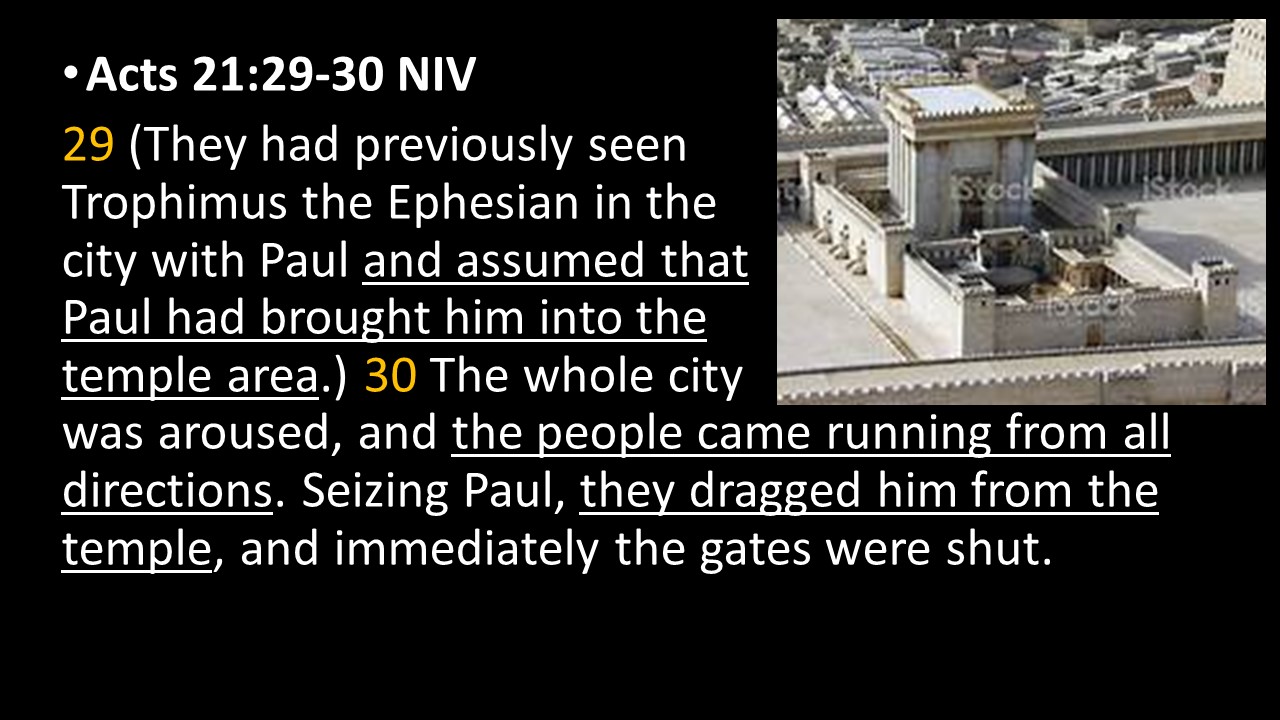
They wrongly assumed Paul took Trophimus into the temple area, forbidden to Gentiles, which he did not do. 

Layout of the Jerusalem temple. Gentiles were not permitted in any of the inner courts under penalty of death. It shows the outlining area where the Gentiles were permitted, but only those areas. 

The Jews were religious zealots, and not receptive to Jesus as Messiah. Roman soldiers were stationed in all major cities, including Jerusalem, to retain order. Once again, the Romans had to intervene, saving Paul from physical harm and possibly even death by stoning as Stephan was stoned to death under similar circumstances in Acts 6:12-7:60. 

Rome’s intent was to preserve order within the Empire. Outrage against Paul reached climax, yet their shouts and charges weren’t consistent. So the Romans took Paul into protective custody. 

In Acts 18:10, when in Corinth, the Holy Spirit told Paul, to continue preaching and not be afraid of attack or harm. Did Paul think it would also be true for him in Jerusalem? Nevertheless, God had a different plan for Paul in Jerusalem. 

The Roman commander confused Paul with an Egyptian who had started a revolt, but when Paul professed his Roman citizenship in Greek, the commander realized that Paul wasn’t that Egyptian—which could be the difference between life and death. A citizen of Tarsus, an important Roman city, apparently carried weight within the Roman Empire. 

Paul was given permission by the commander to address the angry crowd. Aramaic was in the Semitic language family—common language of Judea, also spoken by Jesus and the apostles. As was Greek in Asia Minor. We will pick up Paul’s defense in chapter 22.

We leave Paul under arrest by the Romans in Jerusalem. The fact that he was a Roman citizen and spoke Greek saved him from the outraged Jewish mob, and as a Roman citizen, placed him under protection of the Romans. The Roman Empire, under God’s sovereignty, existed and served as the platform for spreading the Gospel, including a common language and Roman law and order. “Pax Romana” (Roman Law and Order), was the basis of peace that existed throughout the Empire, including the cities Paul visited and protected Paul in his travels. 

Just as Paul faced perilous times in his day for speaking and spreading the Gospel, the United States of America is in perilous times today for neglecting and even suppressing the Gospel. Pray for our Nation, for our Pastor and his family, for our church and its elders, that we may serve God as He would have us serve Him. 

End of
The Acts of the Apostles
Chapter 21