Opening of chapter 10 takes us to a Roman centurial named Cornelius—commander in the Roman army—which is very significant.
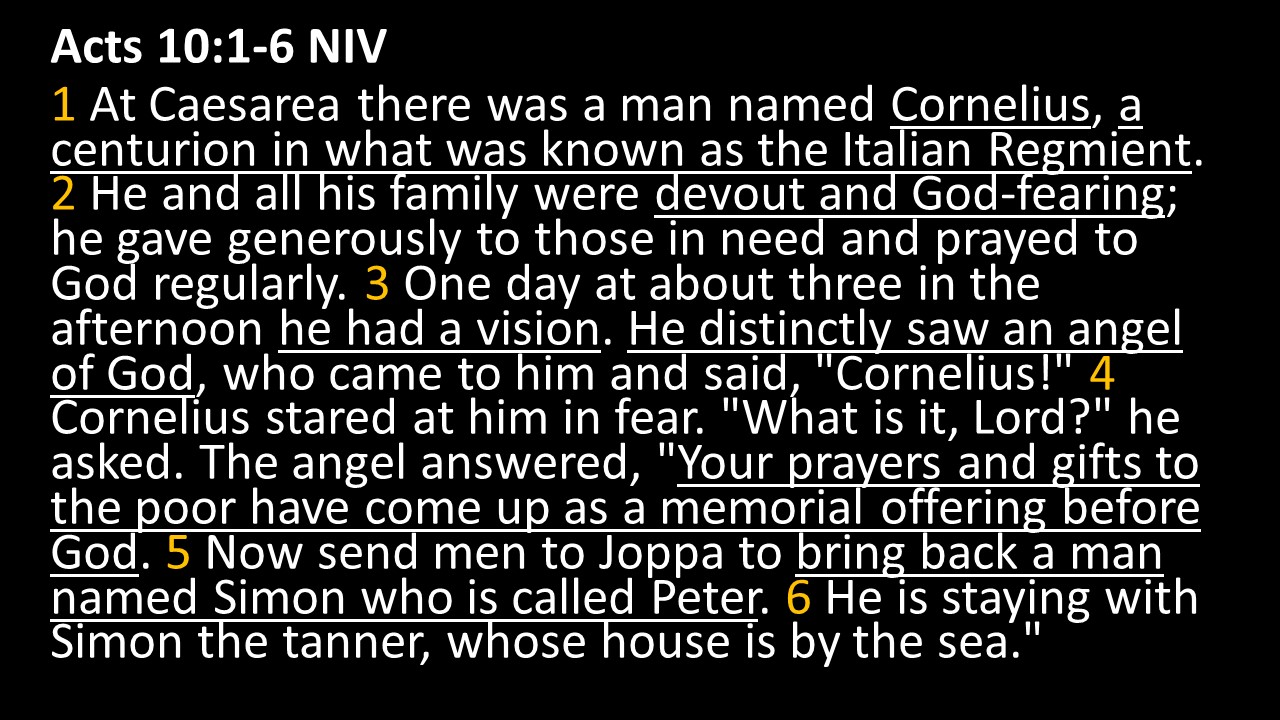
Chapter 10 takes us to the first Gentile Christians. Caesarea was the Roman capital of Palestine. Cornelius, as a Roman centurion, was someone of stature. Cornelius was singled out by God, Himself. V.4 verse tell us why.
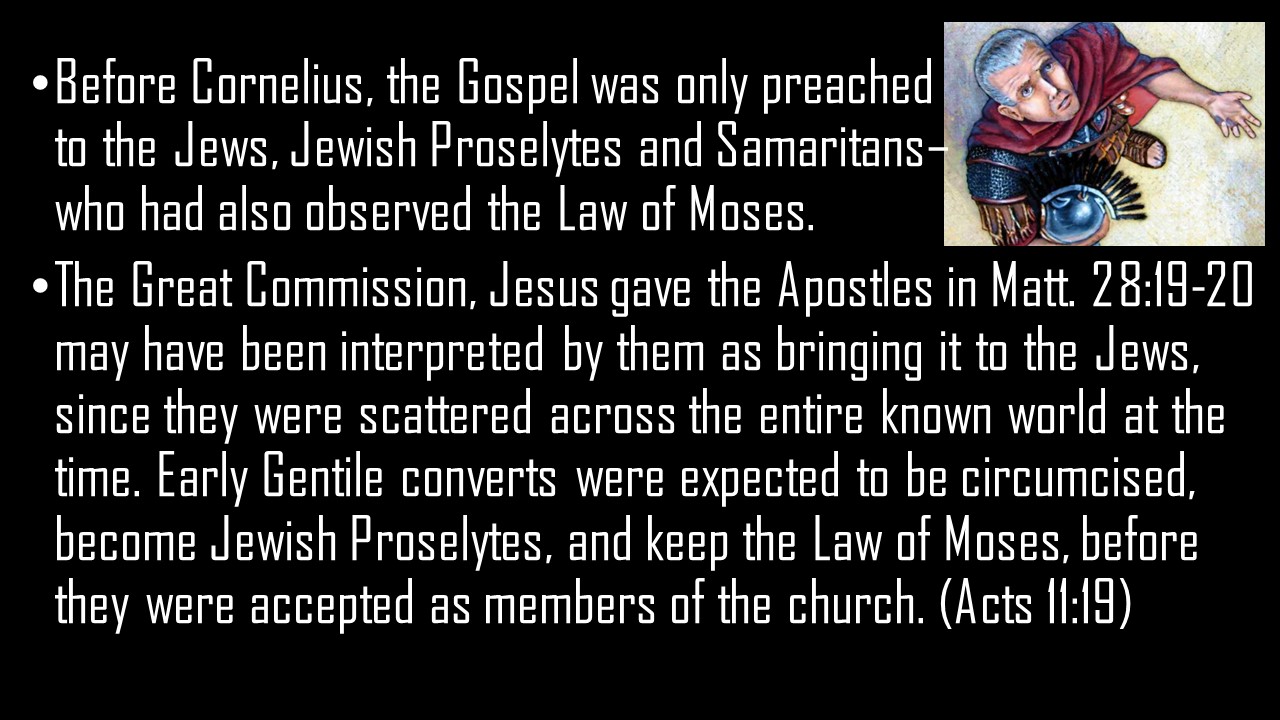
Being a Roman centurion, most likely Cornelius did not convert to Judaism—doing so, would risk his position. Many Jews believed Gentiles were “fodder” to fuel the fires of hell. For Peter to meet with Cornelius was a very big deal and out of character for Peter.

First bullet refers to troops draw from Italy outside the vicinity of Rome, and across the Italian peninsula, as shown on the next slide.

First century Italy, being part of the Roman Empire, had very defensible borders with the alps in the north and being surrounded by the sea everywhere else.

In v.7-19, Peter is prepared in a vision to bring the Gospel to the Gentiles as shown by the mix of unclean animals in the sheet. All of which, prepared him for the arrival of Cornelius’ representatives—all or at the very least most of whom were Gentiles. Up until that time, the Gospel was only preached to the Jews, and then afterward to the Samaritans.

Joppa was a port city on the Mediterranean, which means a merchant-port of trade and wealth. A 35-mile journey between Joppa and Jerusalem.

These verses point to Peter’s vision which is an essential lesson regarding the scope of the Gospel. BUT, let’s talk about what’s in the sheet for a moment… Were the animal illusions or real animals? It contained unclean animal by Jewish dietary laws. Scripture doesn’t tell us if it also included clean animals…next slide.

Peter responded like any devote Jew…."You want me to do what?” But the animals had a different lesson in regard to sharing the Gospel… Per the prior slide, were they real animals being taken back to heaven, OR was it an illusion for illustration purposes? If an illusion, why didn’t it just disappear. Why draw it back to heaven?

Were the animals in the sheet real or a mirage? Did all the animals created in the Garden of Eden perish? Since they did not sin, would God have just eradicated them? We are told in several places in the Bible that there will be a new heaven and new earth. Will God create an empty “new earth” unlike the original Garden of Eden, or just replicate its broad scope of creation? If animals aren’t part of the new earth, would that mean Satan won that battle by destroying a significant portion of God’s creation? Satan never wins against God. Are those animals being held elsewhere in God’s creation? It’s a very large universe. Hmmm! I can’t help but wonder about stuff like this. Just an opinion, not doctrine.

These verses cover Cornelius’ representatives’ visit with Peter. Normally a Jew would not even think about visiting a gentile in their home or inviting them into his home—by Jewish law and custom, Gentiles were unclean! The distance between Joppa and Caesarea varies depending on where one looks. So, it’s anywhere between 24 to 30 miles.

Photo of the house where these event are believed to have taken place. Peter’s natural inclination as a practicing Jew, would be to hesitate, yet, Peter was obedient to the “Spirit’s” command.

A God-fearing man, Cornelius’ conversion to Christ began with an angelic vision. No Jew opened their house to Gentiles. Peter obeyed in spite of his natural inclinations to follow Jewish law.

Arriving the following day (v.24) shows it wasn’t a short walk. Their journey both ways required provisions for the journey. V.27—obviously the word spread regarding Peter. Most likely because of rumors of his miracles, or possible even eye-witness accounts.

Map notes the distance between Joppa and Caesarea as 24 miles. Other references note it as 30 miles. So, the distance is somewhere between 24-30.

V.28 Peter is referring to the lesson given to him by God, lowering a sheet from heaven filled with a variety of unclean animals. We can be certain that the Holy Spirit revealed what the vision had signified, that Gentiles were not unclean to God in sharing the Gospel.

Cornelius explains the angelic vision he had, directing him to send for Peter. Apparently, Cornelius, being a Roman official, was well aware of Jewish custom regarding Gentiles.

During the vision, the angel told Cornelius that Peter’s message was from God.

In these final verses of Chapter 10, Christianity is no longer a Jewish sect. The door has been opened to share with the entire Roman world. Cornelius’ soldiers would most likely spread the word, even sharing their new found faith with family and friends.

Peter explains who Jesus is, as the Son of God, and His crucifixion as a redemption paid for all our sins--both Jew and Gentile. Apparently, news of Jesus and His miracles, had spread throughout the region, during His earthly ministry.

Peter continues to explain who Jesus is, beginning with "you know what happened..."

It was not just a story of Jesus’ resurrection, but a direct testimony by those who ate and drank with Him after His Resurrection. Why should anyone believe Peter? His own miracles were a strong testimony.

Not only did Jesus rise from the dead but is the one whom God appointed as Judge, when all those who reject Jesus stand before Him at the Great White Throne Judgment.

For those who didn't profess Jesus as Savior, they will stand accountable for every sin they every committed. The results will be perfect justice, not too lenient and too harsh, but absolutely perfect in every way. He had to die for our sins, to achieve perfect justice for all those who put their faith and trust in Him as Lord and Savior.

The Holy Spirit was poured out on the Gentiles. The door was opened to the entire Roman Empire. Jesus wasn’t just for the Jews!
V.47 Baptism with water came after they received the Holy Spirit—i.e., being born again. Even the early Jewish converts viewed Christianity as a Jewish Sect. Why then would it be shared with the Gentiles? They also had a lot to learn, just as Peter did.

Let’s end Chapter 10 by looking at Baptism. Why were all believers baptized? Does one have to be baptized to be a Christian? Or even to be saved? In the Roman Catholic religion infants who were not baptized go a place called Limbo, which is a pleasant place but short of heaven's full glory. The Reformation rejected both Limbo and Purgatory, so do I. Perhaps a short study later on.

Communion being the Lord's Supper. We are not saved by the sacraments. We are saved by grace alone through faith alone in Christ alone.


The Apostle Paul explains the place of baptism in the Christian life. It is a sign of our new life in Christ.

Jesus Himself issued the command to the apostles, to make disciples, baptizing them in the name of the Father, Son, and Holy Spirit—the Triune God. In doing so, they are professed members of the visible Church. It also reaffirms our faith in Jesus Christ.

Just as circumcision welcomes Jewish infants into their Jewish heritage, baptism welcomes believes into the visible Body of Christ, the Church.

Just as Circumcision was the old covenant, baptism is the new covenant. The circumcision of Jesus is recorded in the Gospel of Luke chapter 2, which states: And when eight days were fulfilled to circumcise the child, his name was called Jesus, the name called by the angel before he was conceived in the womb.

The main point of Chapter 10 was the Gospel wasn’t just for the Jews. Saul (his Jewish name; Paul his Roman name) was selected and ordained by God (Chapter 9) to go to the Gentile world.
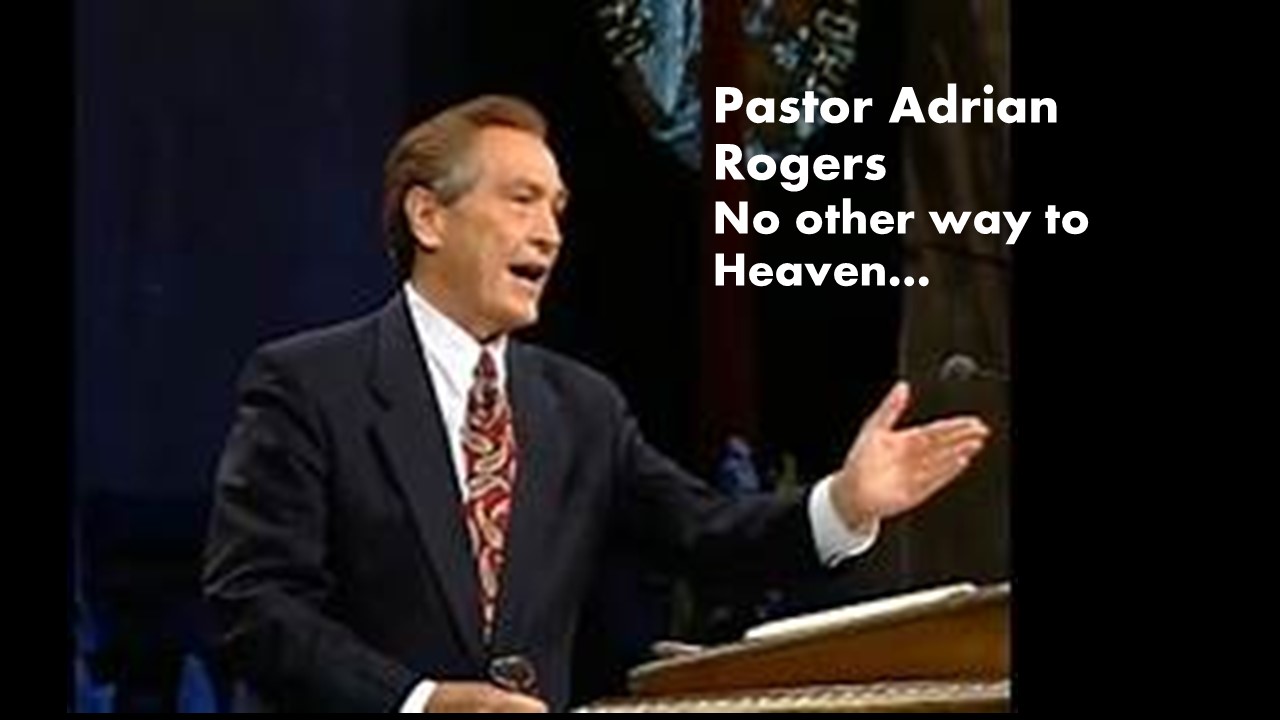
Pastor Adrian Rogers’ 44-minute message, No other way to heaven except through Jesus Christ, by grace alone through faith alone.
https://youtu.be/Ka2VhgjcP8I
(copy and paste into your web browser, then hit enter)

Pray for America, its leaders and its people that they may turn to Jesus as Lord and Savior. Pray for our pastor, his family and our church.