Friday, May 28, 2021

Why Acts? It’s a worthwhile topic regarding the early Church and challenges of evangelism in a pagan world—sound familiar? We can learn from Acts as God’s people living in a world that has turned away from God. 

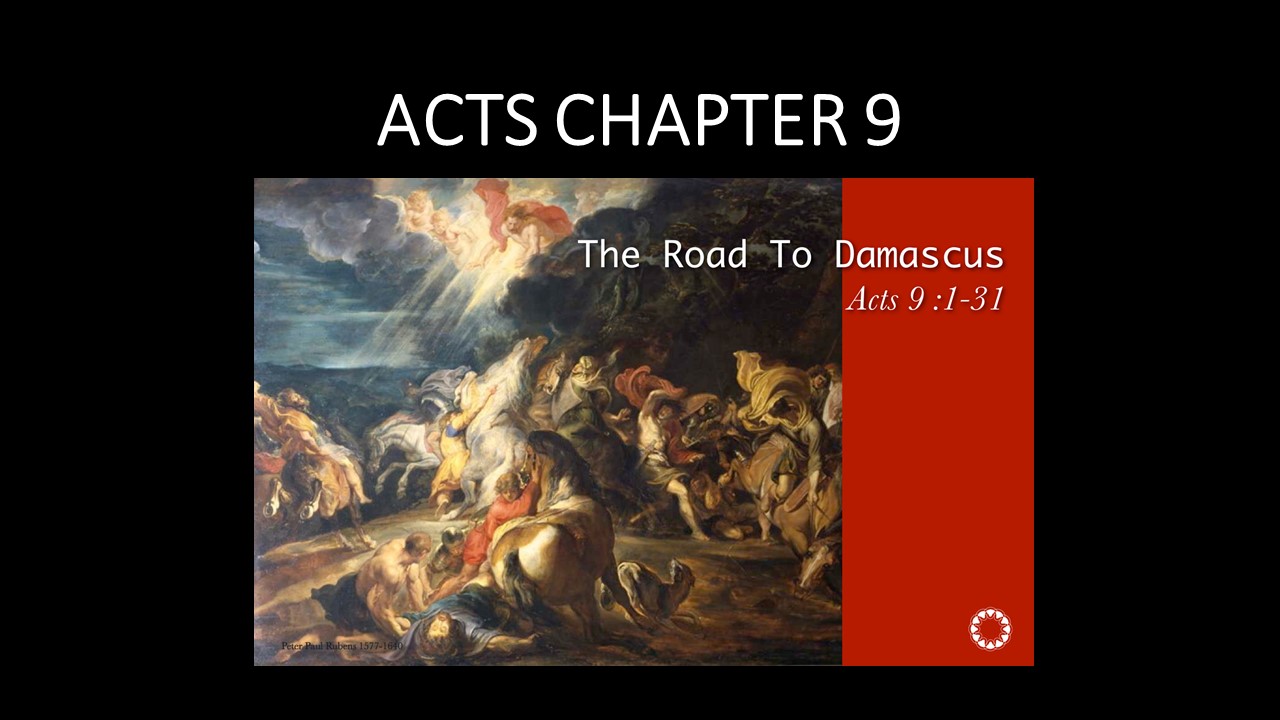
Saul of Tarsus was present at the stoning of Stephen, and familiar with Peter’s miracles, and yet, his hatred for “the Way” was enormous as noted in v.1 –with murderous threats! Saul’s transition was from persecutor to evangelist. He didn’t choose Jesus; Jesus chose him to be an apostle to the Gentile world.


Tarsus was capital of the Roman province of Cilicia in Asia Minor (modern-day Turkey; a predominate Muslim nation.)
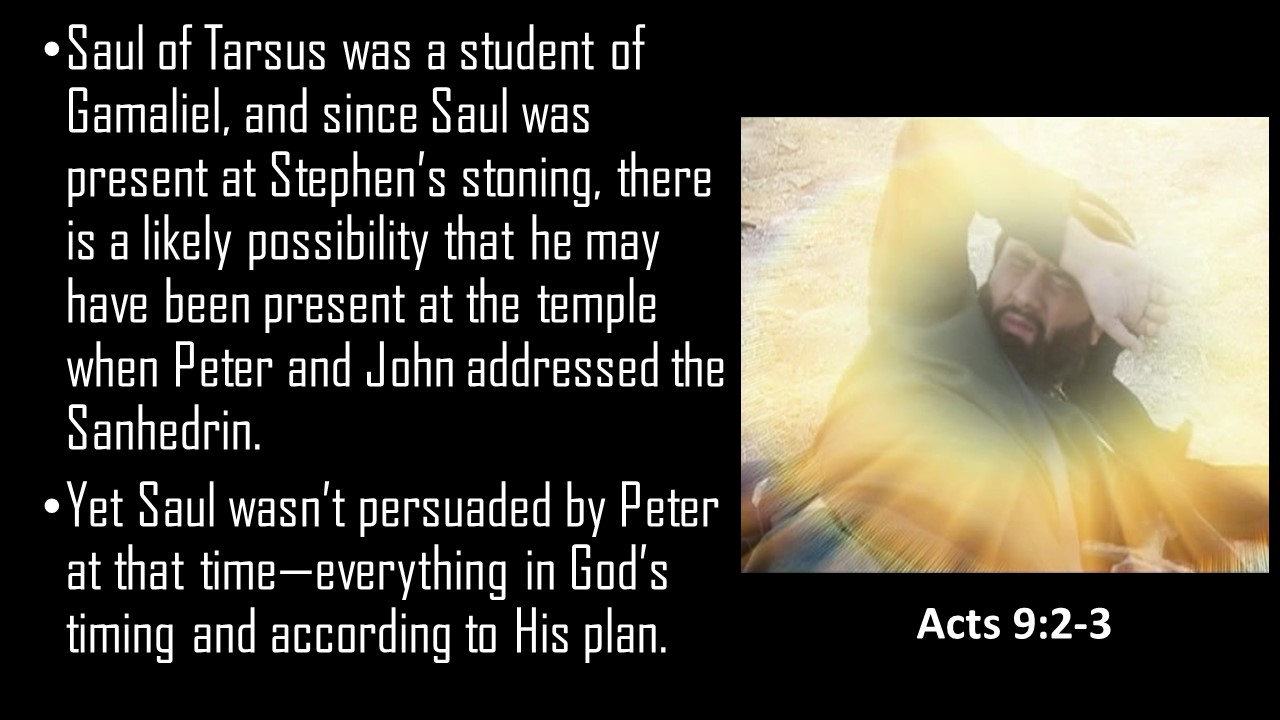
Q. Who chose whom? Saul did not seek after Jesus except to persecuted His followers. As we are told in v.3-6, Jesus chose Paul.  What does that tell us about election? Perhaps a future topic. 

Map shows Saul’s journey to Damascus in Syria from Jerusalem, and his encounter with Jesus Christ (next slide). A road trip of about 150 miles. 

As previously noted, Saul was on the road to Damascus from Jerusalem to persecute and imprison Christians. The Greek word for "sound" in v.7 can also be translated as "voice". What happened to those other men? Did they return to Jerusalem with a report for the Jewish Council of a blinding light and Paul’s state of mind? Can you imagine the excitement or outrage? 

Not mentioned as fact, but presumed, Saul most likely would have bypassed Samaria on his way from Jerusalem to Damascus. Generally, all Jews bypassed Samaria. Traveling by foot, it would have been a two-week trip. 

What the scene may have looked like if by horseback. We don’t know if they walked or rode. As stated in v.7 the men with Saul heard the sound but didn’t see anyone. The Bible doesn’t tell us if anyone of them was saved at that moment. The implication is “No” since they did not experience Jesus’ visit, which was exclusively for Saul. But, afterwards, when Saul as an evangelist preached in Jerusalem, perhaps. 

As we are told in v.10 Ananias was a disciple, a believer in Jesus Christ. Ananias is listed by Hippolytus of Rome (160-236) and others church historians/theologians, as one of the seventy disciples whose mission is recorded in Luke 10:1-20

Paul had three days of total blindness to ponder what had happened to him. Not only his encounter with Jesus, but his state of mind that led him to this very moment. 

The Lord speaks to Ananias to go to Paul in order to restore his sight. Jesus could have done it without Ananias, but worked through His disciple Ananias as a definite sign to Saul, regarding the Way. 

Ananias expressed his fear of Saul as a known persecutor of Christians, and concern about visiting him. Jesus told him that Saul has been chosen to bring the gospel to the Gentiles. 

Saul was baptized (v.18) as a sign that he had been filled with the Holy Spirit, and as such, a member of the visible Church. He was saved by faith alone, and not by any works on his part, for it is by grace we are saved, through faith in Jesus Christ. 

V.22 “grew more and more powerful” in the NIV, is “increased all the more in strength” in the NKJV. Paul didn’t have to spend a lot of time thinking about it and make a labored decision. He was transformed by the Holy Spirit—as Jesus’ chosen vessel.  

To reduce the overall length of study, which would required many, many more slides, this and the next slide provide an overview of verses 23-43. You may want to read those verses on your own. V.23-28 the Jews in Damascus, turned against Saul and plotted to kill him. When he went to Jerusalem, he tried to join the disciples there, but they were afraid of him. Until Barnabas reassured them of Saul’s conversion. Now, Saul the persecutor became Paul the apostle and evangelist. 

V.31, without Saul’s active persecution, Christians felt a sense of relief and enjoyed their new found blessings in Christ Jesus. V.32-43, takes us back to Peter who was healing the sick and even raising the dead. 

Joppa to Caesarea is about 30 miles as shown on the map. What the town may have looked like. 

I wanted to include v.40-42, because of their significance. It demonstrates the power given to the apostles, in this case, Peter, in sharing a "life changing message" of who Christ was, the very one the Jews demanded be crucified. A message that this world and nation are in dire need of. 

The principal message of Chapter 9 is the conversion of Saul the persecutor, to Paul the apostle and evangelist. Those in the flesh have no natural inclination to accept Jesus Christ, even Saul, full of hate for those of “the Way”. God singled him out and appeared to him with the message that Jesus was truly the Messiah. And God took that message one step further by blinding Saul, and then being healed by Ananias a Christian. Paul wasn’t just zapped; he was led by the Holy Spirit through grace with a new found faith in Jesus Christ. 

Dr. John MacArthur’s 28-minute sermon walks us through Saul the persecutor's Transformation to Paul the Apostle. 
https://youtu.be/0lEljjiuegM
(copy and paste into your web browser, then hit enter.)

Pray that the Holy Spirit may touch the hearts of the American people and those in Congress, as He touched Saul the persecutor, in his transformation to Paul the evangelist. Pray for our Pastor, his family and our church. Share the gospel message with a neighbor or friend as the opportunity arises. 

Our current Sunday morning study at 9:00 in Heritage lounge, is "the sovereign of God and the State of Israel". Are the Jews still God's Chosen people? 

End of 
The Acts of the Apostles
Chapter 9

Friday, May 21, 2021

In the opening of chapter 8, Saul gives approval of the killing of Stephen, with the intention of killing even more of those of “The Way” as Christians were called at the time. We will also take a look at Samaria that was situated between Judah and Galilee, where portions of chap. 8 takes place.

Note: you can always go back to the previous lesson, via the Blog Archive in the upper right hand corner of this page. just click on a date. 


Chapter 7 ended with the last words of Stephen as he was being stoned to death for his faith. Saul was there, filled with the same hatred as the Sanhedrin against Christians. Saul, (later to become Paul), imprisoned Christians. He is the same Saul that heard Peter preach before the Sanhedrin, and yet, he wasn’t changed at that time, his hatred continued against what he considered heretical teachings against Judaism. Saul would be considered a righteous Jew in his day!

Philip, one of the seven deacons appointed by the apostles in chap. 6, went into Samaria, a place despised by the Jews, and performed many miracles as noted in v.7. 

Map shows Samaria, where Philip “went down” to proclaim Christ, even though it’s north of Jerusalem. The Bible describes the terrain with Samaria being at a lower elevation than Jerusalem which was situated in a hilly area. Jerusalem is surrounded by valleys and dry riverbeds 

In spite of the miracles of Philip and the Apostles, many still rejected their words about Jesus Christ as Lord and Savior and persecuted the Church. We can be confident that their intense hatred was instigated by Satan and his demons. 
1 Tim 4:1  The Spirit clearly says that in later times some will abandon the faith and follow deceiving spirits and things taught by demons.
2 Cor 11:13 For such men are false apostles, deceitful workmen, masquerading as apostles of Christ. 14 And no wonder, for Satan himself masquerades as an angel of light. 

In Deuteronomy 18:10-12, sorcery is listed among the sinful practices of the nations surrounding Israel. God calls it an abomination: “There shall not be found among you . . . anyone who practices divination or tells fortunes or interprets omens, or a sorcerer or a charmer or a medium or a necromancer or one who inquires of the dead, for whoever does these things is an abomination to the LORD.

The Jews deliberately bypassed Samaria out of religious differences and hatred for the Samaritans. 

The Samaritans believed that Mount Gerizim was the original Holy Place of Israel from the time that Joshua conquered Canaan (what was to become Israel) after their exodus from Egypt and wandering in the desert.  

The Samaritans are a distinct ethnic and religious group found today mostly in Israel. They were a racially mixed people with Jewish and pagan ancestry, although they worshiped Yahweh as did the Jews. The history and origins of the Samaritans are difficult to define, as many of their writings have not survived. There are about 550-600 active practitioners of the Samaritan religion with some admixture of Islam, most of whom live in the city of Nablus in the area now known as the West Bank, as shown on next slide. 

Samaria has been under Israel administration since 1967, when the West Bank was defined by Israeli officials as the Judea and Samaria, of which the entire area north of the Jerusalem District is termed as Samaria, also called Sebaste, modern Sabasá¹­iyah, an ancient town in central Palestine. 

In these verses from the Gospel of John, Jesus addresses the issue of what religion was right regarding worship, Jew or Samaritan. 

Philip was still in Samaria. The Holy Spirit helped spread the Gospel message by signs and miracles. Why not signs and miracles today? In those days, it brought people to belief in Jesus; today it would be used by fakers to fool and trick people for their own personal gain. There is a time and place for everything God does, even miracles. 

The apostles sent Peter and John to Samaria, to ensure that what was being said about their acceptance of God’s Word was an actual acceptance of Jesus Christ. Since the Holy Spirit had not yet come upon them, and they were not yet born-again (John 3:3). Baptism alone (v.16) did not save nor bring one to a saving faith in Jesus Christ. Baptism was/is a visible sign of their acceptance and faith in Jesus Christ.  
John 3:3 In reply Jesus declared, "I tell you the truth, no one can see the kingdom of God unless he is born again.

Paul reminds us in Romans and Galatians that we are saved by grace alone, through faith alone, in Christ alone, and not by works, which applies to every Jew, every Samaritan, and every Gentile that accepted Jesus Christ as Lord and Savior. These verses apply to Acts 8:14-17 in that we receive the Holy Spirit by grace, through faith. It was true then and is true now. 

A summary of v.18-24: Laying on of hands is a sign and seal for ordinations; even healing as noted in the Book of James. The gift that Simon wanted to buy, wasn’t to honor God as noted by Peter, but as a means of profit. 

The Holy Spirit displayed visual signs in the early ministry of the apostles to demonstrate that what they professed was truth. Miracles of healing accompanied their preaching of the Word. Today, the church most likely would put more emphasis on miracles than in sharing the gospel, itself. We can be certain there would also be those who would fake miracles for personal gain. And the Word would never be enough unless accompanied by miracles. 

Peter admonishing Simon to repent. Peter’s word struck a cord with Simon, sufficiently to ask for prayer. But, was it true repentance or just fear? We can fear punishment for our sins, but there is also joy in saving grace and forgiveness. 
 
Map shows the route Peter and John took (v.25) on their return to Jerusalem stopping at many Samaritan villages along the way. Map also shows the desert road Philip took from Jerusalem to Gaza (V.26). 

Green arrow is route the Jews took to bypass Samaria, when traveling between Galilee and Judea. 

Philip was sent by an angel (v.26) to Gaza to intercept the Ethiopian eunuch, who was a Jewish convert that believed in the Lord, Jehovah. He was a high court official of Candace, queen of Ethiopia, and was in Israel to worship at the temple. On his trip home to Ethiopia, he had a life-changing encounter with Philip the evangelist. 

V.30 tells us that Philip ran to catch the chariot, which implies that the chariot was moving. Then he had to raise his voice loud enough to get the eunuch’s attention. 

V.32-33 are quoted from the Book of Isaiah 53:7. 

V.35 Philip explained that Isaiah had prophesized about Jesus, and that Jesus was crucifixion as an atonement for our sins. Something we could never earn on our own merit before a holy and righteous God.  Only God’s atonement and grace could suffice. 

The eunuch desired to express a sign of his faith with baptism (v.36-39). V.37 is not included in many Bible translations, including the NIV, because it is not found in the oldest and best translations of Acts.

Philip was transported by the Spirit, from Gaza to Azotus (Az-o-us) as shown on the map (dotted line). From there, he continued preaching the gospel all the way to Caesarea (red line on map). 


What the seaport city of Caesarea is believed to have looked like during the time of Philip. 
=
The Holy Spirit isn’t transporting people today like He did with Philip. But, we have radio, TV, Zoom, Livestream, social media like Facebook and Twitter, to share the gospel. An email, a casual conversation, all of which are means to share the good news that Jesus Christ is not only Lord, but Savior from eternal damnation in hell, and separation from God. What accompanies the Word is eternal bliss in heaven with God. Something worth pondering, especially for anyone who never accepted Jesus Christ as Lord and Redeemer. and repented of their sins. 

It gets down to praying in the Spirit. How effective are our prayers? How often do we pray, and do we know that God is even listening? Adrian Rogers' 43-minute message explains: How to Pray in the Spirit.
https://youtu.be/Px9SVbmR9PE
(copy and paste into your web browser)

My goal is to see today’s world and our lives from a biblical perspective. In our Sunday Foundations studies, 9:00 A.M. in Heritage Lounge, we are currently looking at God’s sovereignty and the State of Israel.  Hope to see you there. 

Is America a Nation in Crisis, as posted last week? We need to pray for America. If not us, then who? If not now, then when? A whole generation’s future is at stake, perhaps our own children, grandchildren, and perhaps even our great grandchildren. 

End of
The Acts of the Apostles
Chapter 8