A lot is packed into Chap 3, including a miracle that would get anyone’s attention.
Let’s go back to Jerusalem during the time of Jesus. The image shows why the term “up to Jerusalem” or “up to the temple” (v.1) is used. Can you guess what the smoke is?
Picture shows a view of the City of Jerusalem at the time of Acts. Imagine, if you will, actors standing on an empty stage, without a set, reading their scripts, and having to determine the place and period. Compare that to actors on a stage with a setting that fits the occasion. We have the printed words in the Book of Acts, but I believe seeing the backdrop for those first century events helps put the full picture into perspective. A rough estimate of the population of Jerusalem at the time was about 80,000 to 100,000.

To better understand written text, we don’t always need a setting. Sometimes the words are expressive enough, but some background knowledge is still essential to get an adequate understanding and insight. I believe it helps to see images of the place where an event is taking place. Illustration above, shows an empty stage versus a stage fully set. But of course, the Word of God is steps above any book we might read. Always pray for the Holy Spirit’s guidance when studying the Word. Maybe He will help us via the pictures as well.

View shows the temple located in the center of the temple mount. The temple area was a place of prominence in 1st century Jerusalem. As we saw in a prior study, some believe the temple mount (shown) is really the Roman “Antonia Fortress” built by King Herod and that the temple was about 1/3 of a mile away in the City of David, connected to the Fortress by a causeway as shown on the next slide. Since this is the traditional view, we’ll stick with it for now. The exact location will not affect how we interpret Acts. Take note of the location of the gate called Beautiful, where chapter 3 begins. The gate is the destination where the lame man was carried in v.2-9.

Current research indicates this as the true temple location (arrow) with the Roman fortress on what is now called the temple mount. They make a good case for that view, including a video we looked at in an earlier study. A great deal of activity happened on the temple site in the Gospels and chapter 3 of Acts. The gate called Beautiful is in relationship to the temple itself, so the exact location of the temple doesn’t change one word of Scripture. If this image was correct, the next slide tells an important story regarding the End Times.
Rebuilding of Herod’s temple at what is claimed as the true temple site (arrow), would totally avoid the Muslim “Dome of the Rock” mosque, and avoid confrontation with the Muslim world. When the Temple is rebuilt the Antichrist will be set to confirm the covenant with Israel and begin the last 7 years of history for this age (the Tribulation).
2 Thess 2:4 He will oppose and will exalt himself over everything that is called God or is worshiped, so that he sets himself up in God's temple, proclaiming himself to be God.
As we saw in the previous slides, “going up to the temple” meant exactly that, to higher ground. We also noted the location of the “temple gate called Beautiful”. After Shavuot (a.k.a., Pentecost), the foreign Jews had gone home and Jerusalem had grown quiet. Much of Paul’s travels in Chapter 14 will take him to the places where the foreign Jews were from. Early Christianity was initially viewed as a sect of Judaism, giving Paul the latitude to visit the synagogues, professing Jesus as their promised Messiah in accordance with the O.T. prophesies. They may have disagreed and argued, but nevertheless, he made his case proclaiming Jesus as fulfillment of prophesy.

What the scene in v.2 could have looked like with the lame man being carried, perhaps by family members or friends—and placed outside the gate called Beautiful. The image shows stairs, but the Scripture doesn’t mention stairs. There may very well have been stairs as shown in the next couple of slides. Again, it doesn’t affect the message in Acts—God’s Word is true and without error. There may be some minor translational differences, but no glaring errors.
In v.3 the beggar asked for money so when Peter approached and stopped, the beggar most likely expected a coin. The beggar had been lame many years, perhaps his entire life, and hoped for a coin to perhaps purchase his next meal. Since Judas carried the apostle’s finances, Peter and John most likely didn’t carry money, but Peter had something more valuable and significant to give the beggar.
Roman coins in circulation were made from different metals, including silver and gold. V.6 Peter responds to the beggar’s request for money. Previous Palm Sunday crowds would indicate many people had heard of Jesus, perhaps the beggar was one them. In v.7 Peter, inspired by the Holy Spirit, takes the beggar by the hand to raise him up, which the beggar did immediately as noted in v.8. With joyful shouts he followed Peter and John, attracting attention.
This is what the beggar was asking for. Roman coins were legal tender throughout the Roman Empire. Let’s look at Jesus’ own words regarding Roman coins in Matthew 22…
Matt 22:19 "[Jesus said] Show me the coin used for paying the tax." They brought him a denarius, 20 and he asked them, "Whose portrait is this? And whose inscription?" 21 "Caesar's," they replied.
Much of the opposition against Jesus and later the apostles, took place on the temple grounds in Solomon’s Colonnade, a common gathering place for the people as shown in the pictures. A colonnade is a row of columns supporting a roof. Lower right is Jesus preaching at that location. So, when you read of Jesus preaching in the temple, this is most likely the setting at the time.
Luke 21:37 Each day Jesus was teaching at the temple, and each evening he went out to spend the night on the hill called the Mount of Olives, 38 and all the people came early in the morning to hear him at the temple.
Putting the events that are taking place into perspective: Peter & John had access to the temple area through gate #11; area #9 was a courtyard for women; area #6 was for Jewish men; Gentiles were restricted to the Court of Gentiles #12 outside area as shown. Area #5 was the court of priests where the temple sacrifices were held. #13 was Solomon’s porch, where Jesus preached. Illustrations on the right show stairs at the entry to the gate called Beautiful #8.
Most likely they had to carry the lame beggar up those stairs to get to the temple mount. Solomon’s portico is where Jesus turned over the money changers’ tables (Matt. 21:12). Hopefully these pictures help to visualize the events described in Acts and the Gospels.
John 2:13 When it was almost time for the Jewish Passover, Jesus went up to Jerusalem. 14 In the temple courts he found men selling cattle, sheep and doves, and others sitting at tables exchanging money. 15 So he made a whip out of cords, and drove all from the temple area, both sheep and cattle; he scattered the coins of the money changers and overturned their tables. 16 To those who sold doves he said, "Get these out of here! How dare you turn my Father's house into a market!"
An overview of the temple—the gate called Beautiful (arrow) is where the miracle took place. It’s where the lame beggar was carried each day, and where he was cured by Peter. It was also the entrance to the Women’s courtyard. Jewish men were allowed to walk through the Women’s courtyard.
Just one more image clarifying the location of temple porticos.
V.12 Peter responds to the crowd gathering around the healed beggar, basically telling them that John and he have no special healing powers of their own. In v.13 Peter states it as evidence of who Jesus was, the One they killed even though Pilate wanted to let Him go. He gives the honor and glory of the miracle to Jesus, and reminds them in v.14 that they clamored for the release of Barabbas, a murderer (Matt. 27:15-24). Scripture doesn’t tell us, but perhaps Barabbas after his release killed one of those very ones who had called for Jesus’ death. Perhaps Peter recognized some of these very same people as the ones in the courtyard who had demanded the death of Jesus and the release of Barabbas.

V.15 Peter tells them that he and John were eyewitnesses of Jesus' resurrection, noting the very divinity of Jesus, referring to Him as the “author of life”, and this miracle—healing of the beggar—being something only God could do. Also stating that they all knew the lame beggar and now see that he was completely healed; that it wasn’t a trick. He reminds them again that it was a miracle attributed to Jesus. Many may have heard rumors at the time of Jesus coming out of the tomb. V.16 It was by the very name of that same Jesus that this lame beggar was cured. Implying that should be proof enough for each of them as to who Jesus Christ was and is. Did they immediately accept that as proof and repent? Maybe some, but obviously, many did not… i.e., ”Don’t confuse me with the facts, my mind is made up.”

He continues telling them, that they didn’t know what they were asking for in calling for the death of Jesus. V.18 that it was part of God’s plan that was foretold by the prophets (Duet. 18:15-22); that God would send a Messiah (the Christ). Then imploring them to “Repent and turn to God for sins to be wiped away”—a message for them and for today. The Greek word for the Hebrew “Messiah” is “Christos”.
Deut 18:15 The LORD your God will raise up for you a prophet like me from among your own brothers. You must listen to him.
Peter continues his message in v.21-22, telling them that Jesus is in heaven and must remain there until the time of His return (the Second Coming at the end of the Tribulation) as the prophets foretold (Deut. 18). The prophet Isaiah (9:6-7) also told of His coming and reigning (Second Coming and Millennium). Those of the Jewish faith who do not listen to the prophets will be cut off from their people as descendants of Abraham, Isaac and Jacob. V.23 is a prophetic warning that those who do not listen will be cut off from the restoration of Israel (during the Millennium).

In v.24-25 Peter tells them this was not just a single prophetic message, but one that all the prophets spoke of since the time of Samuel and it was up to them to listen to the prophets. No one likes to be criticized, even when it’s true. The Apostles faced the same risk from the religious leaders that Jesus had endured. Peter’s preaching accused the Jews of murdering the Messiah (v.26) promised by the O.T. prophets. We can easily imagine the anger and outright hatred it stirred in them.
The next couple of slides takes us on a visit to what the "temple mount" site looks like today.
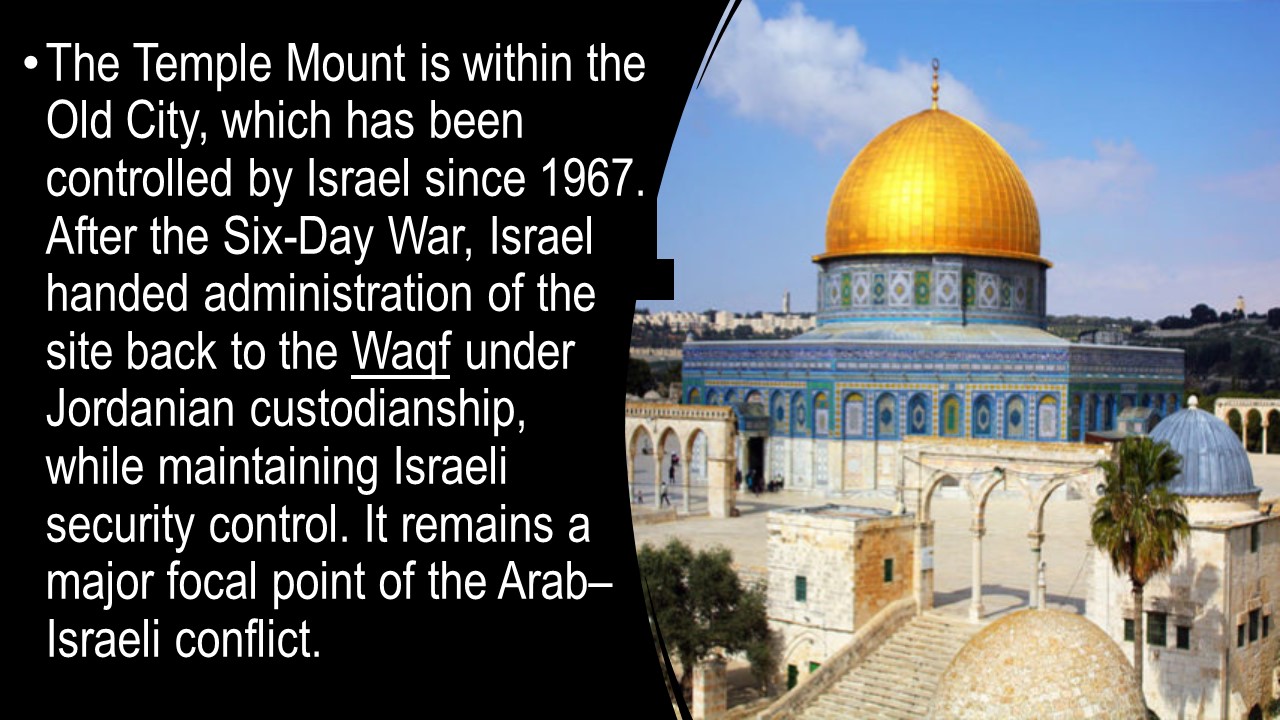
If you were to visit Jerusalem today, this is what you would see. Muslim “Dome of the Rock” mosque sits squarely on what is believed to be the temple site. If you recall in a previous lesson some believe the mosque is just off to the side of what had been the temple site, which indicates the 3rd temple could be built without disturbing the mosque, if it did, it would most likely start an Islamic holy war, if the mosque was disturbed or destroyed. The West (Wailing) Wall is noted by the dotted line, which we will look at. But, if the true temple site was in the City of David, the temple could be built without any risk of war.
The destruction of the temple by the Romans in 70 AD.All that remains of the temple is the “western wall” referred to as the “Wailing Wall” (arrow). This is a frequent occurrence because the Jews have traditionally viewed this wall as part of Herod’s temple—the one destroyed by the Romans in 70 AD (previous slide).
The Temple Mount that we looked at earlier is under the jurisdiction of Islam even though it’s in Jerusalem. Israel provides the security. The next slide explains.
Suppose the Antichrist recognized that the temple could be built without damaging the mosque, if it was in the City of David, that is exactly what he would do with the concurrence of both Jew and Arab. We covered this in a previous study. Waqf is an endowment made by a Muslim to a religious, educational, or charitable cause.
Chapter 3 brought Peter and John into the spotlight of public opinion in Jerusalem. We can be certain the miracle (curing of the beggar) and Peter’s claims about Jesus, would spread far and wide, perhaps raising suspicion and animosity as did Jesus’ miracles and claims. If they accepted Peter’s claims it would mean that they killed the Messiah, which for most they would not/could not, accept as true.
On what we call Palm Sunday, many if not most of Jerusalem turned out to see Jesus. His miracles drew attention and they wanted to see the miracle worker firsthand. It’s hard to imagine that most had not heard of Jesus, being professed as the promised Messiah. It’s that very reason the Jewish religious leaders hated Jesus and saw Him as a threat to their power and prestige. What did those that demanded his crucifixion think about this miracle—curing of lame beggar—attributed to that same Jesus? Of course they denied it and hated even the mention of it.
So why do some believe and others hearing the same message and same facts (curing of the beggar) reject it off hand, in spite of the evidence? As taught by many of the Reformation leaders, including Martin Luther and John Calvin, we are sinners and our hearts are hardened, rejecting anything that makes us uncomfortable or accuses us of sin; it's the Holy Spirit who opens our eyes and minds to the truth.
The Sanhedrin paid those that guarded Jesus’ tomb, to claim that His followers stole His body.
Matt 28:11 While the women were on their way, some of the guards went into the city and reported to the chief priests everything that had happened. 12 When the chief priests had met with the elders and devised a plan, they gave the soldiers a large sum of money, 13 telling them, "You are to say, 'His disciples came during the night and stole him away while we were asleep.' 14 If this report gets to the governor, we will satisfy him and keep you out of trouble." 15 So the soldiers took the money and did as they were instructed. And this story has been widely circulated among the Jews to this very day.
1 Cor 1:18 For the message of the cross is foolishness to those who are perishing, but to us who are being saved it is the power of God. 19 For it is written: "I will destroy the wisdom of the wise; the intelligence of the intelligent I will frustrate."
I can’t help but wonder if Barabbas, after being released, continued to rob and even kill. Suppose he killed one of more of those that demanded his release instead of Jesus. It certainly would be a bit of poetic justice, so to speak but not improbable. So, what would happen to that individual after death? Would he then realize that Jesus was the prophesized Messiah? Would he repent of his sin, or resent being accused and punished, claiming it is Jesus’ fault for not conclusively revealing Who He was? Of course He did, many times with miracles and healing, even curing lepers, and casting out demons. One other thought on Barabbas, perhaps he became a Christian? Scripture doesn't tell us.
Like in the story of Lazarus and the rich man in Luke 16:20-26, our soul departs from our body, the unsaved goes to a place the Bible refers to as Hades, a place of torment. Not once did the rich man repent of his sins, but he just wanted relief from his thirst as Jesus tells us in Luke 16.
Luke 16:22 "The time came when the beggar died and the angels carried him to Abraham's side. The rich man also died and was buried. 23 In hell, where he was in torment, he looked up and saw Abraham far away, with Lazarus by his side. 24 So he called to him, 'Father Abraham, have pity on me and send Lazarus to dip the tip of his finger in water and cool my tongue, because I am in agony in this fire.'

At the end of the Millennium all sinners will be reunited with their resurrected bodies and will stand at the Great White Throne Judgment (Rev. 20:11-15). Being united soul and body, they will spend eternity in hell separated from God, with each receiving just punishment for their unrepentant sins. We can be certain that some, like Adolf Hitler’s punishment, will be more severe than an unrepentant Jew killed during the Holocaust (Rev. 20:12).
God’s justice will fit each individual’s sins perfectly, no more, no less than deserved—the punishment will fit the crime of rebellion against a Holy God. If you do not know Jesus as your personal Savior give serious thought to what the Bible is telling us. This is the reality of what is to come. You can’t earn heaven by good works or just being nice. We are saved by grace alone, through faith alone, in Jesus Christ alone, being born-again (John 3:3).
John 3:3 In reply Jesus declared, "I tell you the truth, no one can see the kingdom of God unless he is born again."
In Acts 3:15 Peter tells the Jews that God raised Jesus from the dead. His resurrection was/is sufficient to overcome and blot out every sin we ever committed. (following slides).
Acts 3:15 You killed the author of life, but God raised him from the dead. We are witnesses of this.
Eph 1:11 In him we were also chosen, having been predestined according to the plan of him who works out everything in conformity with the purpose of his will, 12 in order that we, who were the first to hope in Christ, might be for the praise of his glory.
If we expect perfect justice from an earthly judge, why should we ponder or even question the justice of a Holy God? Without election all would perish and rightly so. Rather than let all perish, God chooses to save some—individually, not collectively. Some will ask, is that fair? Election isn’t a throw of dice or dividing a room and picking the people on one side for salvation and arbitrary excluding everyone on the other side.
I believe it’s safe to presume that Adolf Hitler, who killed six million Jews, even on the day of his death remained unrepentant, and consequently was not saved. Scripture tells us that Saul of Tarsus, who persecuted “the Way” (early Christians) was saved for a purpose, to spread the Gospel under his Roman name of Paul. But he didn’t rebel after realizing who Jesus was, but repented.
Deut 7:6 For you are a people holy to the LORD your God. The LORD your God has chosen you out of all the peoples on the face of the earth to be his people, his treasured possession.
Rom 12:3 For by the grace given me I say to every one of you: Do not think of yourself more highly than you ought, but rather think of yourself with sober judgment, in accordance with the measure of faith God has given you.
Dr. John MacArthur’s sermon is the same message the apostle Peter preached to the Jews at the temple. What is the full meaning of the Resurrection for us, right now? His message is an integral part of the message in Acts chapter 3.
Dr. John MacArthur’s 28-minute sermon on “The Full Impact of the Resurrection.”
https://youtu.be/Htxnnnj5y7c
(copy and paste into your web browser)
Don’t lose heart for America. God is sovereign and in control no matter what’s happening.
It’s been way too long; time to get back together. Hope everyone shows up. We are currently studying the Book of Acts here on the blog, but there will be a different study in Heritage Lounge. Coffee will be available. Hope to see you there. Yes, I will continue our study of Acts on the blog.
End of
The Acts of the Apostles
Chapter 3